Onze-Lieve-Vrouwekerk: the Principal Parish Church of Sint-Truiden


Site at a Glance
- Rating
- 4.5
- Popularity
- Low
- Country
- Belgium
- Primary era
- Medieval
- External website
- Open
- Eras represented
- Medieval, Early Modern, Modern
- Civilizations
- Holy Roman Empire
- Site type
- Religious
- Remains
- Church
On this page10 sections
History
Onze-Lieve-Vrouwekerk, also called the Church of the Assumption of Our Lady, is the principal parish church of Sint-Truiden, Belgium. Built and developed by the Christian communities of the town from the eleventh century onward, it is a Roman Catholic church dedicated to the Assumption of Mary, the belief that Mary was taken into heaven and a feast celebrated on 15 August. The present building is the third church on this site and combines medieval Gothic fabric with later Neo-Gothic work.
An eleventh-century parish foundation
The first church was built in the eleventh century under Adelardus II, abbot of Sint-Trudo Abbey. A fire destroyed it in 1086. A second church, largely Romanesque in character, replaced the burned building. Its exact construction date is uncertain, but it is first recorded in 1107 and is generally associated with a replacement erected in the early twelfth century. Until 1133, it served as the only parish church in the city. In that year, Saint Gangulfus Church also received parish rights.
From Romanesque church to collegiate foundation
In 1399, Jan of Bavaria, prince-bishop of Liège, elevated the church to collegiate status. A collegiate church is served by a college of clergy rather than by a monastic community. At Onze-Lieve-Vrouwekerk, twelve secular canons held this responsibility, appointed by the abbots of Sint-Truiden. The change gave the church a new institutional role, and the largely Romanesque building was subsequently transformed more rapidly in the Gothic style.
The choir was already spacious by the first half of the fourteenth century and accommodated the canons in its choir stalls. The nave and aisles were built in the fifteenth century, extending the Gothic character of the church. The abbey later initiated the construction of the Our Lady Chapel, which was added in 1542.
Towers, rebuilding, and restoration
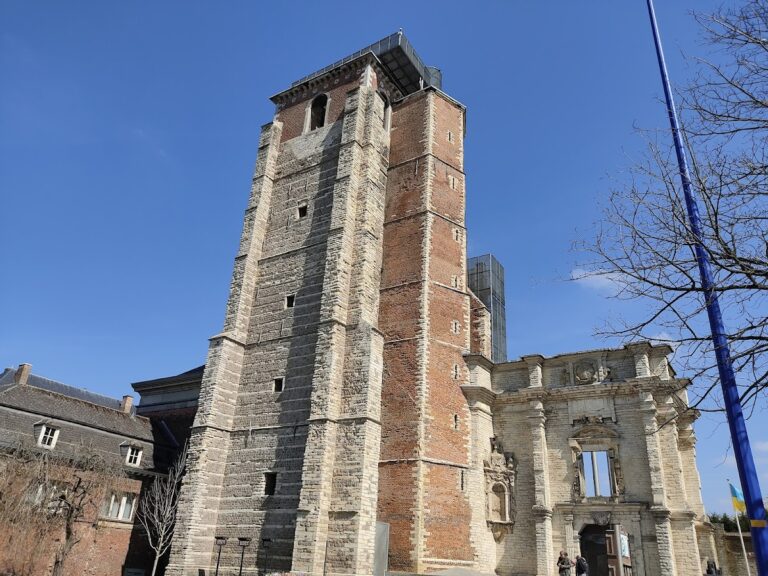
The original tower was erected between 1504 and 1556, but it collapsed in 1668. Lack of funds prevented its immediate reconstruction, and a roof turret was installed to house the bells instead. The present tower was built between 1847 and 1852 by the Ghent architect Lodewijk Roelandt, following an earlier design by J. Gerard. Its construction shortened the church by one bay.
A major restoration took place from 1848 to 1864. It added Neo-Gothic ornament to the exterior and Gothic tracery, the ornamental stone framework of Gothic windows, to the church windows. The portals date from 1878. The original sacristy was replaced by the present smaller sacristy in 1912, and another restoration was carried out in 1970 to 1972 under the architect P. Van Mechelen. A further renovation was completed in 2018. The church is protected as immovable heritage under designation number 22732.
Parish and Franciscan traditions
Onze-Lieve-Vrouwekerk continues to function as a parish church within the Diocese of Hasselt. Its treasury preserves many objects transferred from the former Abbey of Sint-Truiden, including major relic shrines of Saint Trudo and Saint Eucherius. After the Friars Minor, members of the Franciscan order founded by Saint Francis of Assisi, left Sint-Truiden in 2019, the ceremonial assistant continued working at the church. The unpaid office involves assisting the dean, coordinating altar servers and liturgical workers, and supervising the orderly conduct of services. It is described as unique among the deaneries of the Diocese of Hasselt apart from the arrangements of the bishop himself.
The church also preserves a local Franciscan liturgical tradition. Its practices include an annual living Nativity scene during Midnight Mass, a novena and feast of Saint Anthony of Padua, and the celebration of Saint Francis of Assisi.
Remains
Exterior and medieval structure
The church stands at Grote Markt 67 in central Sint-Truiden, where its white sandstone west façade and tall pointed tower mark the eastern part of the market square. Brick, sandstone, limestone, and Limburg marlstone form the principal materials. The four-stage Neo-Gothic tower has an octagonal lantern and a slate-covered needle spire. Openwork, arched friezes, moulded pointed-arch windows, and a rose window decorate its stages, while two stair turrets and two buttresses flank the structure. Neo-Gothic sandstone portals with pointed arches open on the west, north, and south sides, with a fourth portal in the north façade.
The Gothic nave is built of brick on a limestone plinth and covered by a gabled roof with small dormers. A roof turret with a pear-shaped spire rises above it. Flying buttresses and additional buttresses support the nave, while the aisles have slate-covered lean-to roofs. Both arms of the transept are buttressed, with Neo-Gothic stone pinnacles and extensively restored pointed-arch windows. The late-Gothic brick Our Lady Chapel projects from the third bay of the north aisle, and the Gothic brick choir has tall pointed-arch windows.
Nave, vaults, and chapels
The interior is arranged as a three-aisled basilican nave of four bays, meaning that the central nave rises higher than the side aisles, together with a one-bay transept and a one-bay choir ending in three sides. The entrance occupies the ground floor of the tower, which has a rib vault, a ceiling supported by intersecting masonry ribs, resting on corner corbels. Parts of the interior are white-plastered, while the natural-stone pillars remain unpainted. Bundled pillars without capitals support rib vaults between pointed-arch transverse arches, and the aisle vaults rest on carved corbels.
The final two aisle bays and the transept arms have star vaults, more elaborate rib patterns forming star-like designs, with bosses decorated as angels’ heads. A wrought-iron screen separates the Our Lady Chapel from the church. Its plastered and painted interior is treated in a relatively dark Neo-Gothic style, while the choir has a similarly decorated radial vault. The triumphal arch carries a wall painting of the Last Judgment by Johannes Van den Eynde, painted in 1626 and restored in 1862. The chapel contains Jules Helbig’s 1860 painting of Our Lady of the Rosary.
Sculpture and furnishings
A polychromed wooden triumphal cross from the sixteenth century hangs in the central nave. Among the other furnishings is a polychromed wooden Madonna and Child with an inkwell from the fourth quarter of the fourteenth century. Numerous Late Gothic sculptures date mainly from around 1500, including an oak Christ on the Cross from the fourth quarter of the fifteenth century, Saint Anne with the Virgin and Child, and Saints Barbara and Margaret of Antioch. Other works include figures of Christ on the Cold Stone from the first quarter of the sixteenth century, Christ in the Tomb from the sixteenth century, and a Madonna and Child on a crescent moon from the second half of that century.
Later sculpture includes a polychromed wooden Madonna and Child from the second half of the seventeenth century, attributed to the Flemish Baroque sculptor Artus Quellinus the Younger. White-painted wooden figures of Saints Paul and Simon date from the seventeenth century, while a possibly Saint Odilia figure dates from around 1700. Figures of Saint Hubert and Saint Joseph with the Child belong to the first half of the eighteenth century. Nineteenth-century wooden figures represent the Madonna and Child, Saint Lambert, and Saint Trudo.
The furnishings include the Saint Lucy side altar from the first quarter of the eighteenth century, two oak confessionals in the Louis XV style, and an oak pulpit dated 1773. Neo-Gothic choir stalls and a copper baptismal font from around 1860 are also preserved. Several tombstones from the sixteenth and seventeenth centuries remain in the church.
Crypt, treasury, and organs
The crypt is reached through the sacristy and houses the church treasury. Its contents include the relic shrines of Saints Trudo and Eucherius, several reliquary busts, about twelve silver apostle statues, gilded-silver monstrances used to display the consecrated Eucharistic host, and other liturgical vessels, objects, and vestments. The relics of Saints Trudo and Eucherius are kept in sixteenth-century reliquaries, containers made to preserve sacred relics.
Two organs serve the church. The older instrument was made in 1874 by Arnold Clerinx, a local organ builder. The newer Neo-Baroque organ was produced between 1996 and 2014 by Orgelbau Schumacher.