Onoue Kurumayama Kofun: An Early Kibi Keyhole Burial Mound in Japan
Site at a Glance
- Rating
- 3.4
- Popularity
- Very Low
- Country
- Japan
- Primary era
- Classical
- Eras represented
- Classical
- Civilizations
- Unclassified
- Site type
- Burial
- Remains
- Burial Mound
On this page6 sections
History
Onoue Kurumayama Kofun is a large Kofun-period burial mound in Japan, located in Okayama’s Kita Ward at the southeastern end of the independent hill of Kibi no Nakayama. Built during the middle or latter half of the fourth century, in the first half of the early Kofun period, it is regarded as the tomb of a major regional leader who followed the construction of Nakayama Chausuyama Kofun, identified with the tomb of the legendary Kibi figure Great Kibitsuhiko no Mikoto.
A regional tomb in ancient Kibi
The Kofun period was an era of large earthen burial mounds in Japan, generally dated from approximately the third to the sixth centuries. Onoue Kurumayama Kofun is considered one of the representative early tombs of the Kibi region, an ancient polity or cultural area broadly centered in what is now western Japan’s Okayama region. It is also known as Girigiriyama Kofun.
The land south of the mound is now rice-paddy country, but it was formerly covered by the sea. When the mound was completed, it stood on the shore of the Seto Inland Sea. This coastal position has led to the interpretation that its construction was connected with maritime transportation and that the mound was intended to be visible to vessels using the sea routes. In this view, it displayed the authority of the ancient Kingdom of Kibi while also marking a maritime-route hub.
Historical protection
Onoue Kurumayama Kofun was designated a National Historic Site of Japan in 1972. Its importance lies in the evidence it provides for early Kofun-period burial traditions and for interpreting the maritime routes that connected Kibi with the wider Seto Inland Sea.
Remains
The keyhole-shaped mound
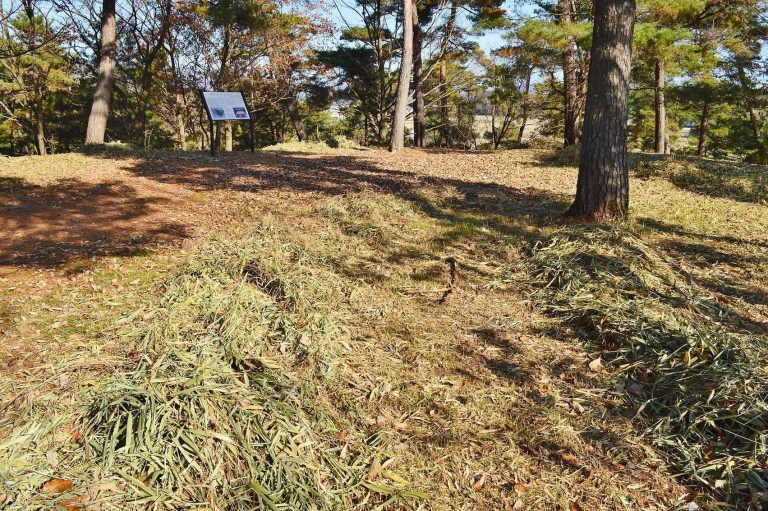
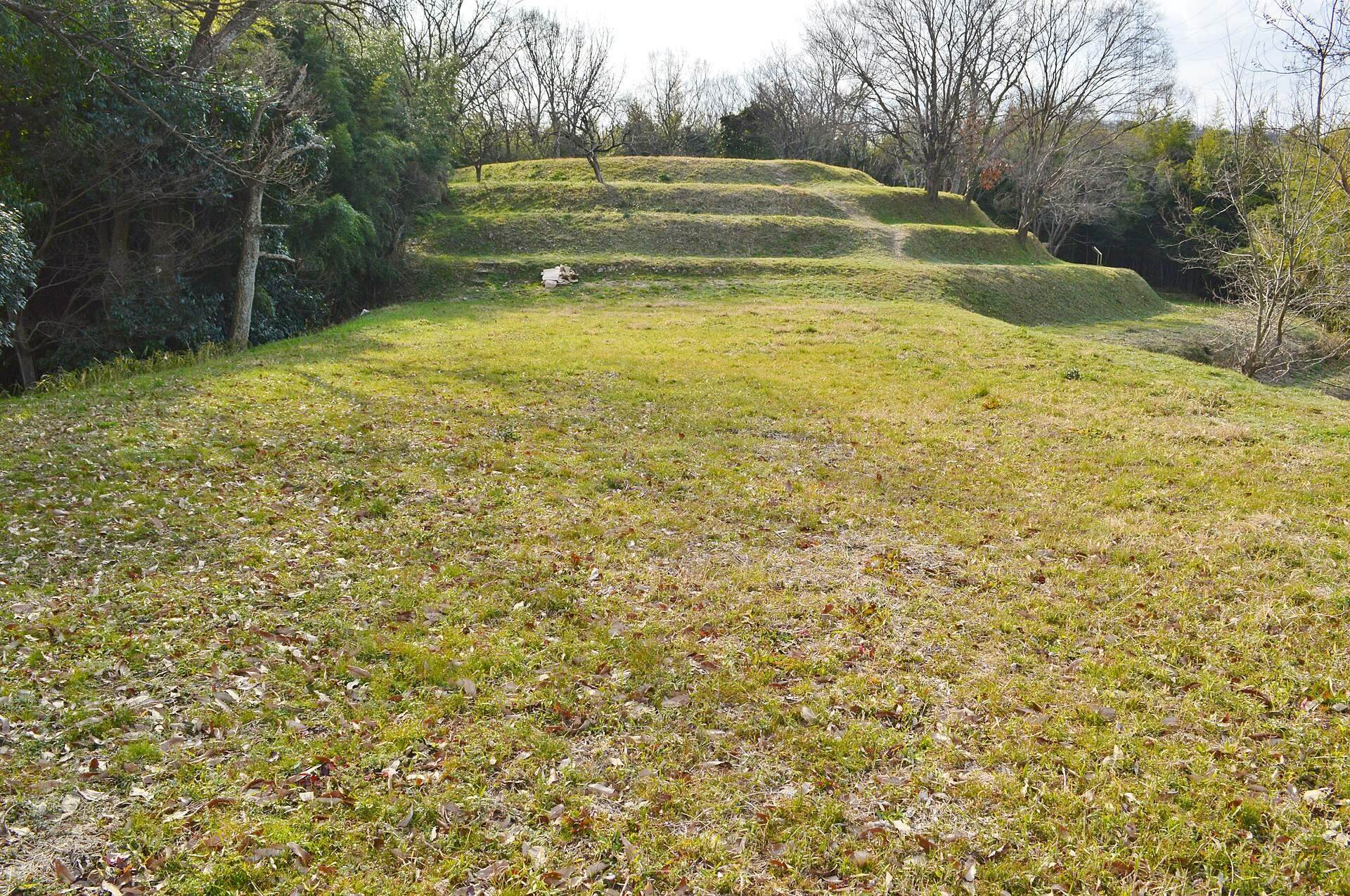
Onoue Kurumayama Kofun is a keyhole-shaped mound, or zenpo-koen-fun, a form that combines a circular rear section with a projecting front section. Oriented eastward, it measures 138.5 meters in total length. The plan has straight sides and resembles a mirror handle because the front portion does not broaden toward its outer end; it has also been interpreted as slightly fan-shaped.
The rear circular section measures approximately 96 meters in diameter and rises about 11 meters high. It was formed in three construction stages. The projecting front section is 52 meters wide and about 9 meters high, with two or possibly three stages of construction. Stone revetment and haniwa have been identified on the mound’s exterior. Haniwa are clay funerary objects placed on or around burial mounds, and the examples here include cylindrical fragments that commonly formed lines or boundaries along the outer edge.
Platform and burial chamber
A projecting platform approximately 20 meters on each side is presumed to have stood on the northern side of the mound. At the center of the rear circular section, a pit-style stone burial chamber is presumed to cross the mound’s main axis at a right angle. This type of chamber was constructed as a shaft or pit within the mound and lined with stone. The mound has not been excavated, so the chamber’s existence and structure remain unconfirmed.