Nyoirin-ji Temple: A Jōdo Buddhist Temple on Mount Yoshino


Site at a Glance
- Rating
- 4.2
- Popularity
- Low
- Country
- Japan
- Primary era
- Early Modern
- External website
- Open
- Eras represented
- Medieval, Early Modern
- Civilizations
- Tokugawa
- Site type
- Religious
- Remains
- Temple
On this page7 sections
History
Nyoirin-ji Temple is a Jōdo sect Buddhist temple in Japan, standing on Mount Yoshino and traditionally founded during the Engi era, around 901–922. Its principal image is Nyoirin Kannon, a form of Kannon associated with the wish-granting wheel. The temple’s formal name combines Nyoirin-ji with Tōnoosan, its sangō, or traditional Buddhist mountain name.
Foundation and imperial association
The monk Nichizō is traditionally credited with founding Nyoirin-ji during the Engi era. The temple later became closely connected with the imperial history of Yoshino during the Nanboku-chō period, an era of imperial division and warfare in fourteenth-century Japan.
Emperor Go-Daigo established a temporary imperial residence at Yoshino after his rival Southern Court had formed there. He designated Nyoirin-ji for imperial prayers and died in Yoshino without returning to the capital. His burial place was established on the mountain behind the temple, after which Nyoirin-ji entered a period of decline.
Rebuilding and religious change
The main hall was rebuilt in 1650 by the monk Bunya Tetsugyū, who is said to have been a son of the warlord Chōsokabe Motochika. During this rebuilding, the temple changed its affiliation from Shingon Buddhism, an esoteric tradition based on ritual, mantra, and mandala practices, to the Jōdo sect, whose teachings center on devotion to Amitabha Buddha and rebirth in the Pure Land.
Nyoirin-ji also preserves associations with later religious and literary traditions. It is the thirtieth site on the Kinki Thirty-Six Fudō Myōō Pilgrimage, a circuit connected with Fudō Myōō, a protective Buddhist deity, and is linked with sacred sites associated with En no Gyōja, the semi-legendary founder of Shugendō mountain asceticism. The haiku poet and travel writer Matsuo Bashō visited the temple and left poems, including one reflecting on the passage of time at the imperial mausoleum.
Remains
Mountain setting and sacred buildings
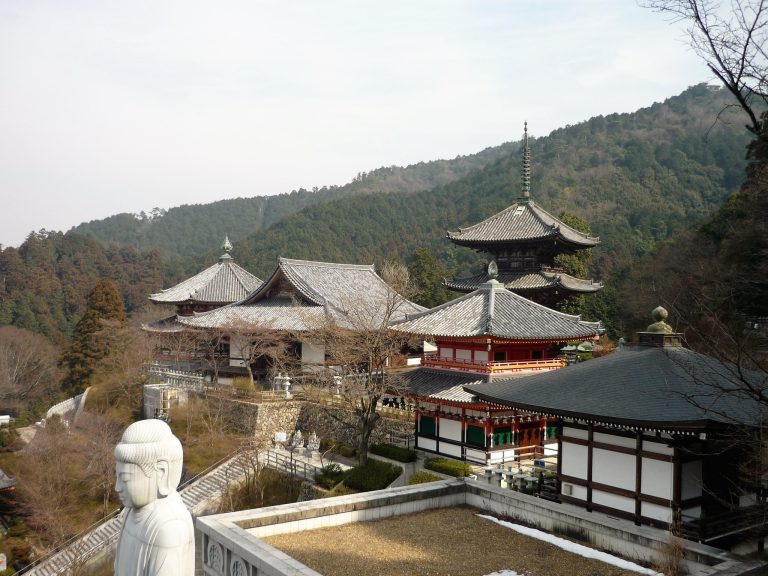
Nyoirin-ji stands on a mountainside in Yoshino. A valley separates it from the area containing Kinpusen-ji and Yoshimizu Shrine. Behind the main hall are the Tōnoo Mausoleum of Emperor Go-Daigo and the grave of an imperial prince, placing the temple’s principal religious buildings within a setting closely connected to the Southern Court.
Main hall and imperial tombs
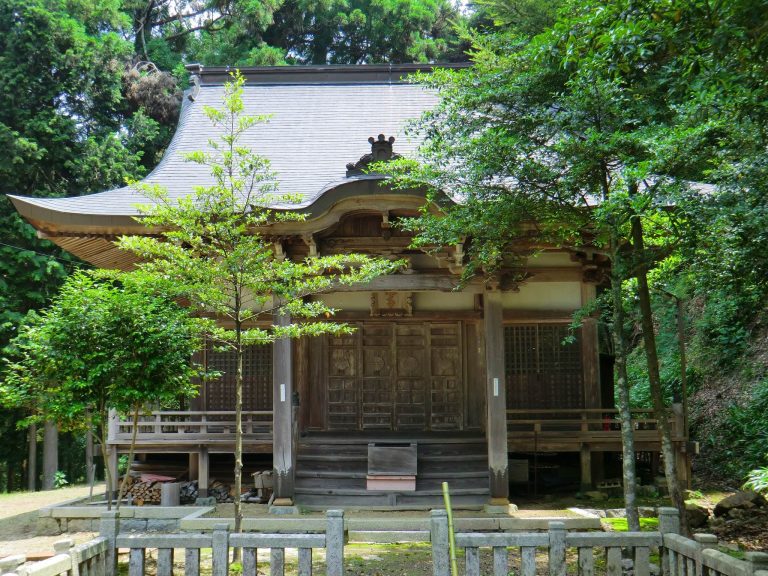
The main hall, rebuilt in 1650, remains the central building associated with the temple’s later Jōdo identity and houses the temple’s principal image, Nyoirin Kannon. The Tōnoo Mausoleum and the grave of an imperial prince occupy the mountainside behind it. A preserved door is identified as the one on which Kusunoki Masayuki, eldest son of Kusunoki Masashige, is said to have carved his death poem with an arrowhead in December 1346.
According to the tradition connected with the door, Kusunoki Masayuki visited Emperor Go-Daigo’s tomb with relatives and retainers before leaving for the Battle of Shijōnawate. The poem is rendered as, “When I think beforehand that I shall not return, my name will remain among the dead.” The door is kept in the temple’s treasure hall.
Treasure hall and Buddhist images
The temple’s treasure hall contains a wooden standing image of Zao Gongen made in 1226 by the Buddhist sculptor Genkei. Zao Gongen is a syncretic Buddhist-Shinto mountain deity especially associated with Yoshino and the Shugendō tradition. The image is installed separately from its shrine, a small cabinet-like structure that protects a sacred image.
The shrine was made around a century later, in 1336, and contains material representing the Yoshino Mandala, a diagrammatic religious image of Yoshino’s sacred landscape. The temple also preserves a wooden standing image of Amitabha Buddha dating from the early Heian period, approximately the ninth century. The illustrated Yoshino Mandala and the other listed cultural properties are displayed in the treasure hall.