Old Town Hall of Bamberg: A Civic Town Hall on the Regnitz


Site at a Glance
- Rating
- 4.8
- Popularity
- Medium
- Country
- Germany
- Primary era
- Medieval
- External website
- Open
- Eras represented
- Medieval, Early Modern
- Civilizations
- Holy Roman Empire
- Site type
- Civic
- Remains
- Town Hall
On this page11 sections
History
Medieval civic origins
The Old Town Hall in Bamberg, Germany, is a medieval civic building whose present basic form developed under predominantly Gothic influence between 1461 and 1467. It was first mentioned in 1387 and stands between the episcopal hill town and the civic Inselstadt, the river-island district, in the Regnitz. Its position marked the historic boundary between ecclesiastical and bourgeois territories while linking two parts of the civic settlement.
A local legend claims that Bamberg’s bishop refused to give the citizens land for a town hall, leading them to drive piles into the river and create an artificial island. The story is historically inaccurate. The boundary ran below the Domberg, and the town hall’s position probably served primarily to connect the two civic districts. Its location nevertheless expressed the political ambitions of Bamberg’s citizens.
Baroque and Rococo remodelling
The building was altered in 1619 before Johann Jakob Michael Küchel carried out a major remodelling between 1744 and 1756. This work gave the town hall its Baroque and Rococo character. Johann Anwander created the facade paintings in 1755. Much of the original painting had become difficult to see by the 1950s, so Anton Greiner repainted the scenes between 1959 and 1962. The paintings have undergone several restorations.
Twentieth-century associations and collections
The German Red Cross was founded in the Rococo Hall on 25 January 1921. A plaque in the passage commemorates that event. Another plaque honours Colonel in the General Staff and resistance fighter Stauffenberg, donated by his cavalry regiment.
Since 1995, the building has housed the Ludwig Collection on permanent loan to Bamberg’s museums. Entrusted by the collectors Peter and Irene Ludwig, it includes one of Europe’s largest private porcelain collections and the largest private collection of Strasbourg faience outside France. The Old Town Hall is a protected architectural monument and forms part of Bamberg’s historic town, which received UNESCO World Heritage designation in 1993.
Remains
Island setting and connected buildings
The town hall stands on an island in the Regnitz between Bamberg’s hill town and Inselstadt. The Upper Bridge leads away from the building, while the Lower Bridge, originally a private crossing, passes beside it at an offset angle. Together, the bridges connect the island structure with both riverbanks and explain the town hall’s unusual position within the city.
Main town hall
The principal building is a two-storey town hall raised over a high basement faced in ashlar stone. Its medieval core dates from 1461 to 1467, while the structure was remodelled in 1619 and again during Küchel’s eighteenth-century campaign. The building’s exterior combines the forms of a civic administrative structure with later Baroque and Rococo decoration.
Bridge tower and Rottmeister House
The attached bridge tower was newly built around 1385 and altered during the fifteenth century. It was probably raised by Martin Mayer between 1749 and 1751, when an additional storey with a lantern roof was added. Attached to the tower is the Rottmeister House, a three-storey half-timbered building with a gabled roof. Dating from 1668, it stands on the icebreaker of the Upper Bridge and provided accommodation for the leaders of the watch units.
Painted exteriors and Rococo interiors
Illusionistic facade paintings
Both sides of the town hall carry reconstructed allegorical scenes and architectural details painted in an illusionistic style. This technique uses painted architecture and objects to create the impression of three-dimensional space. Small genuinely three-dimensional figures on the east side heighten the effect, including a putto’s leg that seems to project from the wall and suggest a figure viewed from more than one angle.
The Rococo balconies and heraldic reliefs were produced by Joseph Bonaventura Mutschele in 1755 and 1756. The original elements were later replaced by copies made by Philipp Dorsch and Lorenz Kamm between 1883 and 1894.
Rococo Hall
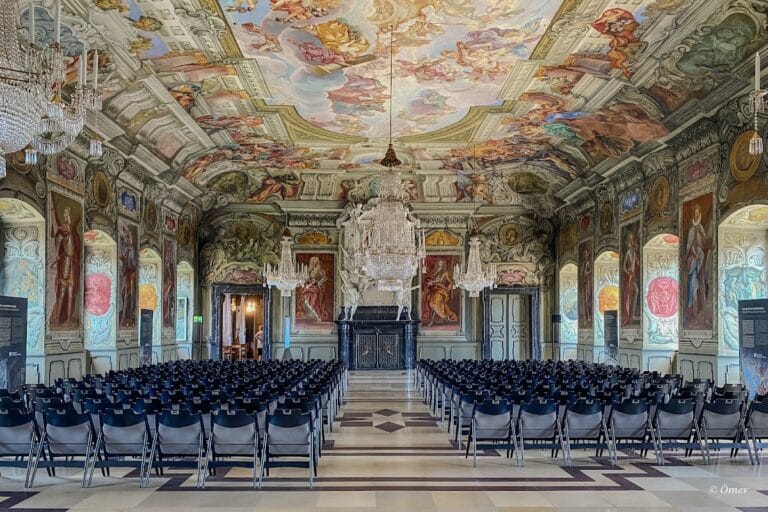
The Rococo Hall occupies the northern part of the upper storey and was redesigned in the eighteenth century. Franz Jakob Vogel created the ceiling stucco in 1745, Joseph Bonaventura Mutschele made the woodcarving in 1750, Joseph Fröschel carried out the carpentry, and Anton Dambacher completed the gilding.
At the centre of the ceiling, a sun appears within an elongated quatrefoil, with a putto in each corner. The allegorical programme represents water, fire, air, and earth. Johann Anwander’s wall paintings present the four cardinal virtues, justice, prudence, temperance, and fortitude, through examples from the Old Testament. Their moral purpose was directed toward the members of the council. Anwander also painted the works above the doors.
Portraits of Elector Maximilian IV Joseph and Bamberg’s last prince-bishop, Franz Freiherr von Buseck, hang on the north wall. Maximilian IV Joseph became Bavaria’s first king in 1806, while von Buseck abdicated in 1802 during secularization in Bavaria. A faience stove, made of tin-glazed earthenware and bearing a relief of the town knight, was installed in the hall in 1898.
Above the entrance to the anteroom is a fifteenth-century wooden panel framed with gilded Rocaille ornament, an asymmetrical shell- and rock-inspired decoration associated with the Rococo. Its saying comes from Eike von Repgow’s Sachsenspiegel, a medieval German law book, and expresses the principle that both sides in a dispute should be heard. The Ludwig Collection’s porcelain and Strasbourg faience are also displayed within the building as part of Bamberg’s municipal museums.