Altenburg: A Medieval Hilltop Castle in Bamberg, Germany


Site at a Glance
- Rating
- 4.6
- Popularity
- Medium
- Country
- Germany
- Primary era
- Medieval
- External website
- Open
- Eras represented
- Medieval, Modern
- Civilizations
- German, Holy Roman Empire
- Site type
- Military
- Remains
- Castle
On this page17 sections
History
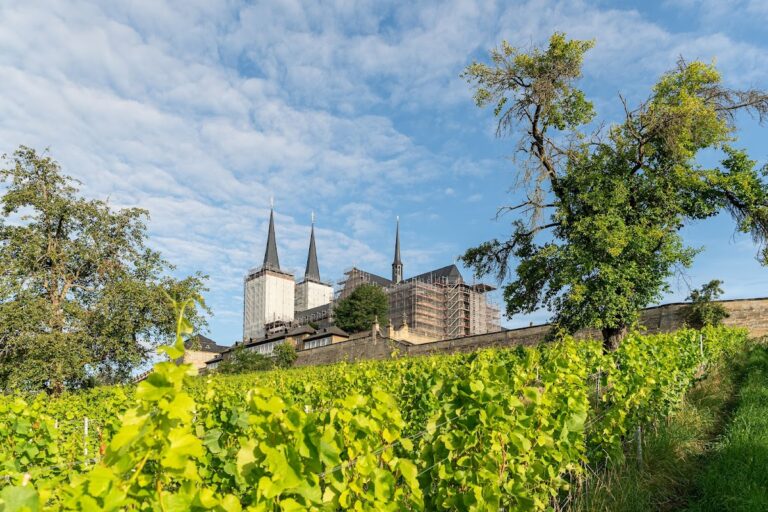
Altenburg is a medieval hilltop castle in Bamberg, Germany, built and developed under the ecclesiastical rule of the Bamberg bishops. First mentioned in 1109, it later became the second residence of Bamberg’s prince-bishops, who combined religious office with territorial rule. The castle in its present extent was formed in the early fifteenth century and occupies a hill overlooking Bamberg and the surrounding Franconian countryside.
Early ecclesiastical castle
In 1109, Bishop Otto of Bamberg transferred the castle complex to the collegiate foundation of St James, a religious institution served by a community of clergy. Bishop Otto I consecrated a chapel at Altenburg in 1124, dedicating it to Saint Walburga, Saint Philip, and Saint James. Its exact location is no longer known, and successive chapels were later destroyed during the castle’s violent history.
From 1305 to 1553, Altenburg served as the second residence of the prince-bishops of Bamberg. The castle therefore functioned both as a fortified stronghold and as a residence connected with the administration of the bishopric. Its surviving medieval form reflects the rebuilding and expansion that took place in the early fifteenth century.
War and destruction
Altenburg was besieged during the German Peasants’ War of 1524 to 1525, a broad uprising involving rural communities and other groups across parts of the German lands. The castle was neither captured nor seriously damaged during that conflict.
Its fortunes changed during the Second Margrave War, a conflict fought from 1552 to 1554 by Albrecht Alcibiades, Margrave of Brandenburg-Kulmbach, and several neighboring territories. In 1553, Altenburg was handed over to the margrave’s forces. The castle was then destroyed after its surrender rather than being taken in an assault, and troops set fire to the successive chapels on the site.
Private ownership and preservation
In 1801, the Bamberg bishopric sold the castle, excluding its fortifications, to the Bamberg physician Adalbert Friedrich Marcus. Marcus converted the surviving gatehouse into a residence. After his death, the property entered bankruptcy proceedings. His friend, the writer, composer, and artist E. T. A. Hoffmann, repeatedly used one of the wall towers as a retreat while living in Bamberg from 1808 to 1813.
In 1818, Anton von Grafenstein of Krummennaab, a postmaster, founded the Society for the Preservation of Altenburg. It is described as Bavaria’s first monument-preservation association. The society’s acquisition of the property helped establish the castle’s continuing association with preservation, religious observance, and public use. A restaurant has operated at the castle since at least the association’s acquisition.
Religious activity on the castle plateau resumed in 1617. A temporary linen chapel was erected there each year, maintaining a tradition associated with the chapel consecrated in 1124 under canon-law provisions. The von Grafenstein siblings restored the endowment for the May 1 service in 1824. The present chapel was built in 1834, held its first Mass on May 1, 1835, and was consecrated on May 1, 1836, by Franz Seraph Freiherr von Lerchenfeld.
The castle’s religious traditions continued through later services. A May 1 service remains associated with the chapel, an evangelical Lutheran service at the crucifixion group has been held on Ascension Day since about 1990, and a September service commemorates deceased members of the Altenburg society.
Later changes and associations
A landslide destroyed parts of the eastern wall during the last quarter of the eighteenth century. At the beginning of the twentieth century, another eastern section was demolished because it threatened to collapse and was rebuilt farther back. The original rectangular enclosure consequently survives only in altered form. Damaged wall sections were reconstructed in exposed concrete at the beginning of the twenty-first century.
From 1902 to 1916, Altenburg housed a brown bear named Hassan. After the Second World War, the bear Toni was acquired, but she was killed at the end of 1952 after failing to tolerate a young bear placed with her and when no new keeper could be found. The last castle bear, Poldi, lived in an enclosure from 1952 until the end of 1982. Bamberg mayor Luitpold Weegmann sponsored the young bear, whose name derived from the mayor’s first name. The enclosure survives with a bear figure, while Poldi’s head is displayed in Bamberg’s Natural History Museum.
In 1930 and 1931, Bamberg merchants formed the Reichsritterschaft zum goldenen Federkiel in the high-princely cathedral foundation of Bamberg. This twentieth-century association used a ceremonial chivalric title and established its seat at Altenburg. The surroundings also contain the grave of Adalbert Friedrich Marcus, a monument to members of the Altenburg society, and a monument commemorating 100 years of the Bamberg bishopric in Bavaria.
Remains
Altenburg occupies a hilltop whose tower stands at approximately 400 metres above sea level. Substantial parts of the medieval complex survive, although the eastern wall and the enclosure were altered after landslides and structural repairs. The surviving buildings, towers, walls, chapel, well, memorials, and later additions form a physically layered castle complex above Bamberg.
Castle buildings and defenses
The Palas
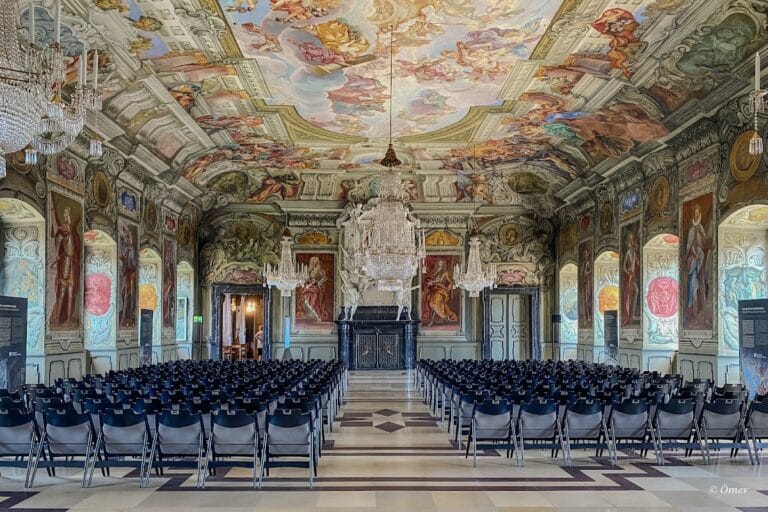
The present Palas, the principal residential building of a medieval castle, was built around 1900 over the partly preserved cellars of the original residential structure. Gustav Haeberle designed it in a romanticizing historicist style with neo-Romanesque features, with financial support from the shoe manufacturer Heinrich Manz. Its Knights’ Hall retains its period interior, including a mural by Wilhelm Reutter on the west wall showing a medieval tournament. One rider has the facial features of Josef Valentin Herd, then Bamberg’s second mayor, while a facial mask on the Palas resembles Heinrich Manz.
Gatehouse and towers
The chapel is entered through the gatehouse, whose passage contains a memorial plaque to Anton von Grafenstein. Two lions holding heraldic shields on the gatehouse came from a house on Bamberg’s Green Market whose facade was altered during rebuilding around 1880. Above the restaurant entrance is a fifteenth-century crucifixion relief whose original provenance is unknown. Memorial plaques to Heinrich Manz and Johann Loewel are fixed to the Palas’s south wall and the southwest corner tower.
The northwestern tower contains part of the coat of arms of the Wild Man, a conventional heraldic figure represented as a hairy human figure. The design was still associated with the castle around 1780 and is also depicted in Johann Sebastian Schramm’s Aurifodina Bambergensis. On the eastern side of the castle stands a reclining lion. Three related lions are located elsewhere, two in private ownership and one in an archway between St Martin’s Church and the Martinsapotheke. All four originally stood on Upper King Street.
Well and fire basket
The castle well originally stood inside a square well house, which was demolished around 1880. The present well structure dates from that period, and its shaft is approximately 30 metres deep. Stones from the demolished well house were reused when the northwestern corner tower was altered.
An iron basket known as the fire basket hangs from the castle tower. It was traditionally regarded as a signal device linking Altenburg with Giechburg near Scheßlitz, but it was probably added during the rebuilding around 1900. Its likely purpose was Bengal lighting, a bright pyrotechnic illumination used for ceremonial displays and performances at the castle.
Chapel and devotional features
Castle chapel
The present chapel occupies the gatehouse and was designed overall by Bernhard Solger, a pupil of Karl Alexander Heideloff and Friedrich von Gärtner. Friedrich Panzer, a royal building inspector, directed its conversion into a room with Gothic vaulting. An older vault was extended southward around the choir, and its keystone depicts the city knight from Bamberg’s coat of arms.
The altar was made by Adam Joseph Schäfer after a design by Heideloff. Its tympanum, the decorated field above a doorway or within a pediment, had originally been intended for the entrance of the church at Tiefenpölz. Funerary monuments transferred from secularized churches in Bamberg were installed in the chapel. The original painted glass windows were removed in the 1960s and are held in the depots of the Historical Museum.
Crucifixion group
The crucifixion group made by Georg Adam Reuss in 1755 remains at the place associated with worship on the castle plateau. Services continue to be held before it, including the evangelical Lutheran service on Ascension Day.
Hermitages and transferred monuments
E. T. A. Hoffmann Hermitage
The E. T. A. Hoffmann Hermitage contains caricatures of Bamberg personalities drawn by Hoffmann on its interior walls. It also holds a surviving fragment of the funerary monument of Leypold Truchsess of Wetzhausen at Dachsbach, who died on November 19, 1516. The fragment is attributed to Jörg Armpauer, known as the Master of the Swan Knight Order. A crown, probably the remnant of a coat of arms, is also located in the hermitage, although its provenance is unknown.
Amalie Hermitage
The Amalie Hermitage commemorates Amalia of Oldenburg, queen of Greece, who lived in exile in Bamberg with her husband, Otto I. It displays the surviving portion of a Werdenstein family coat of arms from Aufseßgasse in Bamberg. The shield was originally about one-third larger and included the arms of related male family lines on either side. A complete representation appears in Schramm’s Aurifodina Bambergensis. A smaller family coat of arms is placed above and to the left, while the coat of arms of the Bamberg bishopric is to the right. The provenance of both is unknown.
Funerary monuments
A probably 1727 funerary monument to Adalbert of Babenberg, of the Popponen family, was transferred to Altenburg after the dissolution of Theres Abbey. During restoration around 1980, the sculptor Leitherer identified older components within the monument.
The chapel also contains the funerary monument of Heinz Fuchs of Bimbach, who died on June 15, 1539. It came from St Anne’s Church of the Franciscan monastery in Bamberg. The monument of Wolf Christoph of Streitberg, who died on March 29, 1560, bears the date 1562 and the monogram “KS,” identifying the sculptor as Kilian Sorg. It likewise came from St Anne’s Church and reached Altenburg through the Domkreuzgang, where it was first stored.
The monument of Martin von Redwitz, who died on April 27, 1505, came from St Christopher’s Church of the Dominican monastery and was probably made by the workshop of Tilman Riemenschneider. Another monument commemorates Georg von Schaumberg of Lauterburg, who died on January 5, 1527. Johann Daucher made it in 1520. Although it came from the Dominican church, Georg von Schaumberg was buried in St Maurice’s Church in Coburg.
Nearby sites