Old Castle of Alcoutim: An Islamic Hilltop Fortress in Portugal



Site at a Glance
- Rating
- 4.2
- Popularity
- Low
- Country
- Portugal
- Primary era
- Medieval
- Eras represented
- Medieval
- Civilizations
- Portuguese, Umayyad
- Site type
- Military
- Remains
- Fort
On this page8 sections
History
The Old Castle of Alcoutim is a medieval Islamic hilltop fortress in Portugal, about one kilometre north of Alcoutim, whose first construction dates to the late eighth or early ninth century during the rise of the Emirate of Córdoba. It occupies an earlier fortified settlement, or castro, whose use began in the Bronze Age and continued into the 11th century. The castle is regarded as an important example of Islamic military architecture in the Algarve and is distinct from the younger Castle of Alcoutim.
Early occupation and Islamic foundation
The hill had a long history before the Islamic fortress was built. Its prehistoric occupation continued through later periods, and material recovered from deposits around the cliffs may relate to the final phase of Visigoth rule, the beginning of Muslim intervention, or both. The Visigoths were a Germanic people who ruled much of the Iberian Peninsula before the Muslim conquest. Nearby graves from the Islamic period have also helped clarify the origins of the site.
The choice of the hill has not been conclusively explained. Its broad visibility, the possible reuse of Roman structures, control of river traffic on the Guadiana, and connections with regional mineral exploitation may all have influenced the decision. The fortress became the centre of a large territory linked to activity along the river and to the extraction of minerals. During the Caliphate of Córdoba, the Islamic state that followed the earlier emirate, and the first taifa period, when al-Andalus was divided among smaller Muslim-ruled states, local infrastructure changed and some residential areas spread beyond the inner defensive walls.
The site may also have provided refuge during the early medieval period, protected by the rocky cliffs around the hill. Its defences were altered over time, including the later addition of a tower guarding the principal entrance. The fortress was abandoned during the ninth century for reasons that remain unclear, and it did not recover its earlier military importance.
Christian conquest and later reforms
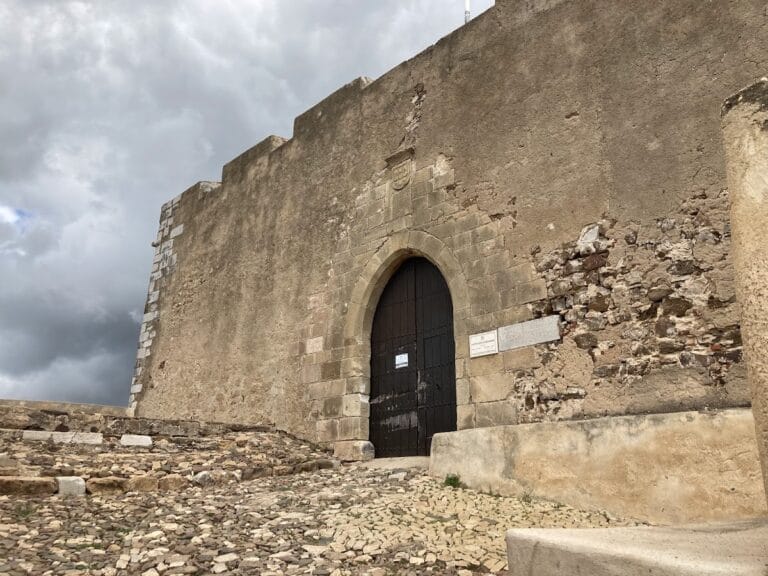
During the 11th-century Christian Reconquista of the Algarve, Christian powers favoured the settlement of Alcoutim. They established a new community and constructed the younger Castle of Alcoutim there, while the old fortress was abandoned as a centre of power. The earlier site nevertheless received later medieval reforms, including new Gothic gates, which indicate a renewed but limited need for the fortification.
Excavation and conservation
Helena Catarino directed archaeological excavations at the castle between 1986 and 1993. Work at several levels established a sequence of occupation from the Bronze Age to the 11th century. Finds from residential areas included tiles, ceramics, and a small number of metal objects associated with the closing phase of emirate-period Muslim occupation. A green manganese bowl was recovered from the wall of a rectangular compartment built in the centre of the castle during the Caliphate period. Another excavated layer was mainly characteristic of the Caliphate, while also containing ceramics from the 11th century.
The Old Castle of Alcoutim was classified as a Property of Public Interest on 7 October 1996. Requalification works carried out in the 2000s were incorporated into Project Guaditer, a Portugal-Spain cross-border cooperation programme. The intervention resulted in stainless-steel guardrails and viewing platforms in 2011.
Remains
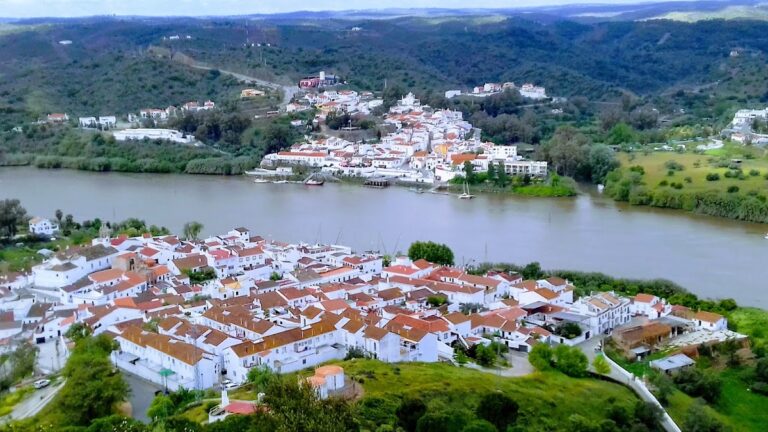
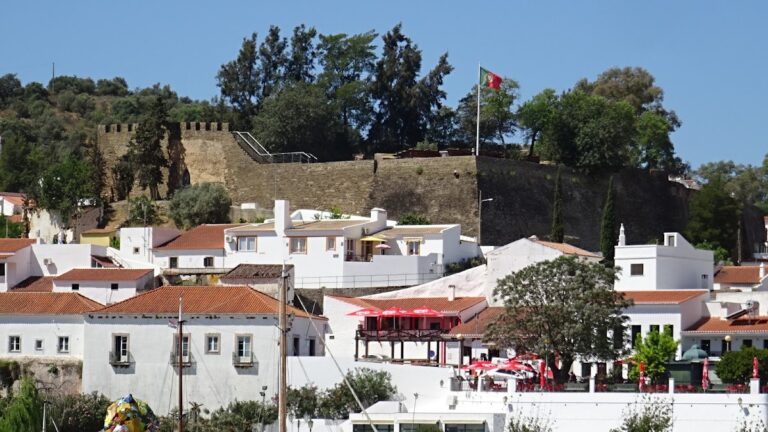
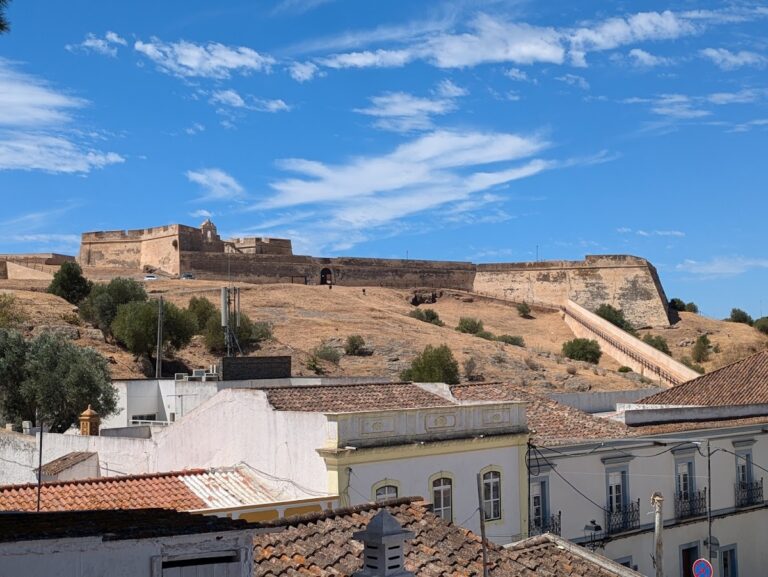
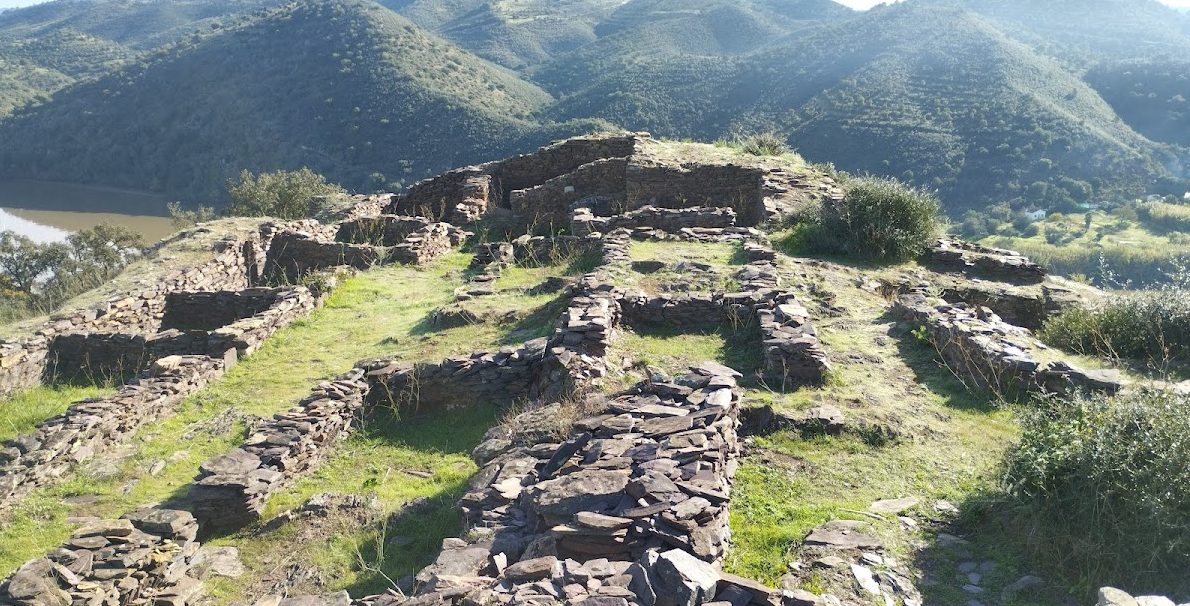
The castle occupies a rural hilltop above the Guadiana River, surrounded by dense vegetation, shrubs, and rocky cliffs. Its position provides broad visibility over the river and the surrounding landscape. The military complex is arranged in two rectangular enclosures, while a lower defensive line protected a settlement that developed around the inner walls. The fortification imposed a regular structural plan on uneven ground and has been associated with Umayyad castle typology, including a loose-stone base and stone-and-earth cementing comparable to other Umayyad military installations.
Upper enclosure
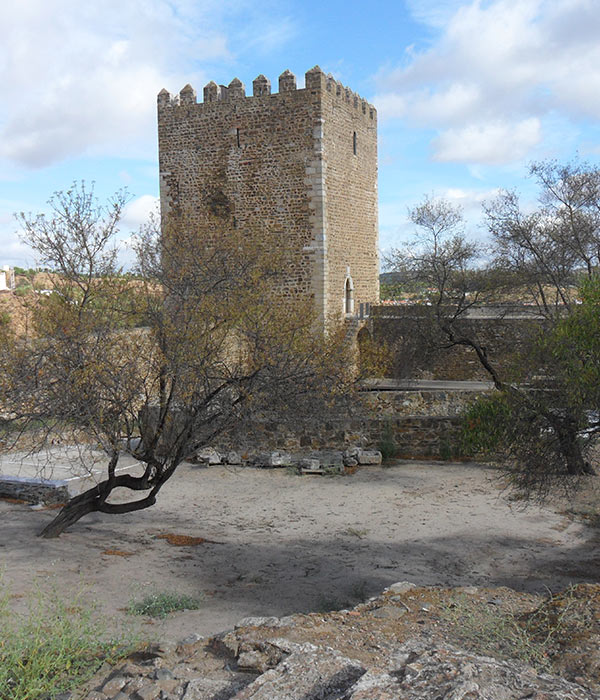
The upper enclosure, or alcazaba, is a fortified citadel covering 704 square metres. It contains several rectangular towers, positioned without occupying the corners, and two gates. Inside are rectangular compartments probably used as residences. Their walls were built with schist masonry, using a layered metamorphic stone that can be split into slabs. An opening measuring 560 by 250 centimetres leads to a cistern, while the enclosure walls measure between 70 and 90 centimetres thick.
Lower defences and outer redoubt
The lower defensive line has a rectangular plan reinforced with towers. It enclosed and protected the settlement that grew around the inner walls, and a gate connected this settlement with the habitable area extending towards the river.
The outer redoubt contains schist towers and rectangular structures made from ashlar-schist masonry, with surviving remains on the western side. Its walls consist of greywacke and shale blocks mixed with soil and clay, and are approximately two metres thick. Greywacke is a dark, compact sandstone containing abundant rock fragments. Four towers stand along the outer wall: two have irregular plans of about 5 by 5 metres, while the other two measure approximately 3 by 3 metres.
Archaeological remains
Ceramic fragments, many fired in an irregular kiln, and a small number of decorative remains were recovered from deposits around the cliffs. The residential areas produced tile fragments, ceramics, and metal objects connected with the end of the emirate period. The green manganese bowl found in a central rectangular compartment provides material evidence for activity during the Caliphate. Ceramics from the 11th century in another excavated layer extend the sequence into the period of Christian conquest, although the development of some phases remains difficult to define precisely.
Nearby sites