Ognissanti Church: A Franciscan and Renaissance Landmark in Florence


Site at a Glance
- Rating
- 4.8
- Popularity
- Medium
- Country
- Italy
- Primary era
- Medieval
- External website
- Open
- Eras represented
- Medieval, Early Modern, Modern
- Civilizations
- Grand Duchy of Tuscany, Italian, Republic of Florence
- Site type
- Religious
- Remains
- Church
On this page24 sections
History
Ognissanti Church, formally the Church of San Salvatore in Ognissanti, is a Roman Catholic church in Florence, Italy, dedicated to the Saviour and All Saints. Construction began in 1251 for the Humiliati, a medieval Catholic order of men and women devoted to evangelical poverty and manual work, and the conventual complex was completed between 1278 and 1294. The church belongs to the Archdiocese of Florence and later became closely associated with the Franciscans, the Vespucci family, and some of the most important painters of Florentine art.
The Humiliati foundation
The Humiliati had arrived in Florence from Alessandria in 1239. They first settled at San Donato in Polverosa and then at the church of Santa Lucia before establishing their larger community outside the old city walls. Their religious life combined communal devotion with textile and glass production. At Ognissanti, their position beside the Mugnone and near its meeting with the Arno provided water for mills and fulling works used in processing wool.
The community constructed the Santa Rosa weir and an extensive canal system. Workshops, wool-drying areas, and housing for workers grew around the convent, making the settlement both a religious center and a place of manufacture. The Humiliati gained economic influence and public standing during the late thirteenth century, when members received important civic offices. Wealthy Florentine families also endowed the church with works of art.
Giotto and republican Florence
A major artistic campaign took place around 1310 and centered on Giotto, the leading Florentine painter of the late thirteenth and early fourteenth centuries. His Maestà, an image of the enthroned Virgin and Child, was placed on the high altar with a painted Cross and the Dormitio Virginis. The Maestà is now in the Uffizi, the Dormitio Virginis is in the Gemäldegalerie in Berlin, and the Cross remains at Ognissanti.
The church also became a setting for Florentine republican politics. Conspirators opposed to Giano della Bella, a powerful political figure in the city, met at Ognissanti. Their number included Dino Compagni, who later became a noted chronicler of Florentine political life.
Renaissance patronage and the Vespucci
During the fifteenth century, Ognissanti attracted the work of Sandro Botticelli and Domenico Ghirlandaio, two major Florentine Renaissance painters. The Vespucci family commissioned Ghirlandaio to create a Pietà, a Madonna della Misericordia, and a Last Supper for the complex. The Madonna della Misericordia shows members of the family kneeling beneath the Virgin’s protective mantle, while a marble floor roundel bearing the Vespucci arms marks their burial well.
The church contains the burials of Botticelli, Giovanni Antonio Santarelli, Luigi Del Buono, Carolina Bonaparte, an ancestor of Amerigo Vespucci who bore the same name, and Simonetta Vespucci. Botticelli’s burial is marked inside the church. The exact location of Simonetta Vespucci’s burial has not remained certain. Carolina Bonaparte was Napoleon Bonaparte’s younger sister and the wife of Joachim Murat, who became king of Naples.
From the Humiliati to the Franciscans
The Humiliati declined during the sixteenth century as silk production displaced wool production in Florence. In 1571, the order was suppressed after conflicts in Lombardy associated with Carlo Borromeo. Cosimo I de’ Medici then transferred the Florentine convent to the Observant Friars Minor, the Franciscan branch founded within the tradition of Francis of Assisi.
The Franciscans moved from San Salvatore al Monte, whose convent had been badly damaged during the imperial siege of Florence in 1529 and 1530. They brought furnishings, artworks, and a robe traditionally believed to have belonged to Francis when he received the stigmata, the wounds understood in Christian tradition as reflecting those of Christ, at La Verna in 1224. The robe remained at Ognissanti from 1571 to 2000 before returning to the sanctuary of La Verna. The church was renovated, reconsecrated in 1582, and dedicated as San Salvatore ad Ognissanti.
The former convent also housed several confraternities, including the Confraternity of the Sacrament of Ognissanti, the Company of Bechella, and the Company of San Pietro dei Cassieri and Citizens at the Gates. Their presence added to the complex’s religious and civic functions.
Seventeenth- and eighteenth-century transformation
The interior was radically remodeled in 1627 for Ferdinando II de’ Medici. Matteo Segaloni provided the design and Sebastiano Pettirossi directed its execution. New altars, paintings, and sculptures were installed, and the friars’ choir was demolished to create the present high altar. The cloisters were paved in stone in 1634, with later restoration in 1772 and after the flood of 1966.
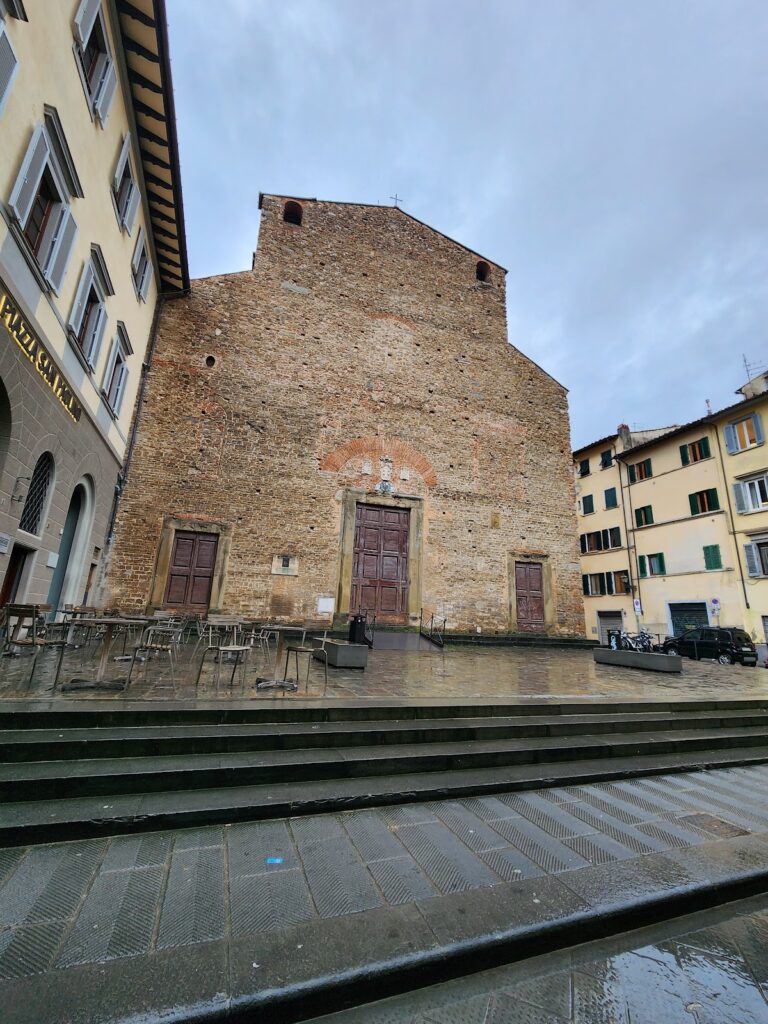
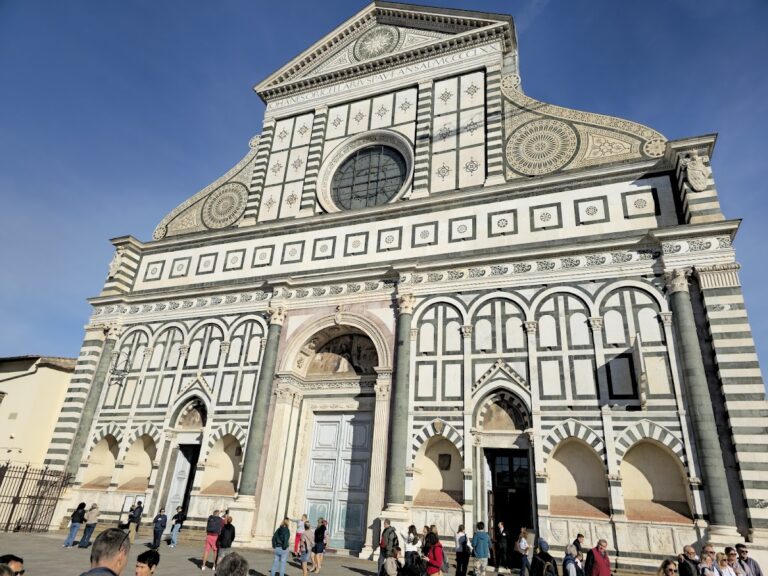
The façade was completed in 1637 according to designs by Matteo Nigetti. Antonio and Alessandro de’ Medici financed the work. They belonged to a family of converted Jews protected by the Medici. The original façade was built in pietra forte, a local sandstone, but conservation problems led to its complete rebuilding in Rapolano travertine in 1872, with the replacement work financed by the city of Florence.
The ceiling decoration was completed in the eighteenth century. Between 1769 and 1779, Giuseppe Romei painted the Glory of Saint Francis and Saint Pasquale Baylon, with architectural illusionism by Giuseppe Benucci. These works added a later Franciscan layer to the medieval structure and the seventeenth-century interior.
Suppression, restoration, and continuing use
The convent was first suppressed in 1810 and definitively suppressed in 1866. The Friars Minor regained part of the former complex in 1885 and maintained a community there. From 1923, other parts of the convent housed a Carabinieri barracks. In 2000 the Friars Minor left the convent, which the archbishop of Florence, Silvano Piovanelli, entrusted with the parish to the Benedictine monastic Family of the Fraternity of Jesus. That community remained until 2005. The Franciscan Friars of the Immaculate administered the complex until 2016, when the church returned to the management of the Friars Minor.
Restoration has also clarified the history of the church’s art. Work on Giotto’s Ognissanti Cross began in 2005 under the direction of the Opificio delle Pietre Dure in Florence. It confirmed the attribution to Giotto and supported a date around 1315. The Cross returned to the church on 6 November 2010. Restoration of the former refectory revealed the sinopia, or preparatory drawing beneath a fresco, belonging to Ghirlandaio’s Last Supper. The church and convent continue to preserve or interpret works connected with Giotto, Ghirlandaio, Botticelli, Taddeo Gaddi, and other artists.
Remains
Ognissanti has a single nave approximately 95 metres long and 14 metres wide, with a deep transept containing several chapels. Its present interior combines the medieval building with the extensive remodeling of 1627. The surviving layers are especially clear because the church escaped the major nineteenth- and twentieth-century restorations in historical styles that altered many other large Florentine churches.
Nave and façade
The nave interior
The nave is covered by roof trusses concealed behind a ceiling. Rectangular windows occupy the positions of the original pointed-arch openings, whose earlier forms remain visible on the exterior. The present windows and continuous cornice date from 1627 and may have been designed by Sebastiano Pettirossi. The cornice bears the coat of arms of Giovanni Battista de Ambra.
Six altars stand along each side of the nave beneath stone-serena aedicules, or framed altar structures, of broadly fifteenth-century character. Some have been restored. Each has a shallow arched canopy with coffers, supported by two columns with Corinthian capitals. On the counterfacade, above the De Ambra arms, Cosimo Ulivelli’s Apparition of the Virgin and Child to Saint Francis dates from 1662. The right holy-water stoup has an onyx basin and is probably a later recomposition, while the left stoup retains a sixteenth-century form.
Romei’s ceiling fresco presents the Glory of Saint Francis and Saint Pasquale Baylon amid painted architectural effects by Benucci. The present stone pavement was laid after the flood of 1966 and replaced the pavement installed in 1897. The earlier remodeling removed almost all funerary memorials, while retaining several considered especially important and a large coat of arms associated with the Medici.
The exterior and campanile
Nigetti’s façade consists of two tripartite levels articulated by pilasters, niches, and elaborate window frames. During the 1872 rebuilding, the original pietra forte was replaced with Rapolano travertine. The window above the central portal became a niche, and the Medici arms in the attic were replaced by the Florentine emblem. The portal retains a semicircular glazed-terracotta lunette of the Coronation of the Virgin and Saints, made around 1510 and attributed to Benedetto Buglioni. The Medici arms formerly in the attic are now above the cloister entrance.
The campanile, or bell tower, beside the church dates from the thirteenth or fourteenth century. It contains three bells cast in 1756, the largest weighing 620 kilograms, and a smaller bell cast in 1690.
Nave altars and Renaissance paintings
The right side of the nave
The right side begins with the Ascension altar, which contains Ludovico Buti’s Ascension, painted around 1580 to 1590. The former chapel of San Lino is now occupied by a commercial establishment. Nearby, the Vespucci altar retains parts of Ghirlandaio’s Deposition and Madonna della Misericordia, painted around 1472 to 1475. The Madonna shelters members of the Vespucci family beneath her mantle. The young figure near the Virgin is traditionally identified as Amerigo Vespucci, while the figure in a white hat is identified as Simone Vespucci.
The Aldana, or Saint Jerome, altar contains a mid-sixteenth-century Madonna and Saints, attributed variously to Maso da San Friano, Francesco Traballesi, and more recently to Francesco Brina with workshop assistance. Its arched upper section, showing angels, was added by Santi di Tito. Botticelli’s Saint Augustine in His Study and Ghirlandaio’s Saint Jerome in His Study, both painted around 1480, face one another. They were transferred from the demolished monastic choir. Botticelli’s fresco includes a playful inscription concerning a fugitive friar, while Ghirlandaio’s Saint Jerome is filled with furnishings and writing connected with Jerome’s translation of the Bible into Latin.
Other works on this side include Nicodemo Ferrucci’s Stigmata of Saint Francis, painted around 1620, and a marble pulpit attributed to Battista Lorenzi and dated around 1564. Its reliefs depict episodes from the life of Saint Francis. Vincenzo Dandini supplied a replacement for Carlo Portelli’s Immaculate Conception. The Saint Salvatore altar contains the remains of the martyr Saint Cyril and a painting attributed to Domenico Pugliani.
The left side of the nave
The Saint Bernardino altar formerly contained an urn with the bones of Saint Valentine and lost its altar table in 1897. Fabrizio Boschi’s Saint Bernardino of Siena Carried into Heaven by Angels is nearby, together with surviving fragments of the funerary monument of Luca Manzuoli, a Humiliati friar and cardinal. The Cross altar contains a wooden Cross dating from about 1340 to 1350, possibly by an itinerant German artist.
The Assumption altar has Maso da San Friano’s Madonna in Glory with Saints and a Glory of Angels by Santi di Tito. The former Martyrdom of Saint Andrew by Matteo Rosselli is now in the right transept. Ridolfo del Ghirlandaio’s Coronation of the Virgin was rediscovered in 1898 beneath a later painting. The baptismal font has stood in this area since 1897 and took its present form in 1942.
The Annunciation altar contains Bartolomeo Traballesi’s Annunciation, formerly placed on the right side of the nave. Its unusual composition shows God commissioning the Archangel to announce the event to the Virgin. It also includes the heads of two probable donors, Benedetto Carloni and his wife.
Chapels and transepts
Chapels beside the nave
The chapel of the Madonna dell’Alba was constructed beside the nave in 1581, within the roof space of the cloister, at the initiative of the Spanish dukes of Alba. Its present decoration dates mainly from about 1730 to 1740 and includes frescoes by Rinaldo Botti, paintings by Giuseppe Pinzani, and a seventeenth-century copy of the Madonna Salus Populi Romani between Saint Bonaventure and a bishop.
The chapel of Saint Rose of Viterbo was formerly dedicated to Saint Lucy. Giovanni Cinqui painted the Glory of Saint Rose in the vault, the Baptism of Christ and Preaching of John the Baptist in the lunettes, and scenes of the saint’s miracles on the walls. Giuseppe Pinzani painted the altar’s Preaching of Saint Rose around 1714 to 1715, and Benedetto Veli supplied an image of Saint Anthony of Padua on the entrance arch.
The chapel of Saint Pasquale Baylon, formerly dedicated to Saint Thomas, was remodeled in 1691 by Antonio Ferri. Pier Dandini painted Saint Pasquale Adoring the Eucharist, The Death of Saint Pasquale, and The Healing of the Sick During Mass. Giovanni Gargioli made the marble altar frontal.
The transept chapels
The base of the campanile is reached from the right transept and contains Stories of Saint Nicholas, painted around 1310 by an artist close to the Master of Saint Cecilia. The transept also contains the school of Lorenzo Lippi’s Lot and His Daughters, painted around 1630 to 1640, Jacopo Ligozzi’s Saint Diego of Alcalá Healing the Sick from 1595, and Donato Mascagni’s Saint Peter Designates His Successor from 1603.
The chapel of Saint Peter of Alcantara has vault and pendentive frescoes by Matteo Bonechi and paintings on the side walls by Vincenzo Meucci, made in 1722. Lazzaro Baldi’s altar painting, Christ Giving Communion to Saint Peter of Alcantara in the Presence of Saint Teresa of Ávila, was removed after a serious fall and had not been restored to the chapel. A disk reconstructed in 1937 from older drawings marks the burial of the Filipepi family, to which Botticelli belonged.
The chapel of the Most Holy Name of Jesus has its present appearance from 1722. It was formerly associated with the Vespucci, Antinori, and Baldovinetti families. Giovan Domenico Ferretti painted the dome, framed by architectural work by Lorenzo del Moro, as well as the Madonna Dolorosa and Saint Joseph in the side ovals. The chapel also contains works by Vincenzo Dandini and other late-sixteenth-century Florentine painters. A doorway leads to the funerary chapel of Carolina Bonaparte, created from a concealed room during the Restoration period. A plaque at its neoclassical altar marks her precise burial place.
The northern transept chapel of the Most Holy Sacrament, also called the Lenzi Chapel, occupies the site of the Humiliati’s original oratory. It contains Lorenzo Lenzi’s slab, attributed to Lorenzo Ghiberti and dated 1442, along with part of a fresco cycle begun by Bicci di Lorenzo and Neri di Bicci and completed in 1451. The Marzichi branch of the Lenzi family obtained patronage of the chapel from 1641, and Ranieri del Pace redecorated it in 1721. Matteo Rosselli’s Martyrdom of Saint Andrew and Saint Elizabeth of Portugal Blessing a Child were transferred here from the nave, while Giuseppe Pinzani painted Saint Elizabeth of Hungary Receiving the Tertiaries around 1730.
The major chapel and choir
The present major chapel was enlarged from 1574 with support from the Bardi family of Vernio, who obtained burial rights there. Its monumental high altar was made between 1593 and 1605 and is traditionally associated with Jacopo Ligozzi. Polychrome marble and pietra dura, an inlay technique using precisely cut colored stones, form panels depicting the Porziuncola, the Stigmata, and the Sermon to the Birds.
The chapel contains Bartolomeo Cennini’s bronze Crucifix, made between 1669 and 1674, and four marble statues of Francis, Anthony of Padua, Bernardino, and Diego of Alcalá attributed to Simone Cioli. Two angels are by Andrea di Simone Ferrucci. Fabrizio Boschi and Cosimo Gamberucci painted scenes of Franciscan miracles, while Giovanni da San Giovanni created the Glory of Angels in the dome, the Cherubim in the pendentives, and the Cardinal Virtues in the lunettes around 1616.
A small compartment within the high altar formerly held the robe associated with Saint Francis’s stigmata at La Verna. Two carved eighteenth-century wooden doors lead to the choir, which was renewed according to designs by Bernardino Ciurini in 1737. Giuseppe Pinzani painted the Expulsion of the Merchants from the Temple on the rear wall in 1740. Later window openings damaged the work, and Gasparo Martellini largely repainted it in 1844 and 1845.
The chapel of Saint John of Capistrano, formerly dedicated to Saint Benedict, may have been the chapel once decorated with frescoes by Giotto that are now lost. After its renewal in 1690, Pier Dandini painted scenes from the life of Saint John of Capistrano and the defense of the Name of Jesus. The chapel of the Robe of Saint Francis, formerly the Nativity chapel and a Vespucci foundation, retains a wooden Crucifix from the circle of Veit Stoss, dated 1502. Alberigo Carlini of Vellano painted its frescoes between 1761 and 1763, and Agostino Veracini painted the Glory of Angels that once formed the background for the Nativity display.
The Vespucci and Franciscan memorials
The Vespucci Chapel retains the surviving sections of Ghirlandaio’s Madonna della Misericordia. The kneeling family members appear beneath the Virgin’s mantle, and the nearby floor marker identifies the family burial area. The chapel therefore preserves both the family’s artistic patronage and its physical connection with the church.
The chapel of the Robe of Saint Francis preserves the Franciscan association through its imagery and former relic display. Across the church, the high altar, transept paintings, cloister frescoes, and chapel decorations repeatedly present episodes from Francis’s life, his miracles, and the devotion of later Franciscan communities.
Sacristy and medieval works
The sacristy doorway retains fragments of fresco, including early-fourteenth-century painted imitation hangings. Inside is Taddeo Gaddi’s large Crucifixion with the Mourning Virgin and Saint Bernard, painted around 1330 to 1340, together with its sinopia. Fragmentary scenes of the Resurrection and Ascension are attributed to Andrea Bonaiuti or Pietro Nelli.
Giotto’s Ognissanti Cross is a large wooden painted Cross measuring approximately 450 by 360 centimetres and originally taller. It was once placed above the presbytery beside the Maestà. After restoration, it was installed in the raised chapel for the fallen in the left transept.
The Gucci-Dini Chapel preserves some of the clearest traces of the fourteenth-century church. Its pietra-serena funerary monument dates from 1375 and is decorated with the prophets Hosea and Isaiah. Scenes from the life of Saint Francis were painted there in 1925 and signed “R. Cresci.”
Cloisters and former refectory
The Great and Minor Cloisters
The Great Cloister was frescoed in the early seventeenth century by Jacopo Ligozzi, Giovanni da San Giovanni, and other painters. Its Stories of Saint Francis were arranged in parallel with episodes from the life of Christ. The chapter house, dispensary, and refectory opened onto this cloister, where three surviving octagonal pillars belong to the medieval Gothic church.
In 1602, medallions showing Franciscan saints and blessed figures were painted above the doors of the cells in the Minor Cloister. Part of the Minor Cloister is now incorporated into the Carabinieri barracks.
The former refectory
The former refectory between the two cloisters now contains the Museo del Cenacolo del Ghirlandaio. Ghirlandaio’s Last Supper, painted in 1480, measures approximately 400 by 810 centimetres. Its painted architecture opens onto an illusionistic garden, while the surviving sinopia is displayed on the left wall.
The room also contains a painted terracotta Madonna and Child by Nanni di Bartolo, approximately 1.40 metres high. Known as the Madonna del Solletico, it dates between 1420 and 1423. Its original polychromy and gilding survive.
Former artworks and the organs
Several major works once belonging to Ognissanti are now preserved elsewhere. They include Giotto’s Maestà and Dormitio Virginis, Bernardo Daddi’s Ognissanti Triptych, Giovanni da Milano’s Ognissanti Polyptych, Donatello’s Reliquary of Saint Rossore, and Carlo Portelli’s Immaculate Conception. These works are now in the Uffizi, the Gemäldegalerie in Berlin, the Museo Nazionale di San Matteo in Pisa, or the Galleria dell’Accademia in Florence.
The church’s major organ was begun by Onofrio Zeffirini in 1565 and modified repeatedly. Its Renaissance gallery, wooden case, and some pipes survive within Tamburini organ opus 553, built in 1967. The instrument has electric transmission, 44 stops, a second division behind the high altar, and a main console with three manuals and pedals. The Most Holy Sacrament Chapel contains a smaller pipe organ built by Domenico Cacioli in 1743 and later altered by Marc’Antonio and Filippo Tronci. It has mechanical transmission, eight stops, one keyboard, and a pedalboard.
Nearby sites