Odintsovo Burial Mounds: A Medieval Slavic Cemetery in Russia
Site at a Glance
- Popularity
- Medium
- Country
- Russia
- Primary era
- Medieval
- Eras represented
- Medieval
- Civilizations
- Unclassified
- Site type
- Burial
- Remains
- Necropolis
On this page13 sections
History
The Odintsovo burial mounds are a Slavic funerary complex in Russia, dating from the 11th to 13th centuries. They served as a cemetery for local people, with mounds raised over the dead or the remains of cremations. The complex has federal-level cultural heritage status in Russia.
Medieval cemetery and use
Odintsovo-VI developed on land previously used for cultivation and, in its final period, extended into part of a nearby settlement. It served as a long-term cemetery. At Odintsovo-VII, pauses in mound construction were associated with games and commemorative funeral feasts held on the mounds; excavations found traces of these activities.
Archaeological investigations
An expedition from the Museum of the History and Reconstruction of Moscow excavated the complex from 1958 to 1971 under the leadership of archaeologist and historian Alexander Veksler. Researchers from the Institute of Archaeology of the Russian Academy of Sciences surveyed the Samynka basin in 1994–1996, and an expedition from the Zvenigorod Historical, Architectural and Art Museum worked at the complex in 2006.
The investigations clarified burial practices from the 11th to 13th centuries and yielded evidence about local people’s physical characteristics, customs, material and spiritual life, and the density and changing pattern of settlement in the area.
Remains
Layout and mound construction
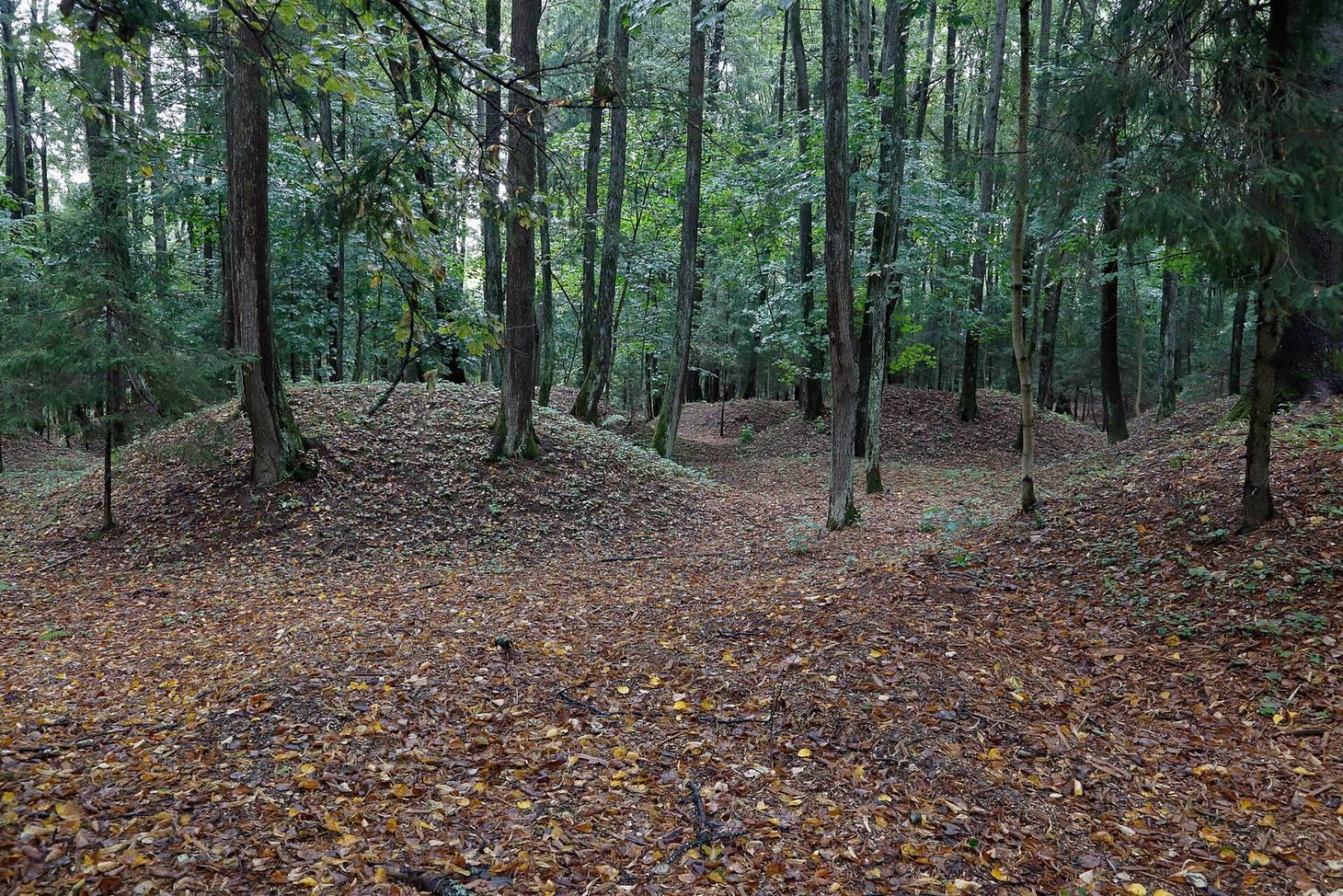
The complex lies in Podushkino Forest Park, within the Larisa Lazutina Hero of Russia Sports Recreation Park. It comprises 19 groups and solitary mounds, numbering more than 300 altogether, alongside six contemporary open settlements, meaning settlements without defensive enclosures, and five settlements from the Muscovite state period, when a state centered on Moscow took shape.
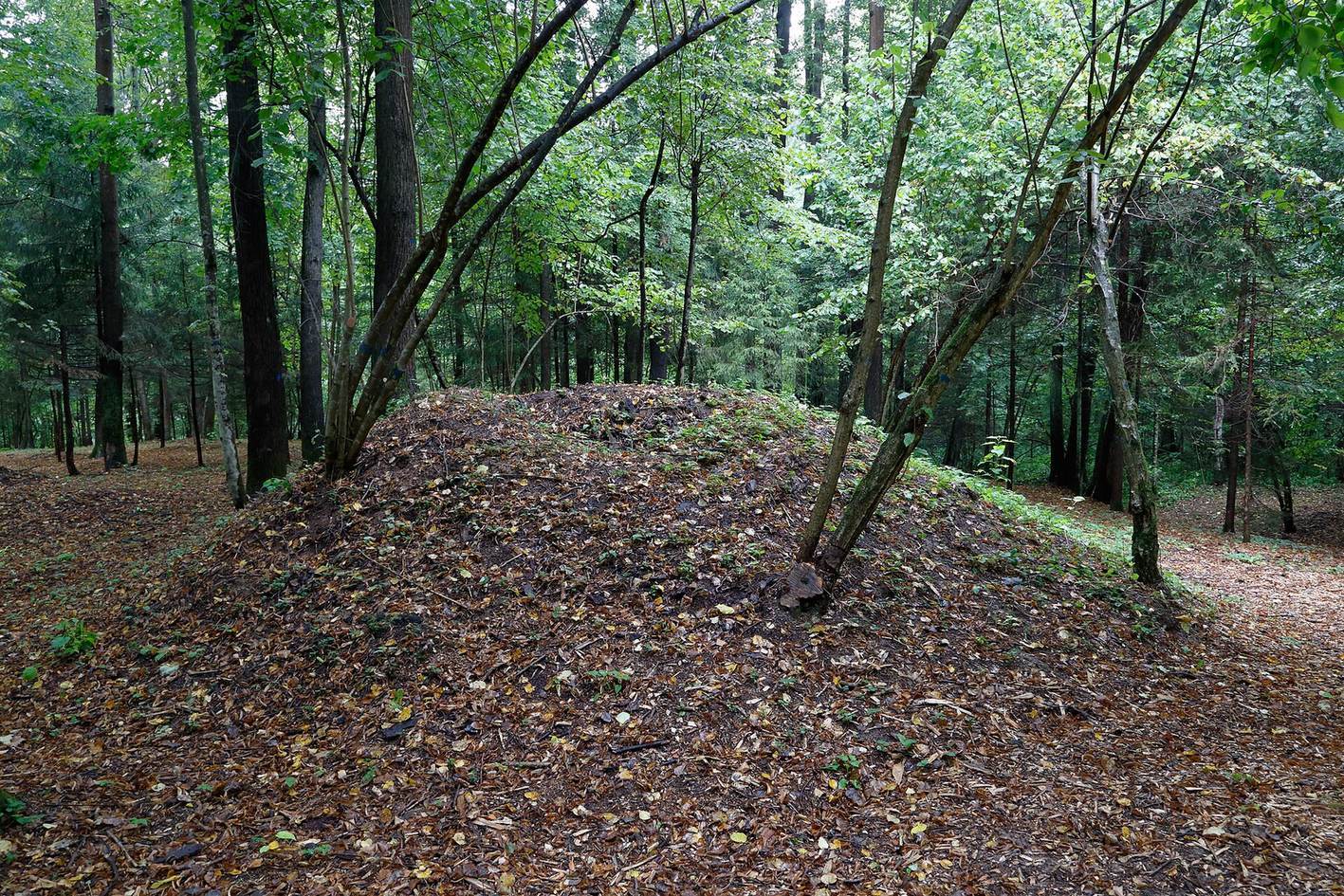
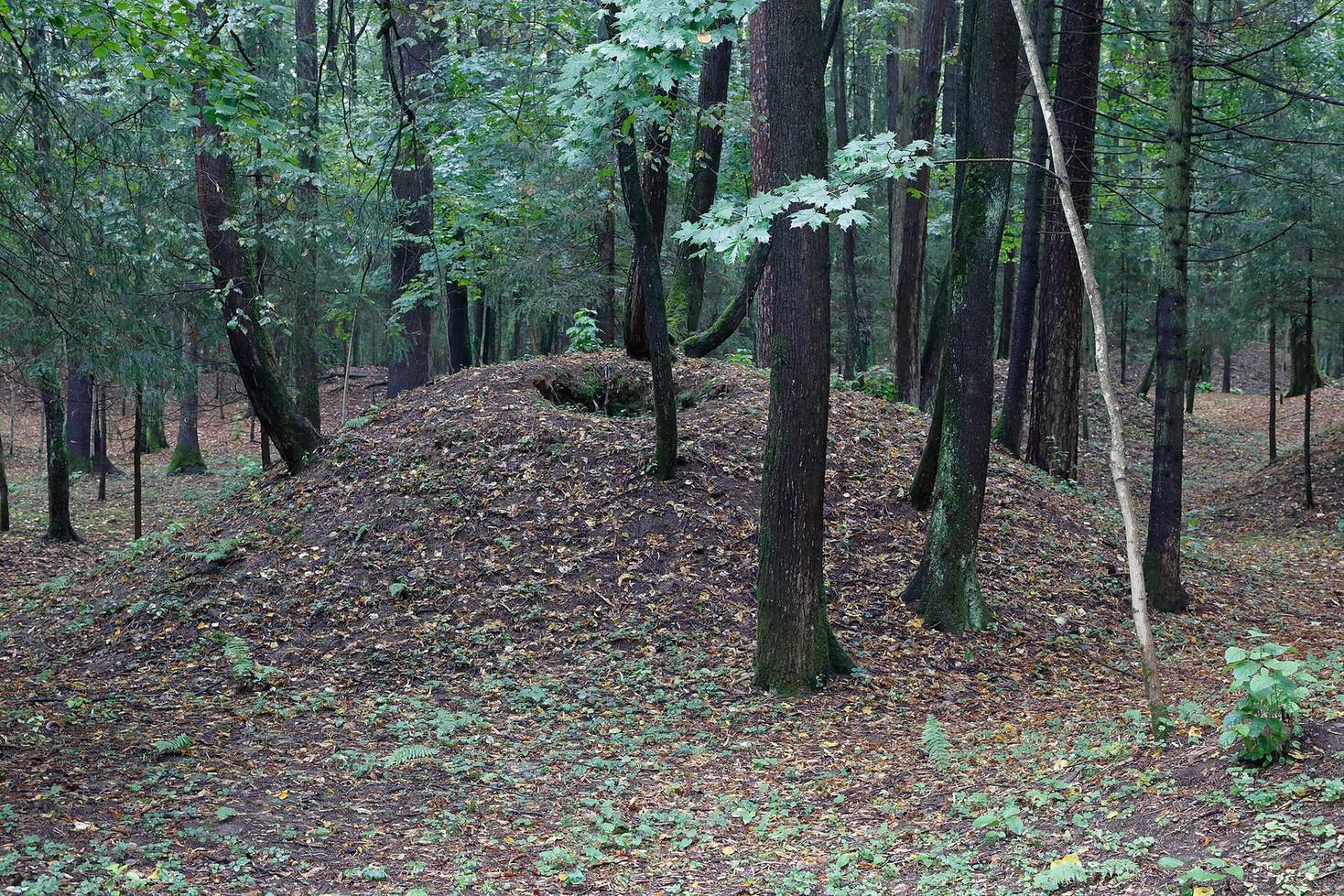
The mounds are generally hemispherical or segment-shaped, measuring 5–15 metres across and 0.5–2.5 metres high. Ring-shaped or semicircular ditches surround some, sometimes with small earthen causeways. In the burial method described at the site, people cleared the ground with fire, placed the deceased on its surface, and dug a ditch around the burial. They used the excavated earth to build the mound.
Burials and grave goods
Burial practices
A mound usually covered one person, though some contained two or more. Burials included uncremated bodies placed on the ground surface, as well as burials associated with cremated remains. Ceramic vessels or fragments occur frequently in early burials, while grave goods become rare in later mounds.
Objects and burial customs
Men’s graves could contain belt fittings and, occasionally, bronze or copper finger rings; women’s graves could include jewelry and metal parts of headdresses. Small iron knives occur in both. Other unusual evidence includes large quantities of pottery broken during burial, tools and interior fittings, and items associated with women placed in men’s graves. Slavic ornaments include temple rings, worn at the temples and associated with the medieval East Slavic groupings known as the Vyatichi and Krivichi.
Odintsovo-VI
Setting and mound forms
The largest group, Odintsovo-VI, occupies a projecting point of land on the Samynka River at the mouth of a ravine. Before excavation, it contained 101 mounds, some damaged. Their shapes included segments, hemispheres, regular and truncated cones, half-ovals, and more complex forms made of joined mounds. They measured 3.4–14.5 metres across and 0.3–2.6 metres high.
Excavated burials and objects
Excavations examined 24 mounds over several field seasons. Male and female burials were uncremated bodies laid on the ground surface, oriented west, northwest, or northeast. Some contained grave goods and others did not; ceramic vessels or fragments were frequent. Finds included seven-lobed temple rings, one made with latticework and another bearing an incised diamond on a lobe, as well as beads, neck rings, bracelets, finger rings, iron knives, a cylindrical lock fragment, a staple, belt buckles and rings, slate spindle whorls used in hand spinning, a whetstone, a stone pestle, and a wooden spoon. The collection was transferred to the Museum of Moscow for safekeeping.
Odintsovo-VII
Some Odintsovo-VII mounds are truncated cones with flat tops. The group also contains rare structures formed from several joined mounds. Excavation found a burial only beneath the central mound; adjoining mounds had been added using the same construction method. This form is distinctive within the Odintsovo complex.
Odintsovo-XI
Odintsovo-XI consists of six mounds: five hemispherical examples with ditches at their bases and one irregular mound made from several joined mounds. Some have been damaged by looting.