Krutitsy: A Historic Orthodox Church Compound in Moscow
Site at a Glance
- Popularity
- Very High
- Country
- Russia
- Primary era
- Early Modern
- Eras represented
- Early Modern, Modern
- Civilizations
- Russian
- Site type
- Religious
- Remains
- Monastery
On this page11 sections
History
Medieval foundation and episcopal center
Krutitsy is a historic Russian Orthodox church compound in Moscow, Russia, founded as a monastery in 1262. Its history is closely linked to the Diocese of Sarai, established in 1261 to serve Orthodox Christians in the Golden Horde, a Mongol-ruled state. The diocese’s capital, Sarai, included Slavic residents among its Christian communities. Its bishops bore the title of Sarai and Don, connecting the Russian Church with people beyond its own borders. Some clergy also hoped that missions to the Mongols might extend Muscovite influence.
Two traditions associate the monastery’s foundation with plans for a church and a bishop’s residence. One says Prince Daniel of Moscow considered building a residence at Krutitsy, but founded a monastery after an ascetic urged him to provide a church and a bishop’s seat. Another links the monastery’s establishment to the arrival of the Sarai bishops and Varlaam the Greek. The first church was completed in 1272.
Varlaam settled at Krutitsy around the turn of the thirteenth and fourteenth centuries and became its first bishop. After his death, the monastery served as a Moscow residence for the bishops of Sarai. By the fourteenth century it had become the center of the Sarai and Don bishopric, whose leaders later became known as bishops of Krutitsy. Grand Prince Ivan II Ivanovich and Prince Dmitry Donskoy each left endowments to the church, in 1356 and 1371 respectively.
As the Golden Horde declined, Bishop Vassian moved from Sarai-Batu to Krutitsy in 1454. The diocese had acquired lands in the Lower Volga and Don regions by 1492. By the late sixteenth century its bishops held the rank of metropolitan, a senior position in the Orthodox Church, and served as influential assistants to the head of the Moscow Church. The Krutitsy bishop also had a separate residence in the Kremlin for stays there. A record from 1610 notes his duty to conduct Sunday services in the Kremlin’s Dormition Cathedral.
Seventeenth-century growth
In July 1612, Kuzma Minin and Dmitry Pozharsky, leaders of the Second Militia, prayed and swore an oath at Krutitsy to free Moscow from foreign forces. The militia was organized to resist occupation during the Time of Troubles, a period of political and dynastic crisis in early seventeenth-century Russia. With the Kremlin’s Dormition Cathedral occupied, the cathedral at Krutitsy temporarily became a particularly important religious center in Russia. Polish mercenaries plundered the compound that year, but a period of renewed prosperity followed.
From the 1650s, Krutitsy was a favored residence for patriarchs and a center for translating Scripture from Greek into Church Slavonic. Its underground rooms also served as prisons. In 1666, the priest Avvakum was held there. Krutitsy was also the setting for disputes between Patriarch Nikon and Old Believers, who retained religious practices rejected by reforms in the Russian Church; some Old Believers were imprisoned at the compound.
The complex expanded under Metropolitan Paul III, who founded a monastic library and directed an extensive building program. By the end of the seventeenth century, much of the architectural ensemble was complete. The grounds included an early decorative garden and Moscow’s first fountain. Paul’s holdings included settlements at Dubrovka, Arbatets, Krutitskaya, and Kalitniki, as well as the village of Kozhukhovo.
Military occupation and nineteenth-century recovery
After Peter I abolished the patriarchate in 1721 and placed church administration under state control, most Krutitsy metropolitans were reduced in rank to bishops. Ignati Smola was an exception, holding metropolitan rank from 1719 to 1722. A major fire in 1737 damaged the compound and destroyed much of its church and service buildings. A theological seminary operated there from 1744 to 1751, before moving to the Intercession Monastery. The Diocese of Sarai and Don was abolished in 1764, and the Krutitsy diocese ended in the 1780s.
In 1788, the compound passed to the military. Church property and diocesan records were transferred to Chudov Monastery in the Kremlin, while many deteriorated buildings were demolished and others incorporated into barracks and gendarme facilities. Alexander Herzen spent seven months in a military guardhouse at Krutitsy at age twenty-two, before his exile to Vyatka. Military use continued for much of the following period. The separate episcopal residence in the Kremlin was abolished in 1770 in connection with a proposed palace project, and its buildings were dismantled in 1776.
Krutitsy suffered further damage during the French invasion of 1812. The Resurrection Church lost its ceilings and decoration, though some ceiling paintings survived, and fire damaged the Dormition Cathedral. In 1816, Moscow’s military governor, Alexander Tormasov, ordered the Resurrection Church demolished. Archbishop Augustine appealed for its preservation through Prince Alexander Golitsyn, and Emperor Alexander I stopped the demolition. The cathedral received a new roof in 1817, and its upper church reopened in 1823. After the future Alexander II visited in 1838, he ordered the Resurrection Church restored. Architects Evgraf Tyurin and Konstantin Thon prepared successive restoration plans, and rebuilding continued into the later nineteenth century.
Military authorities retained much of the land and the Riverside Chambers, while warehouses and barracks surrounded the older compound. Moscow’s city government ordered restoration of the Teremok in 1868. The Dormition Church was restored in 1899, and the lower Church of Peter and Paul was repainted. A 1904 plan to restore the metropolitan’s palace was not carried out for lack of funds, and the buildings remained in poor overall condition into the twentieth century.
Revolution and restoration
After the 1917 Revolution, the churches were looted and their wall paintings covered. Services in the Dormition Cathedral ended in 1924, and worship had ceased throughout the compound by 1925. The cathedral was put to communal housing for the Moscow Military District; from 1936 to 1938, the Resurrection Church was converted into residential barracks. The old cemetery was levelled and turned into a football field. The Diocese of Krutitsy was re-established in 1920 and merged with the Diocese of Kolomna in 1947.
A restoration plan was prepared in 1947 under the direction of Pyotr Baranovsky, who arranged for crosses to be placed again on the Dormition Cathedral’s domes. Work continued through the 1960s, 1970s, and 1980s. The cathedral passed to the Society for the Protection of Monuments in 1964 and later served as a philatelic department and cultural center. Experimental restoration workshops occupied it in the 1980s. From 1982, part of the compound was leased to the State Historical Museum; the cathedral’s two churches were used for storage, and some rooms became exhibition spaces.
Krutitsy was listed as a historic monument in 1966 and is designated a cultural heritage site of federal significance. Military use persisted in parts of the compound, including a garrison guardhouse that remained until early 1996. Between 1991 and 1996, the buildings gradually returned to the Russian Orthodox Church, and Krutitsy became the Patriarch of Moscow and All Russia’s metochion, an ecclesiastical compound belonging to a larger church institution. A service in the Resurrection Church in 1992 was its first since 1924. Since 2001, the buildings have housed the Church’s Synodal Department for Youth.
Remains
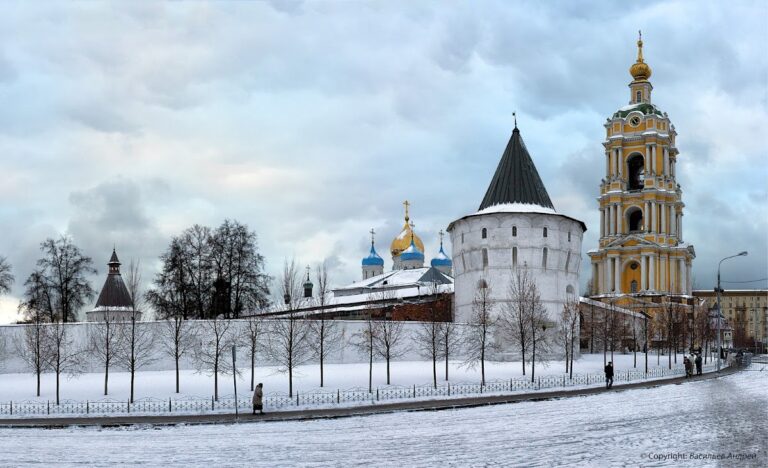
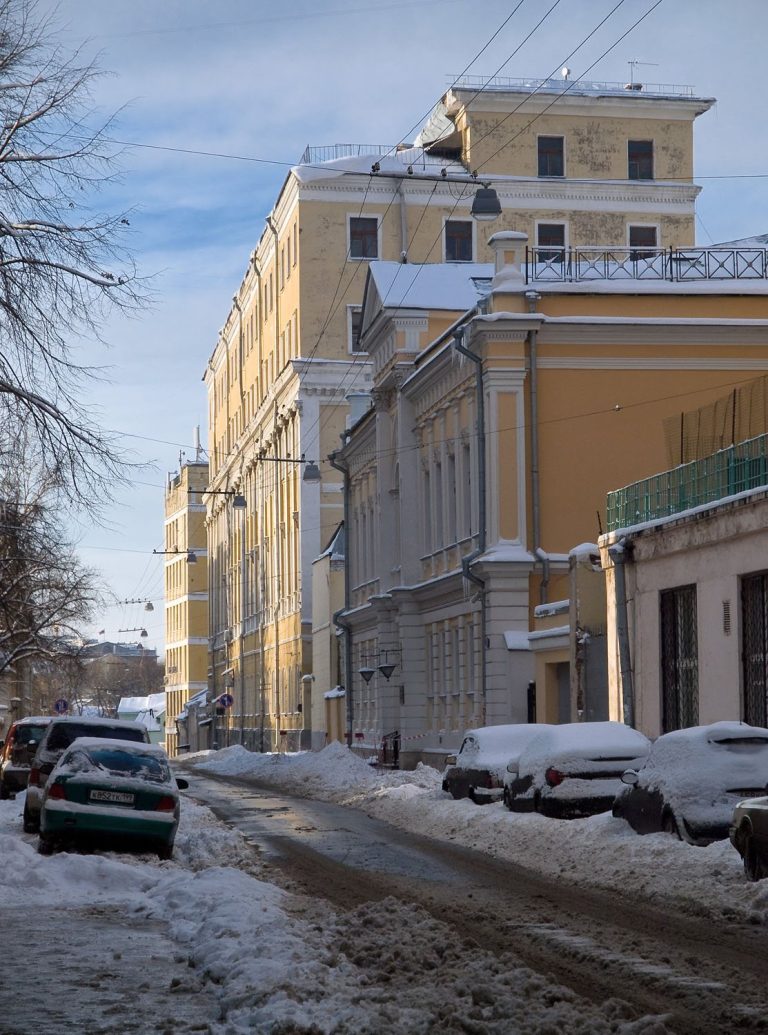
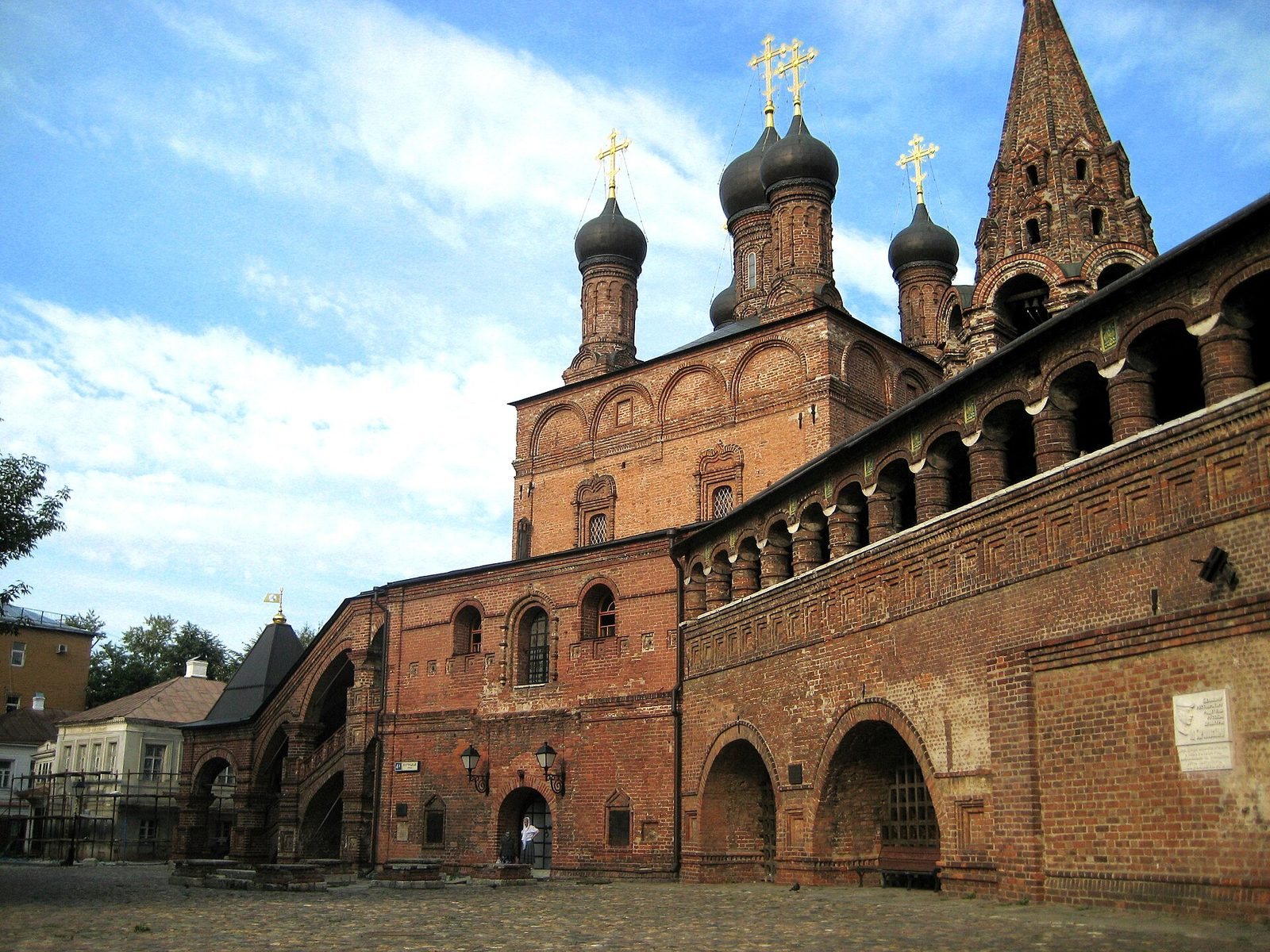
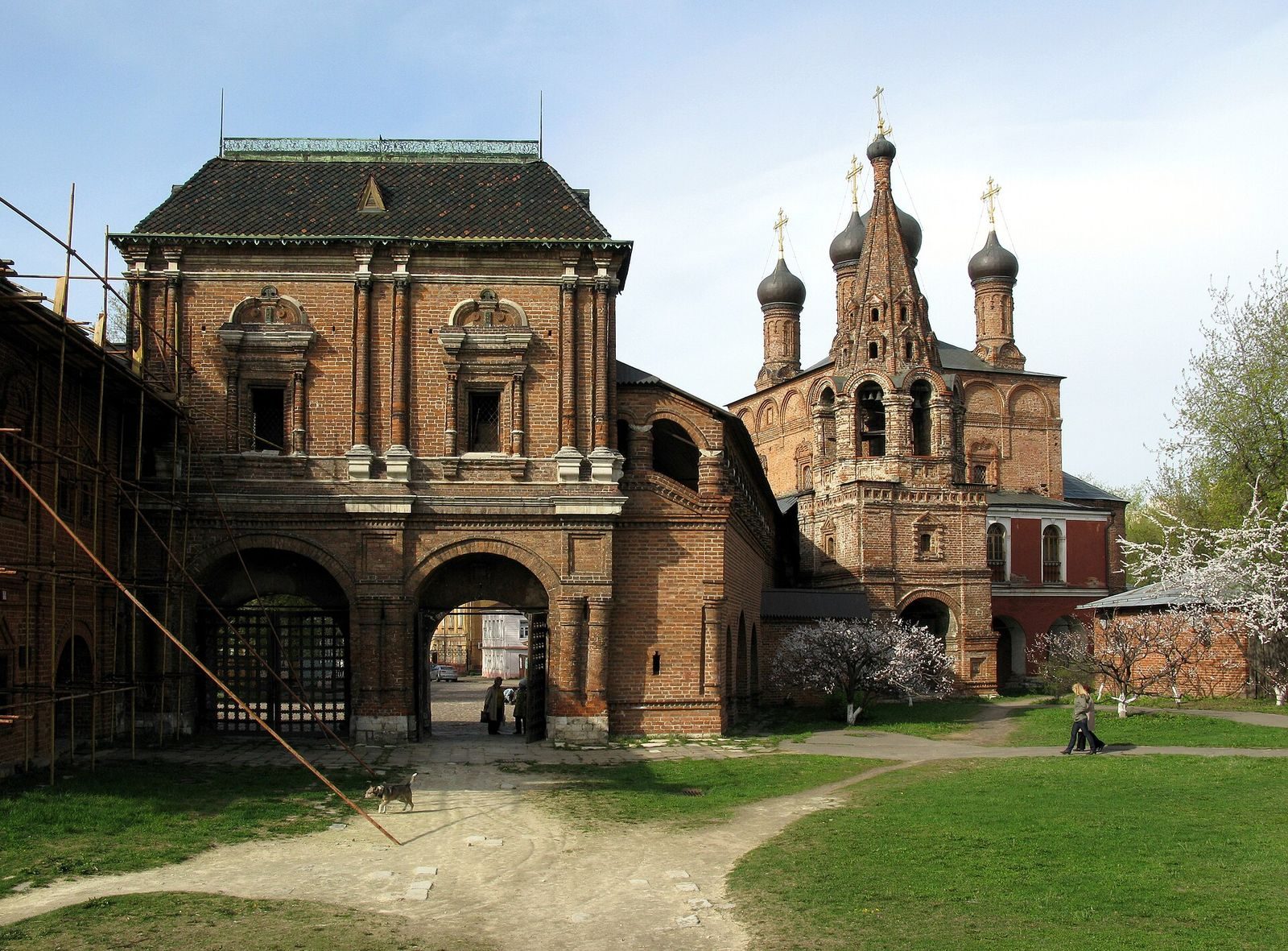
Krutitsy occupies elevated ground on the left bank of the Moskva River, below the mouth of the Yauza. Its name refers to the steep, raised riverbanks. The compound includes a two-level cathedral, the metropolitan’s chambers and offices, a church, an entrance tower, and a gallery and passages linking the chambers with the cathedral.
Dormition Cathedral
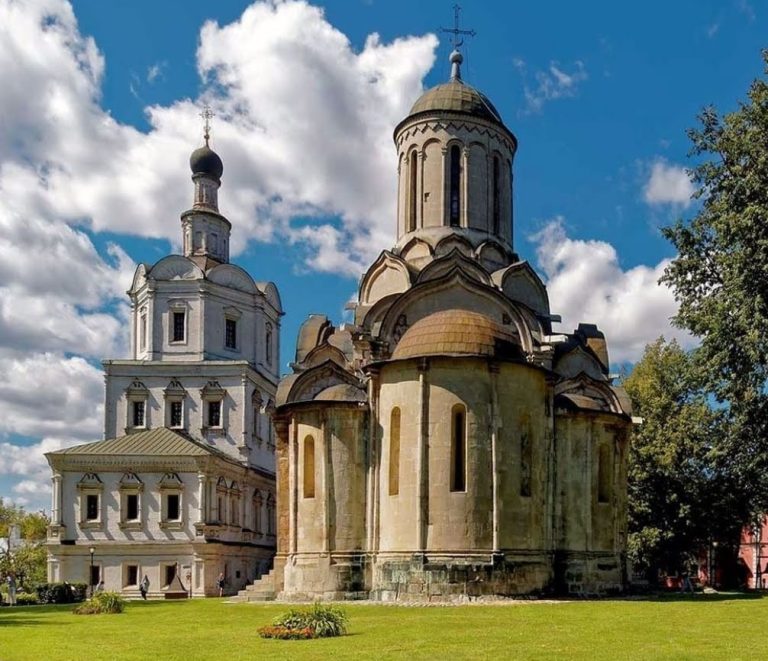
The brick Dormition Cathedral has two churches: the lower winter Church of Peter and Paul, completed between 1667 and 1689, and the upper summer Church of the Dormition, completed in 1700. The five-domed building rises 29 metres from ground level to the base of a cross. Its bell tower has a steep, tapering roof, and a chapel dedicated to Sergius of Radonezh dates to the nineteenth century.
Metropolitan’s chambers and offices
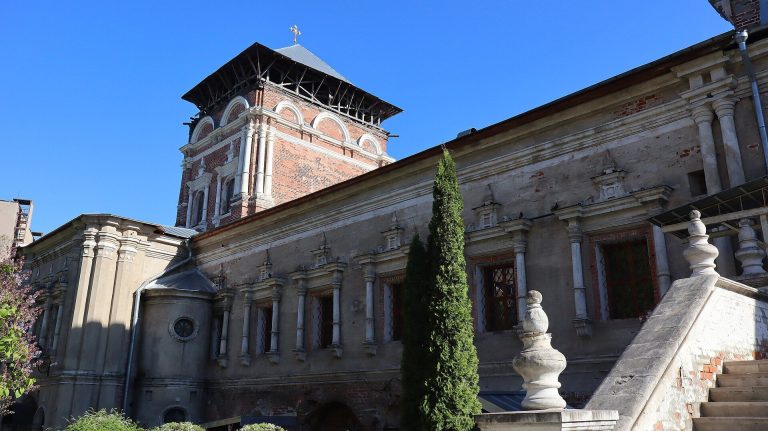
The Metropolitan’s Chambers, also called the Palace of the Krutitsy Metropolitans, date to 1655–1670. The building that housed the metropolitan’s administrative offices was constructed in the second half of the seventeenth century.
Resurrection Church
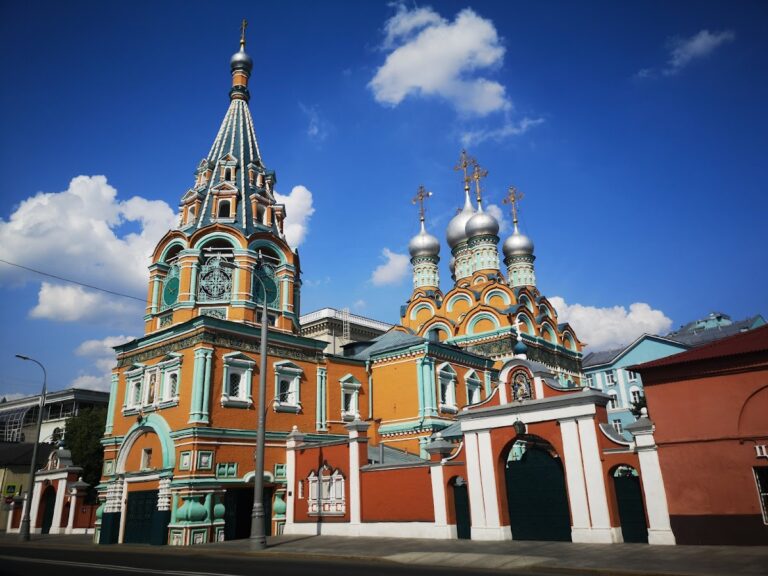
The Resurrection Church, also known as the Cross Chamber or the Church of the Ascension, was completed in the 1650s on foundations dating to the early sixteenth century. Its apse, the rounded sanctuary end, and its lower level were restored during the twentieth century.
Entrance tower and gallery
The Teremok tower stands above the entrance gates. The late-seventeenth-century Resurrection Gallery and passages connect the chambers with the cathedral. The tower and connecting structures are decorated with multicolored glazed tiles attributed to tile-maker Stepan Polubes. Architects Osip Startsev and Illarion Kovalyov are associated with their design.
Riverside and street-side buildings
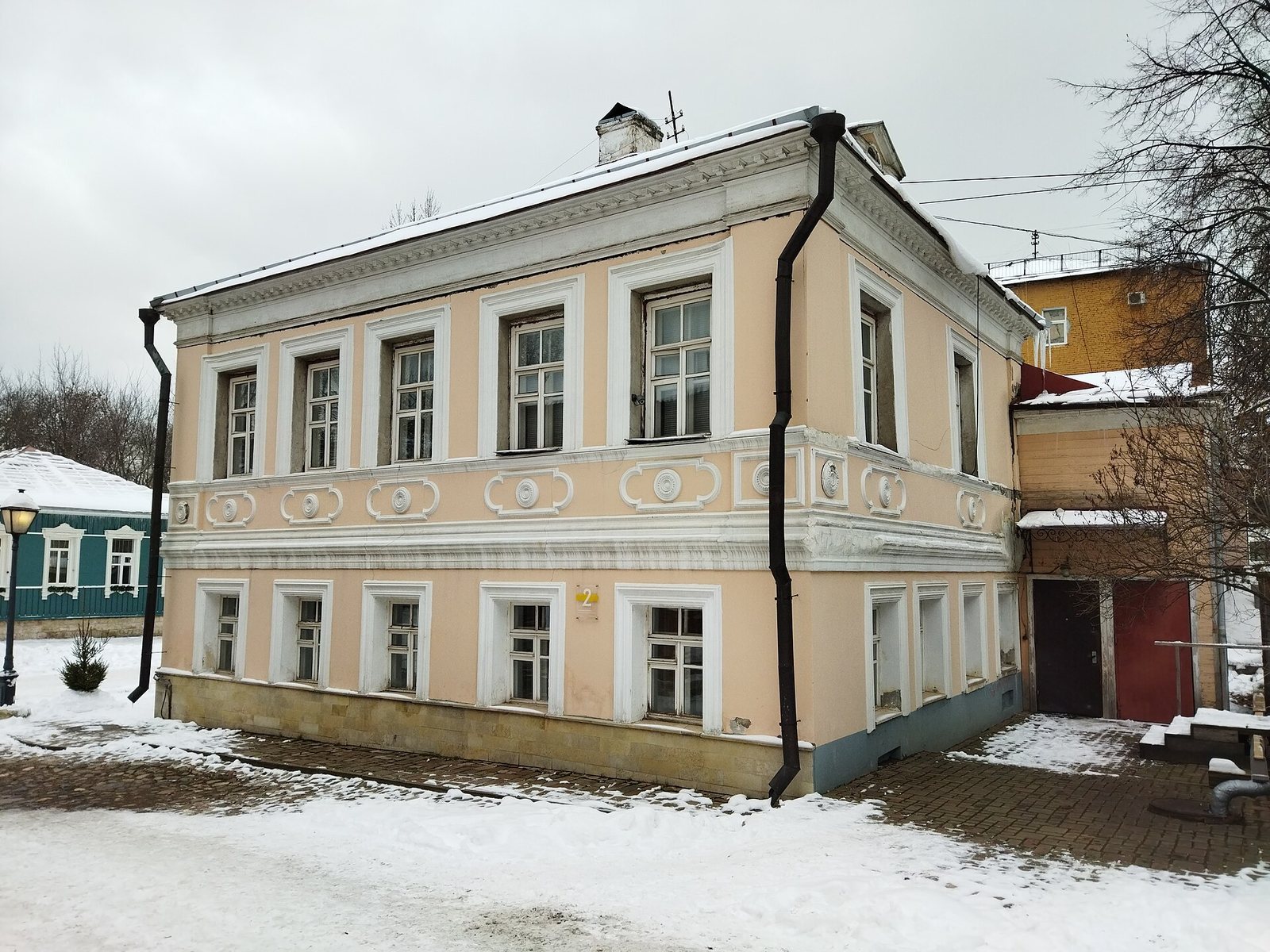
The Riverside Chambers date to 1719. Along Krutitskaya Street, a row of nineteenth-century wooden houses includes numbers 6, 8, 11, and 13. House number 4 is a two-storey building from the same century.