Nousiainen Church: A Medieval Parish Church and Saint Henry’s Burial Site in Finland
Site at a Glance
- Rating
- 4.5
- Popularity
- Very Low
- Country
- Finland
- Primary era
- Medieval
- External website
- Open
- Eras represented
- Medieval, Early Modern, Modern
- Civilizations
- Grand Duchy of Finland, Russian, Swedish
- Site type
- Religious
- Remains
- Church
On this page13 sections
History
Nousiainen Church is a medieval stone church in Finland and the parish church of the Evangelical Lutheran parish of Nousiainen. Probably built in the 1420s, or at the latest in the 1430s, it belongs to the Archdiocese of Turku and stands within the history of Finland’s early Christianization.
Early Christian center
During the Middle Ages, Nousiainen was a center of Finland’s Christianization and the country’s first episcopal see, the seat of a bishop. Following the Finnish crusade traditionally associated with the Swedish king Erik IX, probably undertaken in 1155, 1157, or 1158, Henry of Uppsala served there as Finland’s first bishop. Saint Henry was a Christian bishop later venerated as a saint.
Henry was violently killed during the following winter and buried at Nousiainen. The bishopric moved to Koroinen near Turku in 1229, leaving the church as an ordinary parish church. Henry’s burial place probably continued to give it exceptional religious importance. The church is first documented in 1232.
From wooden predecessors to the stone church
Tradition holds that a wooden church stood at Nousiainen during Henry’s lifetime. Excavations at the present stone church, however, have produced their oldest finds from the early fourteenth century, so it remains uncertain whether Henry’s church occupied the same site. The present building is nevertheless considered likely to have replaced several successive wooden churches.
The stone church was erected during the major expansion of church construction on mainland Finland. A foundation date of 1430 is also given. After Turku Cathedral, it is probably the second-oldest church on the Finnish mainland, although several older churches survive in the Åland Islands.
Later changes and protection
Most of the church’s original historical fabric has survived. The principal later alteration was Saint Henry’s burial chapel, built on the south side of the choir in 1901 to a design by Josef Stenbäck. An eighteenth-century free-standing bell tower was built south of the church under the direction of Matias Leidenius of Turku.
Nousiainen Church is protected under Finland’s Church Act. Its historical importance is also reflected in its inclusion in Finland’s register of nationally significant cultural landscapes and in the Finnish Museums Agency’s register of protected buildings.
Remains
Setting and building plan
Church and cemetery
The church stands beside the Hirvijoki River, about three kilometres northeast of the center of Nousiainen, within a cultural landscape in southwestern Finland. A small walled cemetery surrounds the building, while the parish house, constructed in 1890, stands on the opposite bank of the river.
Nave, choir, and entrances
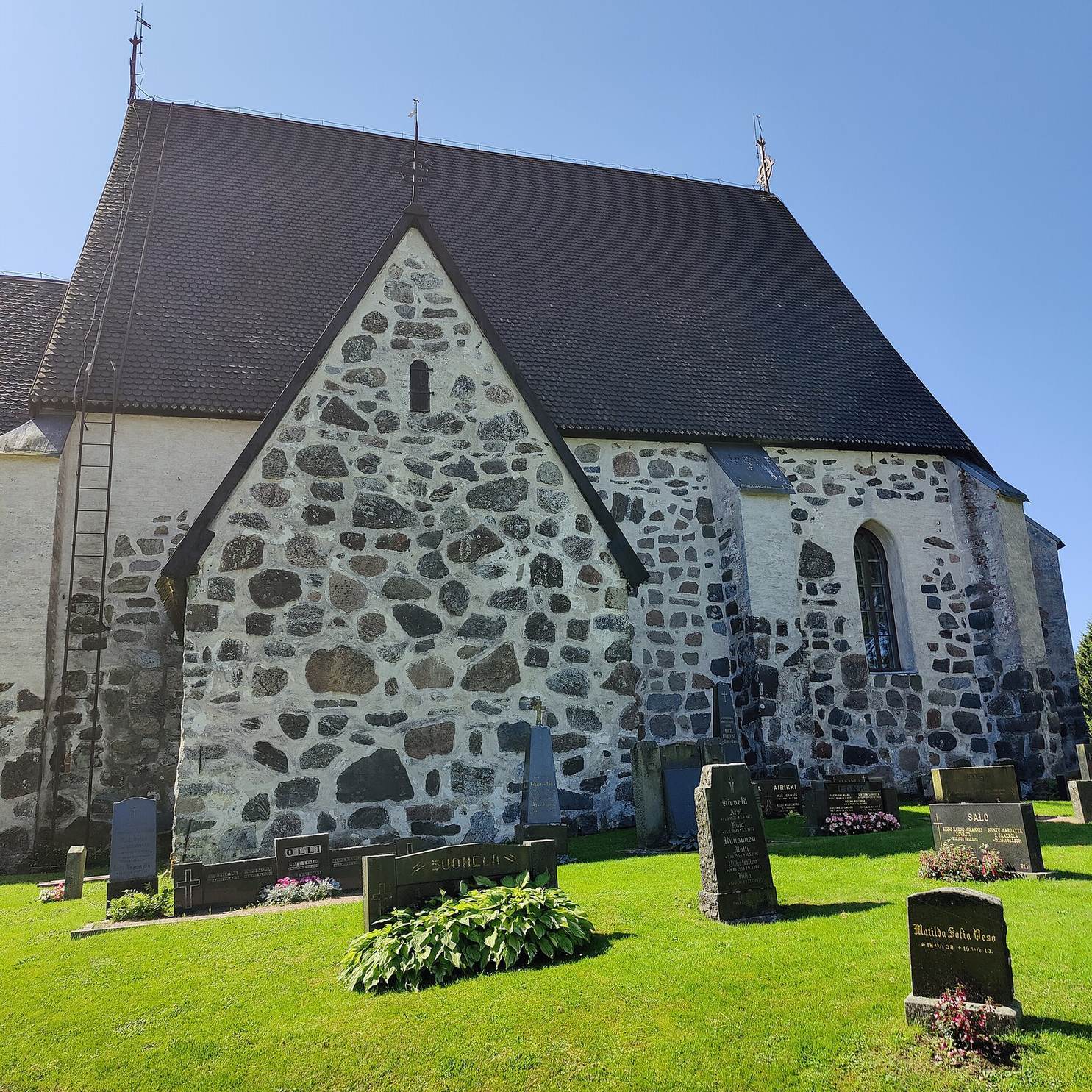
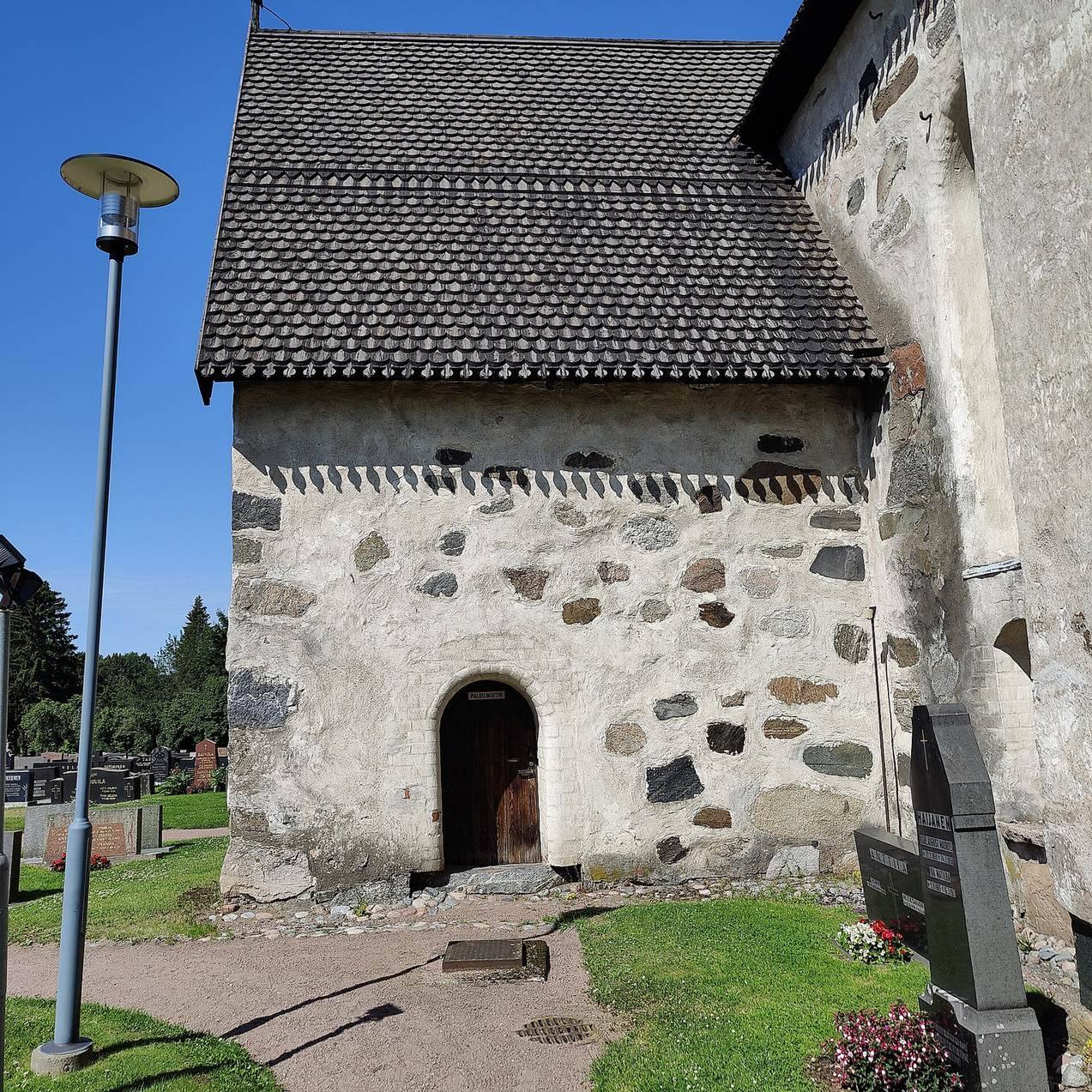
The east-oriented church is built of fieldstone. Its nave measures approximately 26.5 by 15.2 metres and has an unusual plan. The west end has a three-sided termination, while the narrower eastern choir is five-sided and measures about 9.5 by 8.3 metres. A sacristy, a room for storing liturgical objects and preparing for worship, is attached to the north side. On the south side is an armory, an entrance porch in medieval Finnish church architecture, which contains the main entrance.
The armory has doors in both its eastern and western walls. An external preaching balcony is connected to a window in its south wall. The church has no attached tower, and its steep roof is covered with shingles.
Burial chapel and bell tower
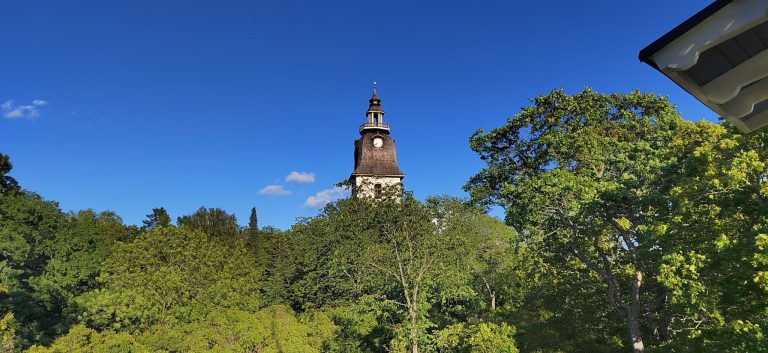
Saint Henry’s burial chapel is attached to the south side of the choir. Its five-sided form imitates the shape of the choir. The separate bell tower stands south of the church and dates from the eighteenth century.
Interior and furnishings
Vaults and wall paintings
Four pairs of pillars divide the nave into three aisles. The central aisle is twice as wide as the two side aisles. The upper sections of the walls contain an unusually large amount of brick, which is also used in the choir windows and the south portal. Simple cross vaults cover the interior. A cross vault is formed by the intersection of two barrel vaults. The vaults are decorated with plain wall paintings that are probably original to the medieval church.
The paintings were covered with whitewash at the end of the eighteenth century and completely uncovered again in 1936. The doors and window openings retain their original forms, while most of the nave’s other interior decoration is modern.
Saint Henry’s sarcophagus
The principal furnishing is Saint Henry’s sarcophagus, a stone coffin or monumental container for human remains, placed in the central aisle. Bishop Maunu II Tavast donated it in 1429, and it was installed in the church after that date. Made of black limestone probably imported from Belgium, it is covered with brass plates engraved with an image of Henry and scenes of his life, martyrdom, and alleged posthumous miracles.
The sarcophagus was moved to the newly built burial chapel in 1901 and returned to the central aisle in 1968. Henry’s remains are no longer inside it and were probably transferred in several stages as relics to Turku Cathedral.
Medieval carvings and pulpit
Fourteen medieval wooden carvings survive from the church’s furnishings. Those still in the building include an early fifteenth-century sculpture of Saint Henry, a triumphal cross, and a sculpture of Saint Sebastian dating from around 1500. A triumphal cross is a large cross traditionally placed near the boundary between a church’s nave and chancel. The other carvings are preserved in the Finnish National Museum. The pulpit dates from 1640.