Notre-Dame des Cyclistes: A Romanesque Chapel and National Cycling Sanctuary in France


Site at a Glance
- Rating
- 4.3
- Popularity
- Low
- Country
- France
- Primary era
- Medieval
- External website
- Open
- Eras represented
- Medieval
- Civilizations
- Unclassified
- Site type
- Religious
- Remains
- Chapel
On this page9 sections
History
Notre-Dame des Cyclistes is a Roman Catholic chapel in France, at the Géou hamlet near Labastide-d’Armagnac, built in the late eleventh century in the Romanesque style. It stands on the site of a Gallo-Roman villa rustica, a rural estate of the Late Empire, and is the surviving part of a medieval fortress complex.
Medieval origins and destruction
Around 1270, the building became a parish church dedicated to Saint-Clair. It was also associated with the Knights Templar, a medieval Catholic military-religious order founded to protect pilgrims and defend the Crusader states. The surrounding Château de Géou included a belt of walls and towers, while the chapel formed the part of the complex that later survived.
In 1355, during the Hundred Years’ War, Edward of Woodstock, known as the Black Prince, destroyed the Château de Géou. Edward was the eldest son of King Edward III of England and a leading English commander in the conflict. The chapel subsequently endured a long period of abandonment.
Restoration as a cycling sanctuary
The building was restored and rededicated as Notre-Dame des Cyclistes on 18 May 1959. The initiative came from Father Joseph Massie, then pastor of Créon-d’Armagnac, Mauvezin-d’Armagnac, and Lagrange. On 22 August 1958, heavy rain prevented a planned Mass elsewhere, so Massie celebrated it at the little-used chapel and proposed creating a cyclists’ chapel inspired by Madonna del Ghisallo, a Catholic sanctuary near Lake Como in Italy that Pope Pius XII had dedicated to cycling in 1948.
Massie had visited Madonna del Ghisallo to bring back its consecrated flame. In 1958, he returned with companions after a 1,500-kilometre bicycle journey across the Alps by way of the Col de Tende. His reputation as a cyclist was also connected with an earlier ascent of the Tourmalet while wearing a cassock. Pope John XXIII, head of the Catholic Church from 1958 to 1963, authorized the chapel’s designation as the National Sanctuary of Cycling and Cyclists under the protection of the Virgin Mary, with support from the bishop of Aire and Dax.
The chapel holds a Mass for cyclists every Whit Monday. It became a national pilgrimage destination for cyclists and also developed a museum function. The Tour de France visited in 1984, 1989, 1995, 2000, 2017, and 2023. The 1989 stage began at Labastide-d’Armagnac on 9 July, while the 2023 visit occurred during Stage 4 from Dax to Nogaro. Earlier visits were linked to the chapel’s anniversary in 1984, a tribute to Luis Ocaña in 1995, and a tribute to Father Massie in 2000.
Luis Ocaña, winner of the 1973 Tour de France, settled in the Armagnac region and maintained a close relationship with the chapel. He married there, and a funeral service was held there after his death in 1994. The chapel and its surroundings were registered as a picturesque site covering 2.4 hectares by ministerial order on 26 March 1980. The chapel itself was listed as a monument historique, a formal French heritage designation protecting a building or site of recognized historical or architectural importance, on 27 February 1996.
Remains
Chapel and former fortress site
The chapel stands approximately two kilometres southeast of Labastide-d’Armagnac at the Géou hamlet. Its Romanesque form, characterized by robust masonry, rounded arches, and heavy structural forms, represents the surviving element of the former fortress. The wider complex was once enclosed by walls and towers, but the chapel is the part of that medieval arrangement that remains.
Entrance and exterior memorials
The entrance is closed by a wrought-iron gate shaped as two high-wheel bicycles. In front of the chapel, a statue of the Virgin Mary stands beside commemorative plaques for Luis Ocaña and André Darrigade. Darrigade, a rider from the region, became road-racing world champion in 1959.
Interior cycling collection
The interior walls are hung with hundreds of cycling jerseys donated by riders from around the world. The display includes original yellow jerseys from the Tour de France, whose yellow jersey identifies the race’s overall leader. Jerseys associated with André Darrigade, Jacques Anquetil, Louison Bobet, Roger Lapébie, Tom Simpson, Jean Stablinski, Bernard Hinault, Raymond Poulidor, Eddy Merckx, and Luis Ocaña are among the items shown. Lance Armstrong’s jersey was removed on 26 October 2012 after the Union Cycliste Internationale withdrew his titles.
Historic bicycles are displayed in the entrance area, reinforcing the chapel’s role as a cycling museum. The collection also includes the bicycle used in Les Cracks, a French film directed by Alex Joffé in 1968.
Stained-glass windows
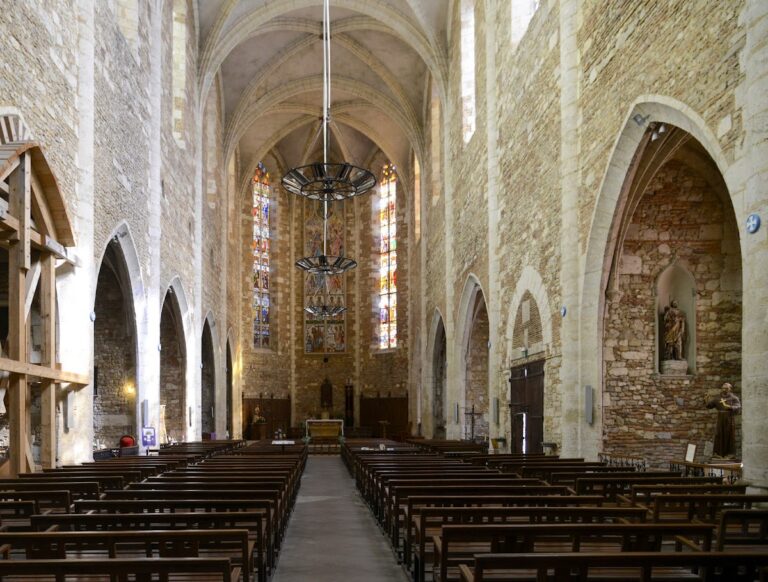
The chapel’s stained-glass windows were designed and made by Henri Anglade, a former Tour de France rider. Their imagery combines Marian devotion with scenes from cycling history. One window presents the Virgin Mary, while others draw on celebrated Tour de France photographs.
Scenes from the Tour de France
The windows depict Fausto Coppi and Gino Bartali sharing a water bottle during the 1952 Tour, Raymond Poulidor competing against Jacques Anquetil on the Puy de Dôme during the 1964 Tour, and a priest giving Henri Anglade a drink during the 1958 Tour. Another window shows Luis Ocaña during his victorious 1973 Tour de France. The Coppi and Bartali scene has been associated with a symbolic easing of their intense rivalry, although that intended meaning remains uncertain.