Notmark Church: A Romanesque Parish Church on Als


Site at a Glance
- Rating
- 4.7
- Popularity
- Very Low
- Country
- Denmark
- Primary era
- Medieval
- External website
- Open
- Eras represented
- Medieval, Early Modern, Modern
- Civilizations
- Danish, German
- Site type
- Religious
- Remains
- Fortified Church
On this page12 sections
History
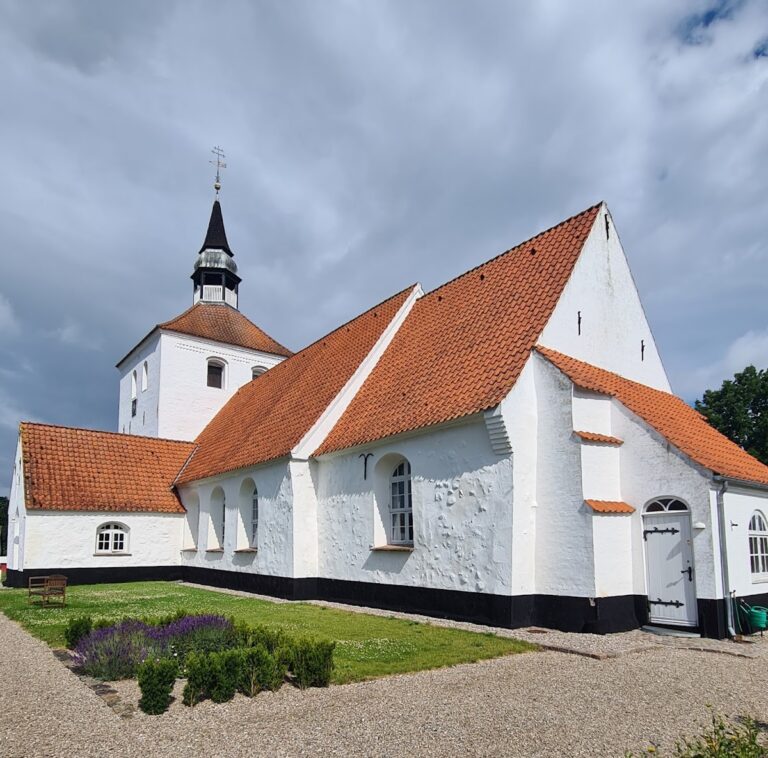
Notmark Church is an Evangelical Lutheran parish church in Denmark, built around 1200 with a Romanesque core. Dedicated to the Virgin Mary, it serves the parish of Notmark on the island of Als, including Almsted, Anholt, Fynshav, Helved, Hundslev, Katry, Padholm, and Skærtoft, within the Danish National Church and the Diocese of Haderslev.
Medieval foundation and defensive role
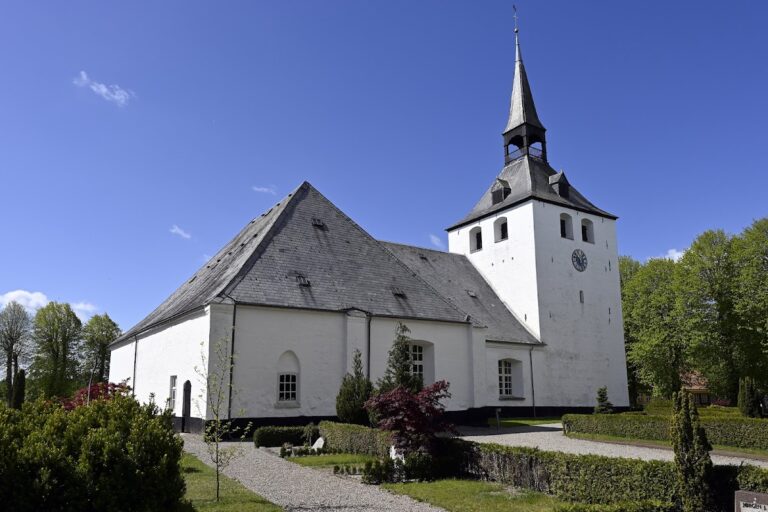
The nave and chancel belong to the church’s original medieval building phase. The massive west tower was probably added partly because of pirate raids by pagan Wends. Such attacks are recorded on Als in 1168 and may have occurred more often than the surviving evidence indicates. The tower served as a defensive refuge and probably also as a granary, giving the church a role beyond worship.
Notmark’s medieval priests included Henrik Lunor, named in 1341, Dithbor Jørgensen, recorded in 1419 and 1424, and Mads Jensen, also called Matthias Johannis. Mads Jensen was simultaneously provost of Als in 1512. His son Hans Matthiesen later became the first Lutheran pastor of Havnbjerg, serving approximately from 1533 to 1566.
The Reformation and the Cruckow pastorate
Local tradition calls Notmark the first church on Als where the Reformation was preached. The Reformation was the sixteenth-century movement that challenged the authority and practices of the medieval Western Church and produced Lutheran and other Protestant churches. A 1690 report by Pastor Frederik Jørgensen Cruckow also described Notmark as the first church on Als to adopt the Lutheran faith, although the chronology is not straightforward. Jørgen Nielsen of Sønderborg, also known as Georgius Nicolai, served as the first Lutheran pastor from 1530 to 1546. Cruckow’s great-grandfather, Jørgen Cruckow the Elder, served from 1550 to 1606, so Frederik Cruckow may instead have meant that he was the first pastor at Notmark to receive specifically Lutheran training.
From 1550 to 1699, four successive generations of the Cruckow family held the pastorate. The last was Frederik Jørgensen Cruckow, also known as Crucovius, who served from 1682 to 1699. He began keeping the church registers in 1688 and commissioned the surviving timber-framed parsonage that same year. An inscription above its entrance, dated 20 June 1688, quotes Ecclesiastes 2:18–19. In 1690, Cruckow prepared a report for the Danish king about taxes paid by parish inhabitants.
Royal visit and parish traditions
King Frederick III visited Notmark Church on 9 September 1669, about six months before his death. The congregation showed him a communion chalice and paten that had apparently been looted during the Northern War of 1657–1660, when Brandenburg-Polish troops allied with Denmark, and later recovered. He was also shown the lost “murder knife” of Hans Tater, an Als robber chief captured and executed with his band in 1634.
During the visit, the congregation presented Frederick III with the fifteenth-century Notmark Manual, a liturgical parchment manuscript, and a roughly two-hundred-year-old German edition of King Valdemar’s law code. The manual is now held by the Royal Library. The silver communion chalice made in 1655 was probably the vessel shown to the king, although local tradition gives it another history. According to the legend, the Duke of Sønderborg threw the chalice over the churchyard wall to escape supernatural beings that could not enter consecrated ground.
Other stories concern the church’s foundation and early furnishings. One says that construction began at Katry, but that the day’s work was moved to Notmark each night. Another places the intended church on a field north of Notmark, formerly a pagan offering place associated with Thor, and interprets the nightly movement as a sign that a Christian church should not stand there. A further legend attributes the first bell to Thomas Sture, who supposedly donated it after a priest advised him that its Christian sound would drive away a mermaid.
Pastors and changing political identities
A second family succession lasted from 1749 to 1822 through the pastors With. Jørgen Petersen With, pastor from 1797 to 1822, owned a private pastoral library of about 1,000 volumes, one of the largest of its period. Sveno, or Svend, Laurentius Svensen served from 1822 to 1830 and died by suicide after severe family and domestic difficulties.
Jørgen Hansen, pastor from 1830 to 1845, was appointed by the Duke of Augustenborg, whose territory then included Notmark. Hansen opposed the duke’s extensive authority and supported the legal interests of the duke’s farmers. He also helped write an 1842 text advocating modernized church ritual in connection with Bishop Mynster’s reforms. His conflict with the duke led to his transfer to Egen in 1845.
Holger Christian Clausen Fangel, described as Danish-minded, served from 1848 to 1893. Waldemar Friedrich Carl August Augustiny, described as German-minded but loyal to his congregation, followed from 1893 to 1916. Ole Christian Jensen served from 1917 to 1935, during the period when Northern Schleswig became Danish again. Before his pastorate, Jensen worked as a missionary in India from 1906 to 1914, and he returned there from 1935 to 1946.
Alterations and modern preservation
The medieval altar retable was dismantled between 1849 and 1907. During those years, a copy of Eckersberg’s painting of Jesus praying in the Garden of Gethsemane served as the altarpiece; the original is in Havnbjerg Church. In 1907, Hans Hampke repainted the chancel murals in a way that altered their original character. The floral ornament and a Last Judgment scene were painted over in white in 1962, while the coats of arms of Thomas and Berta Sture in the chancel vault were retained.
The organ was modified and enlarged in 2009 on the initiative of organist Lars Bruun Nielsen. The work was again carried out by Marcussen & Søn after approval by the parish council, the provost’s office, the National Museum, and the responsible organ specialist. The churchyard’s western memorial wall was erected in 1921–1922 for the 41 people from the parish who died in the First World War.
Remains
Romanesque church and tower
The church is organized around a Romanesque nave and chancel built from fieldstone around 1200. Romanesque architecture is characterized by heavy walls, rounded arches, sturdy proportions, and relatively small openings. Painted consecration crosses, marks associated with the medieval dedication of a church, remain visible on the south wall of the nave and the north wall of the chancel.
The late-Romanesque west tower is built in two principal materials. Its lowest level uses fieldstone, while the upper sections are brick. Just under 13 metres wide, the massive tower is regarded as probably the broadest church tower at a Danish village church. Its north and south gables belong to a sixteenth-century alteration, and four buttresses were added in 1884.
Chancel and later additions
The chancel was slightly raised and vaulted around 1450. It was extended after the death of the fief-holder Thomas Sture in 1563. A fief-holder held land or rights from a superior lord in return for obligations or service, and Sture was buried in a chamber beneath the altar. A late-Gothic porch stands on the south side of the church, while a northern side aisle was added in 1762. The chancel extension is joined by a sacristy dating from 1857.
The Romanesque granite baptismal font dates from the church’s construction period or may be older. Its surface carries a foliate scroll motif. The chancel also preserves wall paintings from 1564, including the surviving coats of arms of Thomas and Berta Sture in the vault. A crucifix from about 1525 hangs on the north wall of the chancel. The same wall carries a Baroque epitaph, or commemorative monument, from 1697 to Johan Franz von Aichelberg, whose painted scene represents the resurrection of the people of Israel from Ezekiel 37.
Altarpiece and memorial furnishings
The late-Gothic altar retable dates from approximately 1500–1525. A retable is a decorated altarpiece placed behind an altar. Its central section has three parts, with a figure of John the Baptist, a carved Coronation of Mary, and a bishop’s figure. The two wings contain figures of the twelve apostles. Its lower section, the predella, dates from 1847–1848.
The Renaissance pulpit was donated by Berta Sture, the widow of Thomas Sture, and was made by the same master as the pulpits in the churches of Ketting and Tandslet. Its four parapet panels show the coats of arms of Thomas and Berta Sture, a Crucifixion group, and a Resurrection scene. A stone epitaph to the couple, Thomas Sture, who died in 1563, and Berta, born Ahlefeldt, is mounted on the north wall of the side aisle.
Bells and organ
Two bells hang in the tower. The older one bears the year 1442 in Indian-Arabic numerals. The younger bell carries the inscription “Gloria in excelsis deo” and names Baltzer Melchior as its maker in 1652, together with Bishop Laurentius Johannis, Provost David Monrad, and Pastor Jørgen Cruckow. It was surrendered as a metal donation in 1918 but reached no farther than Sønderborg. The bell was found beside a road near the railway station in 1921 and rehung in the tower.
The first organ was reportedly acquired in 1515 and placed in the chancel above the altar. The present organ stands at the west end of the nave and retains a Baroque case dated 1769 in an oval acanthus frame above the central tower. The original maker of the case is unknown, although Johann Daniel Busch has been suggested. The case later held rebuilds by Jürgen Hinrichsen Angel in 1792, Peter Ulrik Frederik Demant in 1856, and Marcussen & Søn in 1972.
The present neobaroque Marcussen organ has two manuals and a pedal, with 13 stops. In 2009, its Mixture, a stop using several ranks of high-pitched pipes together, was given softer voicing without a change to its composition. A tremulant, which varies wind pressure regularly, was added to the swell organ, along with a French bassoon-oboe reed stop modeled on the bassoon-clarinet of the Marcussen organ at Christiansborg Palace. The couplers are II/I, I/P, and II/P, and the action is fully mechanical with slider chests.
Churchyard and parsonage
The churchyard surrounds the church. On its western side, a semicircular memorial wall from 1921–1922 carries an individual name plaque for each of the 41 parish dead from the First World War. At its centre, a two-metre-high erratic boulder bears a Danish inscription stating that the Notmark community erected the memorial for its sons who sacrificed their lives in the 1914–1918 war. The grave of dialect poet Martin N. Hansen lies on the north side of the churchyard.
The timber-framed parsonage commissioned in 1688 stands in association with the church. It is regarded as one of Denmark’s oldest and most beautiful parsonages. Its entrance preserves Frederik Cruckow’s Latin inscription dated 20 June 1688, quoting Ecclesiastes 2:18–19. In 2018, the building was one of 15 candidates in a national competition for Denmark’s most beautiful parsonage.
Nearby sites