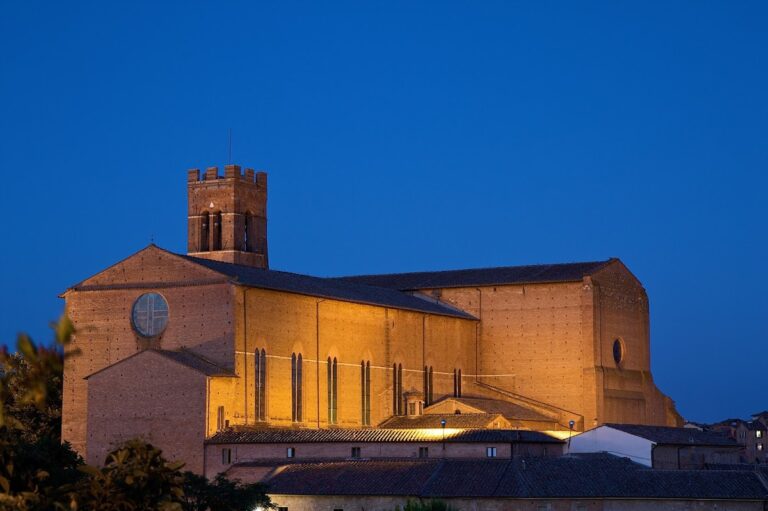
Basilica of San Francesco: A Franciscan Gothic Church in Siena


Site at a Glance
- Rating
- 4.7
- Popularity
- Very Low
- Country
- Italy
- Primary era
- Medieval
- Eras represented
- Medieval, Early Modern, Modern
- Civilizations
- Grand Duchy of Tuscany, Italian, Republic of Siena
- Site type
- Religious
- Remains
- Basilica
On this page18 sections
History
The Basilica of San Francesco is a Roman Catholic church in Siena, Italy, dedicated to Francis of Assisi and served by the Order of Friars Minor Conventual. Built for the Franciscan community, it developed from a small church founded between 1228 and 1255 into a much larger Gothic complex constructed between 1326 and 1475. Standing in Piazza San Francesco, it became one of Siena’s important churches and remains closely connected with the city’s religious history and ceremonial traditions.
Franciscan beginnings and medieval expansion
Franciscan friars reached Siena soon after Francis of Assisi died in 1226. A local tradition also associates Francis with the city in 1212, when he stayed at a chapel near Ravacciano and planted a tree. The chapel later became known as the Church of the Little Tree, and its friars sought a church dedicated to Francis. The first building on the present site was a small Franciscan church erected between 1228 and 1255.
The church was rebuilt on a far greater scale between 1326 and 1475, when the earlier Romanesque structure was transformed into a Gothic one. Agostino di Giovanni and Agnolo di Ventura are associated with the design, while Francesco di Giorgio Martini may have taken part in the fifteenth-century work. The church and convent were initially outside Siena’s walls. As the city expanded, successive lines of fortification enclosed them, and the final medieval enlargement of the walls around 1450 brought the complex within the urban perimeter.
In 1425, the Franciscan Bernardino of Siena preached before the church. Bernardino was a fifteenth-century Franciscan preacher and reformer, and his appearance reflects the basilica’s role in the religious life of the expanding city. The convent itself was erected in the fifteenth century and enlarged in 1518.
Fire, rebuilding, and modern transformation
A major fire in 1655 severely damaged the church. For more than two centuries the building remained in poor condition, while repairs and Baroque additions were introduced without being fully integrated with the medieval structure. Many of those later furnishings were eventually removed during a comprehensive restoration and remodelling campaign.
Major work began in the late nineteenth century. Giuseppe Partini directed the interior restoration between 1885 and 1892, and Vittorio Mariani and Gaetano Ceccarelli designed a new facade between 1894 and 1913 in the Neo-Gothic style then favoured for the building. The campaign radically changed the church’s appearance and removed much of its Baroque furnishing, although some paintings from dismantled altars were later returned. The present campanile, or bell tower, was built between 1763 and 1765 to designs by Paolo Posi, with Filippo Francini also associated with its construction.
The suppression of religious orders during the Napoleonic period altered the history of the conventual complex. In 1855 it became property of the Archdiocese of Siena and was used as the seat of the archiepiscopal seminary. In 1968, the adjacent former convent was acquired by the University of Siena and adapted for university use, including departments concerned with economics, politics, statistics, and economic law. The former convent also housed the university’s legal-circles library, whose holdings include more than 177,000 books and pamphlets, 1,000 sixteenth-century books, and numerous manuscripts.
The Miracle of the Sacred Particles
The basilica was raised to the rank of minor basilica by Pope Leo XIII because it preserves the Eucharistic hosts associated with the so-called Miracle of the Sacred Particles. The episode began on 14 August 1730, when a ciborium, a covered vessel for consecrated hosts, containing 351 consecrated hosts was stolen from the church. Three days later, on 17 August, the hosts were found in the alms box of the nearby Collegiate Church of Santa Maria in Provenzano. They were covered with dust and cobwebs.
For hygienic reasons, the hosts were not consumed. They were returned to San Francesco the following day in a large procession. At the request of the faithful, they were preserved as an act of devotional reparation, first in a corporal, a square liturgical cloth used beneath sacred vessels or Eucharistic elements, and later in a newly sealed ciborium after a canonical inspection by the Franciscan minister general.
When the ciborium was opened about thirty years later, the hosts appeared intact. Similar inspections followed approximately twelve times. Chemical and biological examinations in 1914, commissioned shortly before the death of Pope Pius X and conducted by Siro Grimaldi and Enrico Medi, identified the particles as flour used for unleavened bread. The examinations found no bacteria, mites, or mould in the particles, although such organisms had affected the inside walls of the ciborium. Another inspection on 10 September 2014 found the preserved particles still intact.
Franciscan memory and Sienese ceremony
The fourteenth-century cloister once held a large fresco cycle by Ambrogio Lorenzetti, painted in 1336 and showing the Stories of Blessed Pietro of Siena and other Franciscan martyrs of India. The cycle was almost entirely lost, but fragments were rediscovered during restoration of the convent in the late 1970s. The largest pieces are preserved in the Palazzo del Rettorato, while smaller fragments remain visible in the cloister.
A portal commissioned by Niccolaccio Petroni in 1336 survives in the cloister’s third bay. Probably made by Agnolo di Ventura, it gave access to the Petroni family burial place. Its lunette relief shows the Virgin and Child with Francis and Blessed Pietro of Siena. The imagery has led to the proposal that Petroni also commissioned the wall paintings around it.
The basilica also forms part of Siena’s contrada ceremonial life. A contrada is a historic neighbourhood community with its own institutions, symbols, and traditions. The church lies within the territory of the Contrada della Giraffa, except for the Chapel of San Gherardo, which belongs to the Contrada del Bruco. These two communities hold the patronage of the Main Chapel and the summer chapel of the Sacred Particles respectively, while the flags of all Siena’s contrade hang in the nave.
Remains
The surviving complex combines a broad Gothic church with chapels, transept spaces, cloisters, a crypt, sacristy, and former convent buildings. Its plan follows an Egyptian-cross arrangement, in which the nave and transept form a cross with a broad, straight-ended eastern zone rather than a semicircular apse. The church has a single wide nave, a transept, and chapels along both sides. Exposed roof trusses cover the nave and transept, while the chapels have groin vaults, formed by the intersection of two barrel vaults, and generally end in flat walls.
Facade and nave
Exterior facade
The medieval facade was decorated with alternating bands of white and green marble, following the external side walls of Siena Cathedral. It included a fifteenth-century portal and rose window associated with Francesco di Giorgio Martini. The facade was replaced during the restoration of the late nineteenth and early twentieth centuries. The present composition uses brick, a cusped marble portal, a rose window, marble coats of arms, and restrained decoration.
The portal lunette depicts Francis and Bernardino venerating the Virgin and Child, with two angels at the sides. Christ carrying the cross appears above the cusp, while symbols of the four Evangelists flank the rose window. The marble coats of arms represent Siena and families that contributed to the church’s maintenance and restoration. The rose window is the only surviving ancient element of the fifteenth-century facade associated with Francesco di Giorgio Martini. His Renaissance portal was removed from the exterior and installed at the beginning of the nave on the left.
Nave and counterfacade
The interior walls are faced with alternating white and dark-green marble bands based on the appearance of Siena Cathedral. The nave elevation has two principal zones, with altars below and Gothic windows above. Paired lancet windows line the nave, and a large multi-light window marks the eastern end. The church has 36 stained-glass windows made by the F. Zettler glassworks of Munich around 1885–1890. Twenty-five were remade by the same firm after the Second World War because bombing had destroyed them.
The central chapel takes the place of a conventional choir and apse. Its nineteenth-century marble high altar was designed by Giuseppe Partini and carved by Leopoldo Maccari. The large stained-glass window, made by F. Zettler in 1889 and remade in 1952, shows Pope Honorius III approving the Franciscan Rule. The arrangement reflects a Cistercian architectural scheme and the simplified spatial model favoured by the Mendicant Orders, medieval religious orders such as the Franciscans and Dominicans whose churches accommodated preaching and large urban congregations.
The counterfacade preserves remains of two fourteenth-century tombs. It also holds two large detached frescoes formerly located on the Porta Romana and Porta dei Pispini. Sassetta began the Coronation of the Virgin in 1447, and Sano di Pietro completed it in 1450. Sodoma painted the Nativity of Christ in 1531; the work was badly damaged and originally included a self-portrait of the painter.
Left side of the nave
The Renaissance portal on the left side was designed by Francesco di Giorgio Martini around 1450 for the exterior facade and moved inside during the nineteenth- and twentieth-century restoration. Nearby, late-thirteenth-century marble reliefs show the blessing of the foundation stone, Francis blessing the birds, and Francis appearing to Pope Gregory IX. These sculptures came from the earlier Romanesque church and were embedded in the wall.
At the end of the left nave wall is a detached Crucifixion fresco by Girolamo di Benvenuto, dating from the late fifteenth or early sixteenth century. Six altarpieces on this side are associated with Alessandro and Ilario Casolani, Jacopo Zucchi, Pietro Sorri, Pietro da Cortona, a painter connected with Deifebo Burbarini, and Dionisio Montorselli.
Right side of the nave
The right side contains a lunette showing the Visitation and saints by an early fifteenth-century Sienese painter. Other fragments, attributed to Andrea Vanni and dating from the second half of the fourteenth century, depict Catherine of Alexandria, Margaret, Gherard, Clare, John the Baptist, and Francis receiving the stigmata.
A late-thirteenth-century wooden crucifix stands at the end of the right nave wall. It is among the oldest works in the church and survived the fire of 1655. Three paintings on this side are by Giuseppe Nicola Nasini, Giovan Battista Ramacciotti, and Alessandro Casolani with Vincenzo Rustici. The Tolomei tomb was transferred here from outside the church, and a floor slab is traditionally identified as the tomb of Pia de’ Tolomei.
Transept and chapels
The transept contains eight chapels, four on each side of the central chapel. Their furnishings bring together works removed from other parts of the complex, paintings commissioned for the church, and surviving medieval fragments. Several works preserve the memory of the former chapter house and cloister, whose decoration was dispersed or detached over time.
Medieval frescoes and funerary works
A detached Maestà, a devotional image of the Virgin enthroned with the Christ Child, was painted by Jacopo di Mino del Pellicciaio before 1396 and formerly stood in the convent cloister. Two frescoes by Ambrogio Lorenzetti, painted around 1335–1340 in the chapter house, depict the Martyrdom of Six Franciscan Friars and Saint Louis of Toulouse taking leave of Pope Boniface VIII. A Crucifixion by Pietro Lorenzetti, painted around 1336–1337 in the same room, was later detached and transferred to the church.
One chapel near the central chapel contains Andrea Vanni’s Madonna and Child of 1398. The painting remains darkened by the 1655 fire despite later restoration. It and the late-thirteenth-century nave crucifix are identified as the only inflammable works in the church known to have survived that event. Another chapel preserves the marble funerary monument of the knight Cristoforo Felici, made by Urbano da Cortona in 1463, together with a marble relief of the Assumption of Mary made around 1340 by Giovanni d’Agostino.
Sacred Particles chapels
The Sacred Particles are preserved in the second and fourth chapels on opposite sides of the transept, according to the seasonal arrangement. The summer chapel was originally made by Lorenzo di Mariano, known as the Marrina, in 1504, but was entirely remade in the nineteenth century. Its original decoration survives in the graffito floor, which shows the four Cardinal Virtues.
The winter chapel contains a detached late-fourteenth-century fresco by Lippo Vanni depicting the Virgin and Child with saints. Other works associated with the transept include Lippo Vanni’s Christ in Pietà with the four Evangelists, dated 1370, and a fifteenth-century marble statue of Francis transferred from the former facade. Later works include Pietro de Pezzatis’s Immaculate Conception of 1891, Cesare Maccari’s Saint Anne giving alms to the child Mary of 1890, Ricciardo Meacci’s Delivery of the Keys to Saint Peter of 1892, and Tito Sarrocchi’s 1891 bust of Monsignor Giovanni Pierallini.
Main Chapel and later additions
The Main Chapel contains busts of Silvio Piccolomini and Vittoria Forteguerri, the parents of Pope Pius II. Their tombs were commissioned by their son from Antonio Federighi in 1459, and their bodies were transferred from Pienza to the basilica.
A Neo-Gothic polyptych, an altarpiece made of several panels, includes a Madonna and Francis by Pietro de Pezzatis dated 1898. Aldo Marzi added a panel depicting Maximilian Maria Kolbe in 1973. Kolbe was a twentieth-century Franciscan friar who was imprisoned at Auschwitz and voluntarily took the place of a condemned prisoner.
Sacristy and conventual buildings
Sacristy
The sacristy is entered from the right transept. It contains a sixteenth-century lavabo, a basin used for ritual handwashing, surrounded by frescoes of angels by Sodoma.
Cloisters and oratories
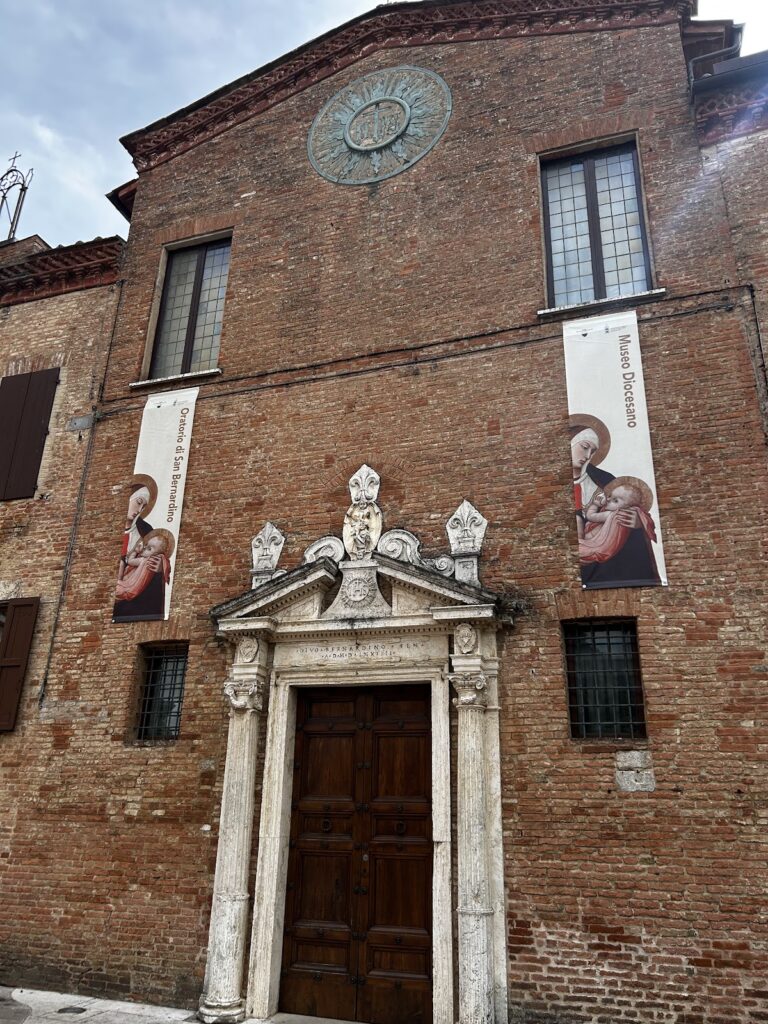
The complex includes three cloisters, a crypt, the Oratory of Saints Ludovico and Gherardo, and the Oratory of San Bernardino. The Oratory of Saints Ludovico and Gherardo is decorated mainly by Astolfo Petrazzi and Rutilio Manetti, with additional paintings by Deifebo Burbarini and Annibale Mazzuoli. Its subjects include Gherard freeing prisoners, Louis before the pope, the glory of Louis, Gherard being invoked by the sick and victims of plague, Gherard in ecstasy during Mass, and the saint freeing a possessed person.
The cloister portal commissioned by Niccolaccio Petroni remains in the third bay, with its relief of the Virgin and Child, Francis, and Blessed Pietro of Siena. Smaller remnants of Ambrogio Lorenzetti’s 1336 fresco cycle remain visible in the cloister, while the largest recovered fragments are preserved in the Palazzo del Rettorato. Together with the church’s detached paintings, reused medieval reliefs, and surviving funerary monuments, these elements preserve the changing history of the Franciscan complex after its Romanesque foundation, Gothic enlargement, fire, and later remodelling.