Oksbøl Church: A Medieval Lutheran Church in Denmark
Site at a Glance
- Rating
- 4.6
- Popularity
- Very Low
- Country
- Denmark
- Primary era
- Medieval
- External website
- Open
- Eras represented
- Medieval, Early Modern
- Civilizations
- Danish
- Site type
- Religious
- Remains
- Church
On this page11 sections
History
Oksbøl Church is an Evangelical Lutheran church in Oksbøl, Denmark, on the island of Als in North Schleswig. Built in the late twelfth century in the Romanesque style, it is dedicated to the Virgin Mary and belongs to the Diocese of Haderslev. The church shares a joint pastorate with Nordborg Church, and its parish includes Broballe, Hardeshøj, Lusig, Lyngen, Mjels, Oksbøl, Steg, and Stegsvig.
Medieval development
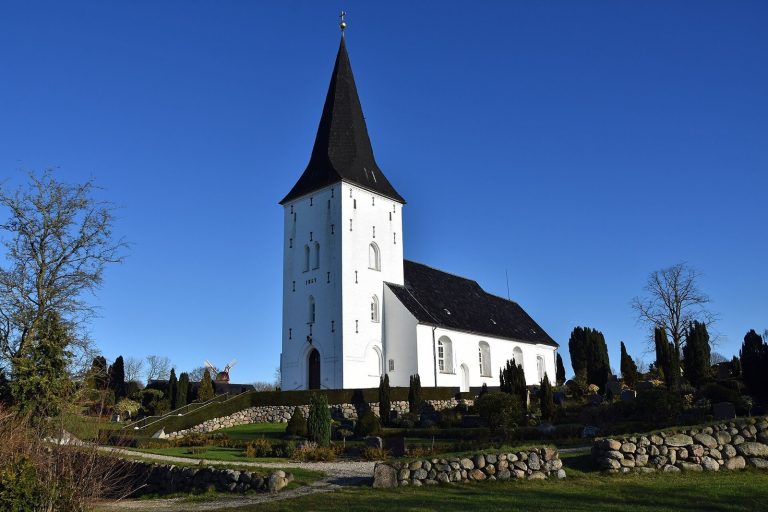
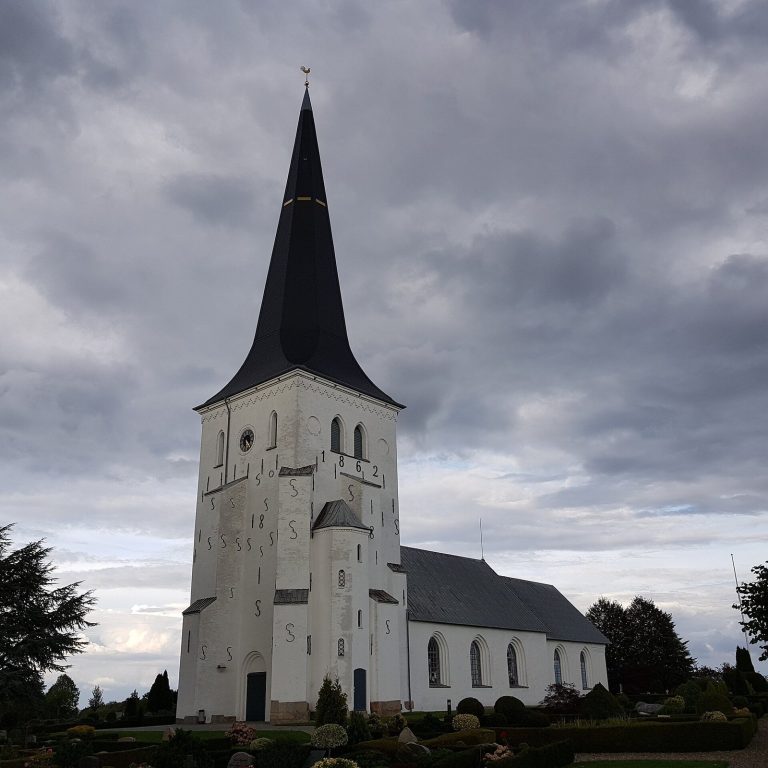
The church began with a Romanesque nave. Its medieval fabric was enlarged in later centuries, first with the addition of a Gothic tower in the fifteenth century. A south porch was added during the late medieval period. The choir received a Late Gothic vault, reflecting the continuing transformation of the building after its original construction.
A burial chapel was added on the north side for Peter Enwaldt and his wife. Enwaldt was a tenant farmer of Mjelsgaard, a manor associated with the Oksbøl parish. The couple’s connection with the church also extended to its furnishings, including a chandelier and communion vessels.
Early modern and modern changes
The church’s interior was altered as tastes changed. In 1852, the Gothic altarpiece was dismantled because it no longer suited nineteenth-century preferences. It was replaced by Carl Balsgaard’s painting of the Annunciation, copied from a work by the Italian painter Agostino Masucci that had formerly been in the royal painting collection. During the 1890s, the art historian Richard Haupt gathered the altarpiece’s separated pieces and took them to the Municipal Museum in Flensburg. The work was transferred to Sonderborg Castle Museum in 1920 and, following restoration, returned to Oksbøl Church in 1957 at the request of the church council.
The wooden baptismal font was removed from service in 1889 and replaced with a Neo-Gothic sandstone font. After restoration, the older font returned to use in 1981. Early Gothic communion vessels donated by Peter Enwaldt in 1695 were destroyed in the 1913 fire at the vicarage, and new vessels were provided the following year.
The church’s bell cast in 1639 was surrendered during the First World War, the international conflict that affected much of Europe, but it survived and came back in 1919. A major restoration in 1993 and 1994 exposed wall paintings. The First World War memorial for those who did not return was originally placed outside on the wall beside the church porch and moved into the porch in 1975.
Tradition and place-name
A foundation legend explains the church’s position away from the village centre. According to the story, villagers who could not agree on a building site tied a beam to an ox and drove it into the fields. They were to build where the animal was found bellowing the next day. The tale is also used to connect the name Oksbøl with the sound of an ox, although the stated meaning of the name is a village around an outlying farm with oxen.
Remains
Medieval fabric
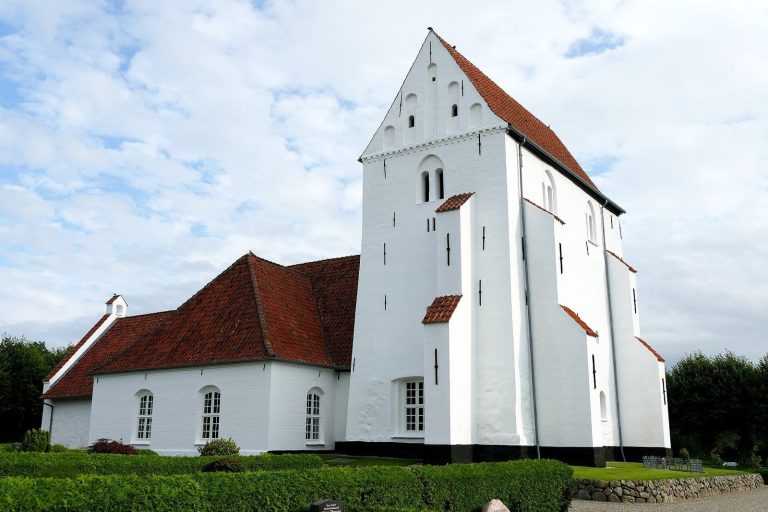
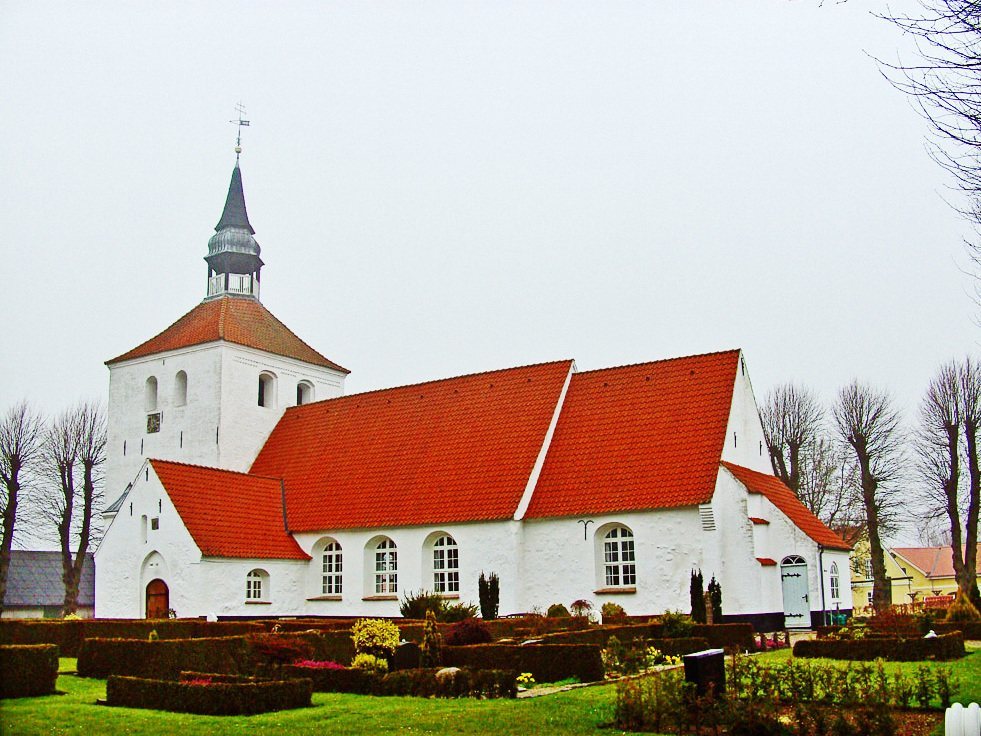
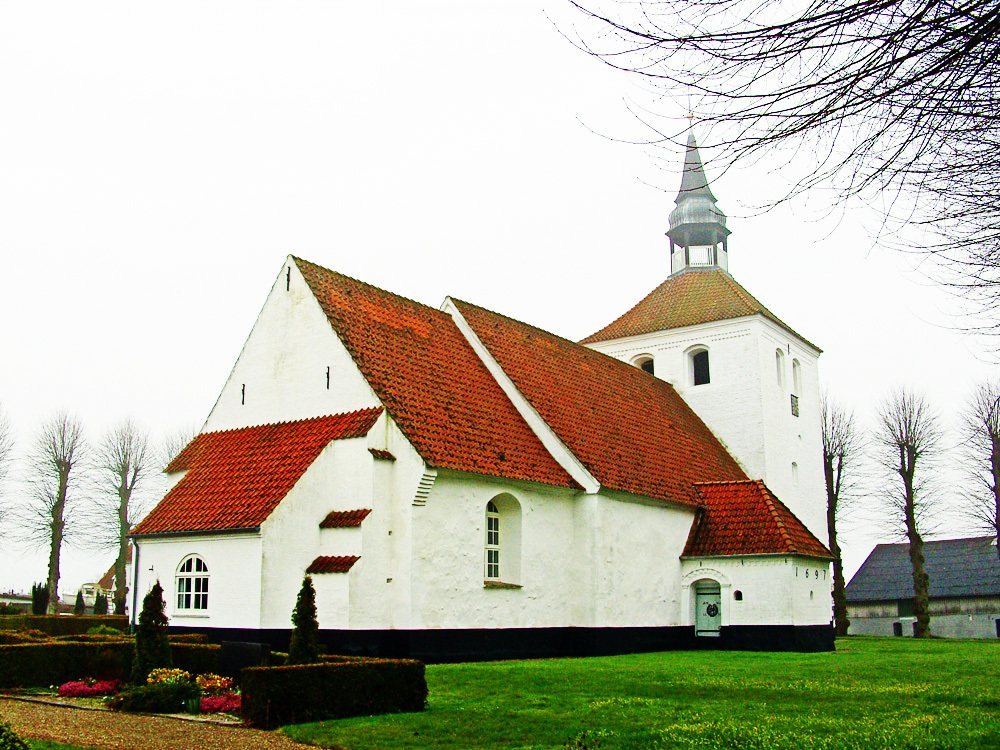
The original nave is a Romanesque structure built from fieldstones set on granite blocks. The choir contains a Late Gothic vault. At the west end, the fifteenth-century tower is Gothic in form. Masonry anchors on its west wall display the date 1593, recording a repair, while the present pyramidal roof dates from 1775.
A late medieval porch projects from the south wall, and a small eighteenth-century sacristy is attached to the church. The burial chapel stands against the north side and was built in 1697 for Peter Enwaldt and his wife. Together, these additions show how the medieval church was expanded and adapted over several centuries.
Altarpiece and preaching furniture
Winged altarpiece
The Gothic winged altarpiece, or retable, dates from the first half of the fifteenth century. A retable is an altar structure with a central section and hinged side panels that can be opened or closed. The work came from the same workshop as the altarpieces in the churches at Hørup and Tandslet on Als. Its central shrine contains carved figures of Christ as Judge of the World, the Virgin Mary, and John the Baptist, with two apostles on each side. Each wing contains four further apostles.
Pulpit
The pulpit was carved around 1625 to 1630 by Jørgen Ringnis. A pulpit is the raised structure used for Christian sermons. The carving follows the cartilage style, a seventeenth-century decorative manner based on curling organic forms. Its frieze panels show the Sacrifice of Isaac, the Brazen Serpent, the Crucifixion of Christ, the Resurrection, and the Ascension. Herm-form wooden pillars, meaning human or allegorical figures used as supports, divide the panels. They carry figures representing a woman with a book, Hope, Charity, Justice, Fortitude, Prudence, Temperance, a man without an attribute, and the Devil’s great-grandmother, portrayed as an older woman with a distorted face, wings, and pendulous breasts.
Baptismal font and chandelier
The Baroque wooden baptismal font is dated 1692. It consists of a water basin resting on a column embraced by a putto, a small childlike figure used in European religious and decorative art. A large chandelier made in 1642 came originally from Dalum Monastery near Odense. Peter and Eva Maria Enwaldt donated it to the church in 1697.
Bells, organ, and memorial
Oksbøl Church has two bells. Michel Dibler of Flensburg cast one in 1566, while Peter Melchiorsen of Husum cast the other in 1639. The latter was returned to the church after its wartime surrender and survival.
The first organ was built by Marcussen & Søn in 1853. It had four stops and an octave coupler. The same firm supplied an eight-stop, single-manual replacement in 1937. The present instrument was built in 1988 and inaugurated on 27 November that year. It has two manuals and pedal, twelve stops, mechanical tracker action with slider chests, and couplers II/I, I/P, and II/P. Its specification includes the Tragtgamba register, which imitates the tone of the bowed string instrument known as the viola da gamba.
The First World War memorial in the church porch bears the names of those who did not return. Its position inside the porch reflects the later relocation of a memorial that originally stood on the exterior wall beside the church porch.