Lysabild Church: A Romanesque Parish Church in Denmark


Site at a Glance
- Rating
- 4.4
- Popularity
- Very Low
- Country
- Denmark
- Primary era
- Medieval
- External website
- Open
- Eras represented
- Medieval, Early Modern, Modern
- Civilizations
- Danish, German
- Site type
- Religious
- Remains
- Church
On this page15 sections
History
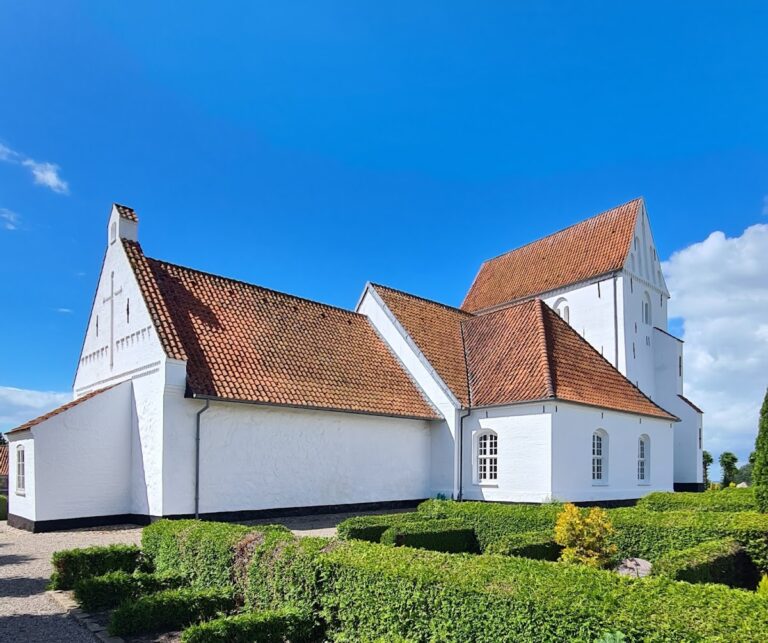
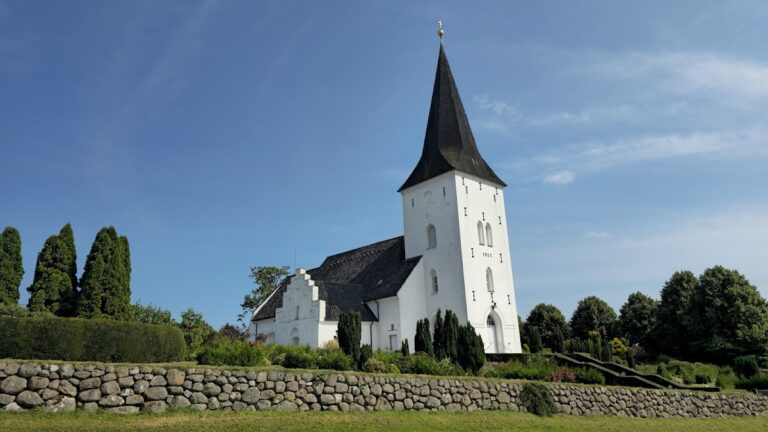
Lysabild Church is an Evangelical Lutheran parish church in Lysabild, Denmark, on the island of Als. Predominantly Romanesque in character, its nave and chancel were built in brick during the first half of the thirteenth century. Dedicated to Saint Michael, it is among the oldest churches on Als and, with more than 500 seats, is one of Denmark’s five largest village churches. Its parish now belongs to the Diocese of Haderslev, a regional territory administered by a bishop, and includes Drejby, Fjelby, Lysabild, Lysabildskov, Mommark, Pøl, Sarup, Skovby, and Vibøge.
The Holy Blood tradition
Lysabild’s medieval history is closely connected with devotion to the Holy Blood, a relic associated with a reported Eucharistic miracle. Helmold of Bosau, a twelfth-century German cleric and chronicler, wrote that a priest saw flesh and blood in a chalice on Als. Thirteen or fourteen days later, according to his account, a Slavic army entered the region, destroyed churches, captured inhabitants, and killed those who resisted.
Helmold did not name Lysabild, and the place itself is first recorded in 1245 as Liusapeld. The association with Lysabild rests on the fact that no other church on Als is known to have possessed a Holy Blood cult. The oldest surviving parts of the present church date from approximately 1200 to 1250, so the miracle is understood as having taken place in an earlier wooden church. The blood-stained host was apparently returned to Lysabild in 1168 and locally venerated as a Holy Blood relic.
An annual Holy Blood market was held at the church and attracted pilgrims who believed that pilgrimage had cured illness. Their donations helped pay for later building work, including the chapel associated with the relic. In Helmold’s period, the church must have been subordinate to the Bishop of Schleswig. Like the other churches on Als, it later came under the Diocese of Funen.
Reformation and early Lutheran clergy
The Reformation ended veneration of the relic, which was subsequently lost, and the Holy Blood market moved to Nordborg on Als. The earliest recorded pre-Reformation priests are Otto Nielsen, mentioned in 1475, and Peter Sture, recorded in 1487 and 1488. A local tradition says that the last Catholic priest of Lysabild was killed by a wild boar while returning from Tandslet, but his name has not survived.
The first Lutheran pastor is also unidentified. Tradition says that he was executed in Sønderborg around 1533 for taking part in a conspiracy to free the imprisoned King Christian II, a sixteenth-century king of Denmark, Norway, and Sweden. In 1534 he was succeeded by Jørgen Petersen, also called Georgius Petri. Petersen had studied theology under Martin Luther in Wittenberg and became provost of Als in 1546. A provost is a senior cleric responsible for a group of parishes.
Jørgen Petersen’s son, Daniel Jørgensen Quercinus, later became pastor. He died by suicide in 1582 after disloyalty to the church and the king, together with substantial debts, had placed him under severe pressure. Peter Conradi then served as pastor from 1582 to 1620, having been transferred from the position of court preacher at Sønderborg Castle. In opposition to surviving Catholic customs, he removed the altars from the Holy Blood Chapel and the former Marian Chapel. His son, also named Peter Conradi, served from 1620 to 1667 and was provost of Als from 1653 to 1661.
After a fire at the parsonage, Peter Conradi began preserving the surviving church records in 1627. He initially kept them as personal, diary-like notes, creating an important record of parish life and administration.
Eighteenth- and nineteenth-century parish life
Westi Egeberg was pastor from 1729 to 1778. He had previously served as a chaplain in Slagelse and translated Erik Pontoppidan’s devotional book Heller Glaubensspiegel into Danish. His successor was his son Martin Egeberg, formerly a deacon at Lysabild, who served as pastor from 1778 until his death in 1780.
Augustinus Meldal held the pastorate from 1802 to 1821 and introduced the new Evangelical Christian Hymnal in place of the Kingo Hymnal. His son Martin Meldal followed him and served from 1821 to 1833. In 1832, Martin Meldal compiled a parish chronicle entitled Chronicle for Lysabild Parish.
A mid-eighteenth-century tradition claimed that a nobleman had lived where the church now stands, killed another nobleman during a quarrel, and secured a papal indulgence by promising to build a chapel to Saint Michael. Another version said that the nobleman’s residence became the church and that the Holy Blood Chapel had once been his carriage hall and prison. These stories are regarded as unhistorical. They probably developed from later uncertainty about the chapel’s origin and from the churchyard moat, whose appearance encouraged the idea that the site had once been a noble residence or castle.
The moat was levelled in 1841 and 1842. Before that change, people reportedly skated on it in winter. Its removal altered the setting that had helped sustain the castle tradition. Another local story concerns Johan von Hego, supposedly a magical schoolmaster and sexton who prevented the wings of the Lysabild mill from being installed until he was invited to its second topping-out celebration. He is considered fictional because he does not appear in the church’s list of sextons.
North Schleswig and the twentieth century
During German rule in North Schleswig from 1871 to 1920, most members of the parish remained oriented toward Danish culture. The Lysabild-born politician Hans Lassen represented Danish North Schleswigers in the Schleswig-Holstein Provincial Parliament, the Prussian House of Representatives, and the Reichstag. He also served on church synods.
After North Schleswig returned to Denmark in 1920, Hans Christian Madsen became the second pastor appointed at Lysabild. He served from 1940 to 1960. During the German occupation of Denmark in the Second World War, he joined the Danish resistance, temporarily went underground, and hid in an attic.
Remains
Medieval building fabric
Nave and chancel
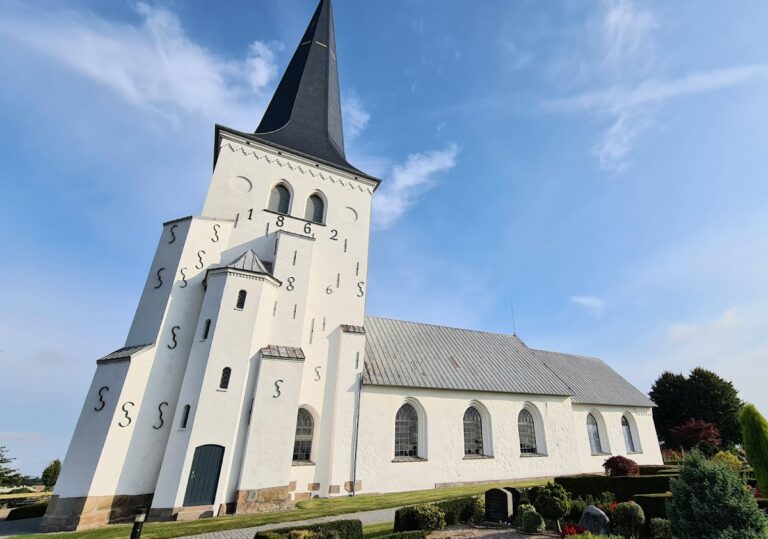
The surviving church is predominantly Romanesque, with a brick nave and chancel erected during the first half of the thirteenth century. By no later than the fourteenth century, the nave had been extended westward by one vaulted bay. Around 1400, both nave and chancel were raised by about 1.20 metres through the addition of eleven or twelve courses of brick, and a cross-vault was inserted. These alterations give the medieval core its present layered form.
Tower and south aisle
The tower was built in the later fifteenth century and altered several times afterward. Its present lantern spire dates from 1763 and replaced an earlier spire that was approximately 18 Danish ells, or about 11 metres, taller. That earlier structure served sailors as a landmark. The tower now reaches approximately 40 metres. A south aisle was added in 1782, requiring the demolition of a Marian Chapel and a porch along the south wall.
Holy Blood Chapel
A two-part chapel was added on the north side around 1400 to 1425. Its western half is the Holy Blood Chapel, while the eastern half has long been used as a materials room. Wall paintings were applied around 1425 and uncovered in 1949 before being restored in 1952. The eastern vault surface shows the Crucifixion and the catching of Christ’s blood. The western surface depicts Christ in the Garden of Gethsemane while the disciples sleep. Grotesque figures fill the vault spandrels, including a man in a two-coloured costume with a pumpkin-shaped beret.
The foundation of the chapel’s outer wall incorporates a cup-mark stone, a prehistoric stone surface with deliberately made bowl-shaped hollows. The prehistorian and museum director Jens Raben discovered it during the first half of the twentieth century. The stone measures 1.75 metres high and 1.35 metres wide and bears more than 100 large and small depressions. Black tar on its lower part and white lime plaster on its upper part had initially obscured the markings.
Raben considered the stone’s incorporation into the church wall unlikely to have happened by accident. He connected cup-mark stones with pre-Christian religious practices, including solar and fertility cults, and proposed that older and newer religious traditions may have stood in tension when the chapel was built. The original purpose of such stones remains uncertain.
Furnishings and liturgical objects
Baptismal font and crucifix
The oldest furnishings include a Romanesque baptismal font carved from Gotland limestone and a Late Gothic chancel-arch crucifix dating from approximately 1475 to 1500. The font’s central section between bowl and base is missing and was supplied later. The crucifix lacks its lower quatrefoil panel, which carried the name of the Evangelist John.
Altarpiece and pulpit
The present Rococo altarpiece was made in 1791 by the builder Hans Petersen Blæshøj and the sculptor Rudolphsen of Augustenborg. Four Corinthian columns divide its composition. The outer columns support free-standing figures about 1.25 metres high, showing the horned Moses with the tablets of the Law and the triumphant Christ carrying a victory banner.
At the centre is a Descent from the Cross painted in 1791 by Jes Jessen of Aabenraa. It is set within a Louis-Seize frame, an early Neoclassical form associated with eighteenth-century French decoration. Above it, the gable contains the Eye of God surrounded by rays and is topped by a Rococo cartouche bearing the divine name JHWH in Hebrew letters. The altarpiece replaced a Gothic winged altar with carved figures of all the Apostles, which had deteriorated during the eighteenth century. The Neoclassical pulpit was made in 1795 by the Sønderborg cabinetmaker Friedrich Hansen.
Bells and chandeliers
The tower contains two bells. The older was cast in 1623 by Michael Westphal of Rostock. It was surrendered as a metal donation in 1917 and later returned to Lysabild. The younger bell was cast in 1706 by Conrad Kleimann of Lübeck. The chandeliers date from 1902 in the south aisle and 1922 in the main nave.
Organ
An organ is recorded at Lysabild as early as 1686. It stood against the north wall, east of the Holy Blood Chapel. A west gallery was installed in 1875, and the present organ was placed there in 1878.
The instrument was built by Philipp Furtwängler and Sons of Elze as part of a joint order for the churches of Asserballe, Ketting, and Lysabild. The Lysabild organ was the only two-manual instrument in the group. It cost 4,500 marks and was first played on 7 November 1878 after inspection by Heinrich Schmahl, then organist of the Arp Schnitger organ at Saint James Church in Hamburg. Its dedication service took place on 10 November.
The organ has twelve stops distributed across two manuals and pedal, with mechanical slider chests, couplers II/I and I/P, and a bellows-call stop. Three stops were replaced around 1970 to brighten its sound. This change removed the Romantic string stops, but the instrument otherwise remains largely unaltered. The replaced stops had originally been Viola da Gamba 8 feet, Bordun 16 feet, and Salicional 8 feet.
Nearby sites