Niedermunster Abbey: A Medieval Pilgrimage Monastery in France


Site at a Glance
- Rating
- 4.2
- Popularity
- Low
- Country
- France
- Primary era
- Medieval
- Eras represented
- Medieval
- Civilizations
- Holy Roman Empire
- Site type
- Religious
- Remains
- Monastery
On this page15 sections
History
Niedermunster Abbey is a former religious and pilgrimage foundation in France, at the foot of Mount Saint Odile near Saint-Nabor. It was founded around AD 700, according to tradition by Saint Odile, as a lower monastery for pilgrims who could not climb to Hohenbourg, the monastery on the mountain. The foundation story survives in the Life of Saint Odile, although no contemporary evidence confirms it. The institution first grew from a hospice serving travelers, poor people, the sick, and pilgrims before becoming a nunnery associated with Odile’s niece Gundelina. Saint Odile was traditionally believed to have died at Niedermunster in 720.
From hospice to religious community
During the Carolingian period, the establishment was adapted to the Benedictine rule, a system regulating communal monastic life. In the twelfth century, its canonesses, women religious living in a collegiate community, followed the Rule of Saint Augustine. Their routine centred on monastic worship, perpetual prayer, the organization of pilgrimage, and the education of girls from noble families.
For much of the early medieval period, Niedermunster and Hohenbourg functioned as one institution and held their property jointly. In 1016–1017, Emperor Henry II, who ruled the Holy Roman Empire from 1002 to 1024, granted Abbess Helewig the right to govern Niedermunster independently and to choose the abbess and advocate. An advocate was a lay protector and legal representative of a religious institution. Until then, Niedermunster had remained dependent on Hohenbourg. The two establishments operated separately from the thirteenth century.
Destruction and rebuilding in the twelfth century
Niedermunster suffered severe damage during conflicts connected with the Investiture Controversy, a struggle over the control of church appointments between rulers and the papacy. Tradition attributes the destruction of both Niedermunster and Hohenbourg to Frederick II of Swabia, known as Frederick the One-Eyed. He was said to have burned the monasteries while attacking the Hohenbourg community and seized their property and advocacy rights.
After becoming emperor in 1155, Frederick Barbarossa undertook the rebuilding of both monasteries as an act of penance. He appointed Relinde, an Augustinian abbess from Regensburg, to direct the work. After her death around 1176, he appointed Herrade of Landsberg to Hohenbourg and Edelinde of Landsberg to Niedermunster. A major rebuilding campaign took place during the twelfth century, including the construction of the abbey church between about 1150 and 1180.
Niedermunster possessed extensive landed property. Henri of Meistratzheim gave the community a court around the end of the twelfth or the beginning of the thirteenth century. Its other possessions included the court of Arlesheim and dependencies at Brunstatt, Heimersdorf, Hirsingue, and Biesheim. In 1239, Abbess Wilburgis sold Arlesheim and its dependencies to the Bishopric of Basel. The abbey also held the courts of Blienschwiller, Kogenheim, Sermersheim, and Soultz-les-Bains, along with property at Gertwiller, Saint-Nabor, Barr, and Ottrott. A vineyard at Bernardswiller was left to the abbey in 1318.
Decline and sixteenth-century destruction
The abbey’s institutional and religious importance declined during the fourteenth century. Niedermunster and the neighboring convent of Truttenhausen were pillaged during the Peasants’ War around 1525, a series of uprisings by rural communities against social, economic, and political burdens. Fire destroyed the conventual buildings in 1542. The canonesses dispersed in 1545, and lightning destroyed the collegiate church in 1572. Niedermunster was never rebuilt or reoccupied, and the destruction brought its pilgrimage associated with the cross to an end.
The abbey was renowned for relics, including a fragment of the True Cross and a large cross-shaped reliquary, a container made to preserve and display a religious relic. After the sixteenth-century destruction, the cross relic was transferred to the Jesuits at Molsheim. It disappeared during the French Revolution after being melted down at the Strasbourg Mint. Relics identified as the head and arm of Saint Lazarus of Marseille were taken to Andlau after the fire and later disappeared during the Revolution.
Legends, property reuse, and archaeological work
A foundation legend relates that Hugo of Tours received the True Cross relic from Charlemagne, the Frankish ruler and emperor traditionally connected with its transfer. Hugo placed the reliquary on a camel accompanied by five Burgundian knights. When the camel stopped at the foot of Mount Saint Odile, the event was interpreted as a sign that Niedermunster should be founded there. The camel carrying the cross became an emblem of the abbey. The relic drew pilgrims, and Richard the Lionheart was reputed to have visited in 1194, although the earliest surviving record of that visit dates only from 1751.
After the abbey was abandoned, its buildings became a source of stone until the nineteenth century. Materials were reused in the fortifications of Benfeld, the Premonstratensian church on Mount Saint Odile, the bell tower of Erstein church, the Taufflieb Bank in Barr, and other buildings. The Bishopric of Strasbourg acquired the ruins in 1895. Archaeological investigations, particularly those conducted by Felix Wolff from 1902 to 1904, helped consolidate the remains and revealed further parts of the medieval complex, including numerous burials and the graves of former abbesses in the church nave. Niedermunster has been protected as a French historic monument since 1846.
Remains
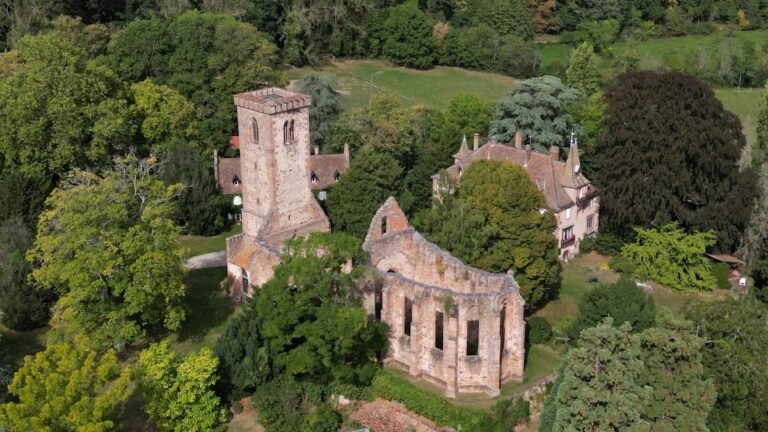
Niedermunster lies at an altitude of 511 metres in the Niedermunster valley, among meadows and forests at the foot of Mount Saint Odile. The twelfth-century complex included the Romanesque abbey church of Saint Mary, cloister buildings, a pilgrims’ hospice or hospital, and the chapels of Saint Nicholas and Saint James. The surviving site is largely ruined, with the church remains forming its principal architectural group. A farm and barn built in 1758 from reused abbey stone also survive.
Abbey church and monastic buildings
Saint Mary’s abbey church
The abbey church was a three-aisled Romanesque basilica, a longitudinal church with a high central nave and lower side aisles. It had a transept, or cross-arm, a rectangular choir, and a crypt, a chamber below or near the choir. The nave was covered by groin vaults, formed where two barrel vaults intersect, and followed a bound system in which each bay of the main nave corresponded to two bays in the side aisles. Cross-shaped piers and columns alternated along the nave.
The western end had two towers, a porch, and a gallery. Pilasters and rounded-arch friezes articulated the west facade. The church’s architecture and workmanship have a close stylistic relationship to the nearby church at Rosheim. Surviving elements include parts of the main facade, the choir, the entrance porch and stairways, the former ambo, the Saint John the Baptist altar, and fragments of the monastic buildings. Some architectural pieces were installed between 1835 and 1843 in the ruins of Altkeller lowland castle at Ottrott.
Medieval funerary slabs
Medieval funerary slabs remain in the church area. They include slabs associated with Abbess Ursula Zu Triebel and with an abbess who died in 1370. One image shows the latter beneath a raised shroud, with her hands joined in prayer. Another slab bears a large cross, probably marking the burial place of an important nun. Excavations also revealed numerous medieval burials, including those of former abbesses in the nave.
Buildings associated with the pilgrimage complex
Saint Nicholas Chapel
Saint Nicholas Chapel stands in the former hospital courtyard a short distance downhill from the abbey. It is a Romanesque chapel with a single nave and a choir tower. The lower part of the tower contains two choir spaces covered by barrel vaults. A tomb slab for a canon who died in 1512 remains inside the chapel.
By 1838, Saint Nicholas Chapel was in ruins. It was rebuilt to its former design between 1848 and 1850 with materials recovered from the site. The architect E. Cron carried out the work under the direction of Emile Boeswillwald.
Saint James Hermitage
Saint James Hermitage stood in the forest near the abbey until the French Revolution. Tradition places its foundation in 803 and connects it with the five Burgundian knights in the camel-and-cross legend. An eighteenth-century house was later built on the chapel ruins. It was first occupied by a farmer and then by a forester before burning in 1814. The nearby hermitage was cleared of ruins around 1859–1860.
Water, relic traditions, and symbols
Abbey well and healing tradition
A well at the centre of the abbey is traditionally believed to cure eye diseases. Another foundation tradition connects Saint Odile with a spring created when she struck a rock while helping a blind and thirsty man. People suffering from eye disorders later visited the spring seeking healing, reflecting Saint Odile’s wider association with the protection and healing of eyesight.
Seal and camel emblem
The abbey’s seal of 1264 shows the Virgin Mary seated on a throne with her hands raised in prayer. Its inscription identifies the seal as belonging to the lower monastery. After the True Cross relic arrived in the early ninth century, the image of a camel carrying a cross frequently replaced the Virgin’s image, linking the abbey’s visual identity to its foundation legend and pilgrimage relic.
Nearby sites