Kolotsky Monastery: A Russian Orthodox Monastic Centre in Russia


Site at a Glance
- Rating
- 4.8
- Popularity
- Low
- Country
- Russia
- Primary era
- Early Modern
- External website
- Open
- Eras represented
- Early Modern
- Civilizations
- Russian
- Site type
- Religious
- Remains
- Monastery
On this page17 sections
History
Kolotsky Monastery is a Russian Orthodox women’s monastery in Kolotskoye, Russia, founded by tradition in 1413 and associated with the medieval history of the Moscow region. It stands on an elevation crossed by the Old Smolensk Road, about 22 kilometres west of Mozhaisk. The monastery’s origins are linked to the appearance of the Kolotskaya Icon of the Mother of God, a sacred devotional image in Orthodox Christianity, to a poor settler named Luka.
Foundation and the Kolotskaya Icon
The monastery’s foundation is dated to 1413 in the Book of Degrees. According to the foundation tradition, Luka found the icon and took it to Mozhaisk. Prince Andrei Dmitrievich of Mozhaisk met him there during a religious procession, after which the icon was carried to Moscow. It was received by Metropolitan Photius, Grand Prince Vasily I, the clergy, boyars, and townspeople.
The tradition associates the icon with miraculous healing. Donations made through it allowed Luka to build an Assumption church in his native village and a substantial stone residence for himself. After he was injured by a bear and repented of his conduct, Prince Andrei ordered a monastery to be founded, granted it land, and placed the icon there. Luka became the community’s first resident. A stone church dedicated to the Dormition, or Assumption, of the Mother of God was probably built during his lifetime.
The monastery’s traditional feast of the Kolotskaya Icon was held on July 9/22. Oral tradition places a healing spring at the location where the icon appeared, and a procession to the spring was held on the feast day. The tradition helped define the monastery as a place of pilgrimage and remained connected with its religious identity after later changes to the buildings and community.
Growth and ecclesiastical influence
During the fifteenth and sixteenth centuries, the monastery expanded, became wealthy and well known, and attracted many pilgrims. Its abbots, the superiors of the monastic community, attended ecclesiastical councils in Moscow. In 1563, Ivan the Terrible, the first Russian ruler to use the title tsar, took the miraculous icon with him during his campaign against Polotsk.
The monastery’s senior clergy also took part in major political and ecclesiastical decisions. Herman signed the 1566 council charter concerning the continuation of the war with Poland. Euphemius participated in the 1572 ecclesiastical authorization for Ivan the Terrible’s fourth marriage, while Nikandr took part in the 1598 charter that elected Boris Godunov to the Russian throne.
The community was normally governed by abbots, although some superiors were later elevated to the rank of archimandrite, a senior monastic cleric traditionally above an abbot. Cornelius, one of the monastery’s abbots, was transferred to Moscow in 1566 to serve as treasurer of the metropolitan court. In 1567, Metropolitan Philip of Moscow appointed him Archbishop of Rostov and Yaroslavl.
Destruction and rebuilding in the seventeenth century
By 1609, the monastery contained two stone churches and a bell tower with a third church. Polish forces plundered it during the Time of Troubles, a period of political crisis, dynastic uncertainty, and foreign intervention in the Russian state in the early seventeenth century. A description from 1626–1627 records that the two large churches stood ruined, while services continued in the small church beneath the bell tower.
Rebuilding began in the 1620s, but the renewed complex was more modest than the earlier monastery. The present Assumption Church preserves the main cubic body of this seventeenth-century structure. Later work changed its appearance, while retaining elements of the earlier building and its connection with the monastery’s postwar recovery.
Reconstruction and the 1812 campaign
A major rebuilding of the monastic ensemble began in the second half of the eighteenth century. The Assumption Cathedral was substantially altered, wooden cells were replaced by stone buildings, and the grounds were enclosed by a brick wall with six towers. The rebuilding gave the ensemble a unified Baroque character.
The monastery became involved in the military events of 1812, when Napoleon Bonaparte led the French invasion of Russia. Mikhail Kutuzov, the senior Russian commander during the campaign, surveyed the prospective battlefield from the monastery bell tower. By noon on August 21, the main Russian forces and headquarters had gathered there, and the position was initially intended for the decisive battle. On August 22, Kutuzov ordered a retreat to Borodino.
On August 24, a battle between the Russian rearguard and advancing French forces took place beside the monastery. Major General Ivan Krasnov of the Don Cossack Host was mortally wounded. On the same day, Denis Davydov, a Russian military officer and poet, assumed command of a partisan detachment near the monastery. French forces later occupied the complex. Napoleon stayed there and climbed the bell tower, while a French military hospital operated in the monastery for a time. The complex was subsequently plundered and burned.
After the war, 10,000 rubles from the Synod’s treasury were allocated for restoration. During the abbacy of Ioasaph, the cathedral was repaired, its iconostasis, the screen of icons separating the sanctuary from the main body of an Orthodox church, was renewed, and the walls of the main church were painted.
Revolution, suppression, and revival
The monastery was abolished after the Revolution. In 1918, a commune for the poor was established there. The fortress walls and all but one of the towers were destroyed, and the remaining monks were arrested and executed on suspicion of counter-revolutionary activity.
The Assumption Church continued to function as an ordinary parish church until 1934. It then housed a boarding school for deaf children. The original Kolotskaya Icon was lost in the 1970s. In the 1990s, the monastery was revived as a women’s monastery, and a modern copy of the icon was placed in the cathedral. The monastery is now a functioning religious institution and a federally significant cultural heritage site of the peoples of the Russian Federation.
Remains
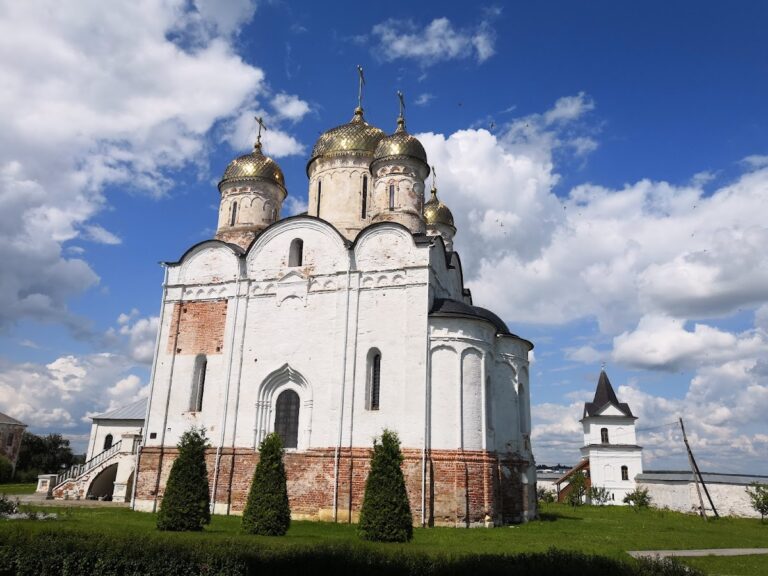
The surviving ensemble consists principally of the Assumption Church, a four-tier bell tower, one corner tower, and three stone cell buildings. A small fragment of the former brick enclosure also remains. The buildings represent successive phases of construction from the seventeenth-century rebuilding through the unified Baroque reconstruction of the eighteenth century.
Churches and bell tower
Assumption Church
The present Assumption Church retains the main cubic body of the seventeenth-century building from 1626–1627. Its preserved zakomary, curved external gable forms characteristic of medieval Russian church architecture, remain visible. The eighteenth-century rebuilding added a new drum and dome, together with chapels dedicated to the Prophet Elijah and Saint Nicholas. Earlier windows were blocked during this work, and their surrounds were removed.
Earlier church group
By 1609, the monastery’s stone Cathedral of the Dormition of the Mother of God had a chapel dedicated to Saint Nicholas the Wonderworker. The complex also included a stone Church of the Epiphany with a refectory, a communal dining hall, and a bell tower containing a third church dedicated to Saint Alexis, Metropolitan of Moscow. At that time, the enclosure was made of wood. The surviving Assumption Church preserves the principal fabric of the later seventeenth-century rebuilding rather than the full pre-1609 arrangement.
Bell tower
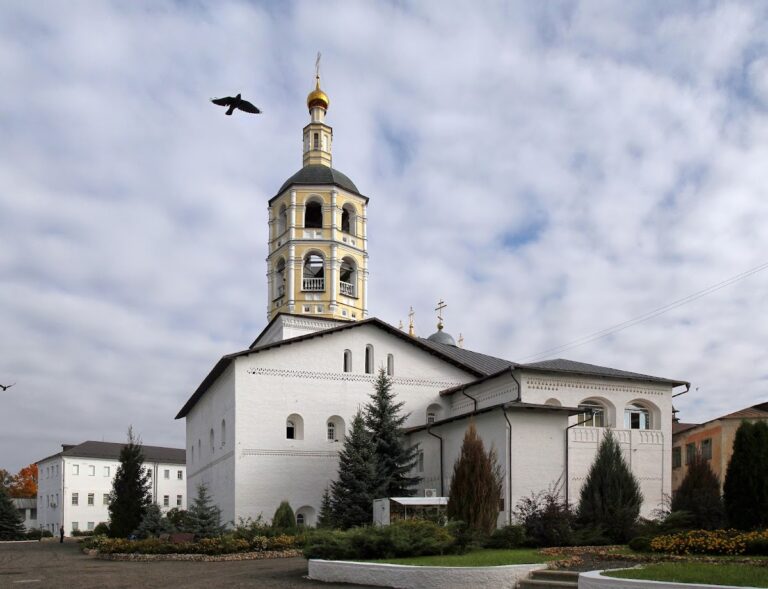
The bell tower was built between 1739 and 1763 as part of the eighteenth-century reconstruction. It has a square plan, four tiers, and an octagonal belfry tier, the section designed to house and sound the bells. A memorial plaque on the tower records Denis Davydov’s assumption of command of a partisan detachment near the monastery in 1812.
Enclosure and monastic buildings
Brick walls and corner tower
The eighteenth-century monastery was enclosed by a brick wall with six towers. One corner tower survives, together with a small fragment of the wall. These remains preserve part of the defensive boundary that once defined the rebuilt monastic grounds.
Cell buildings
Three stone cell buildings survive from the later monastic ensemble. The cathedral, bell tower, and two of the cell buildings have been restored. The third cell building remains under restoration, preserving another part of the residential buildings that replaced the earlier wooden cells.
Icon traditions and surviving copies
Chapel at the traditional appearance site
The traditional location of the Kolotskaya Icon’s appearance is marked by a small wooden chapel. Its present structure dates from the 1990s and is associated with the healing spring and procession preserved in the monastery’s oral tradition.
Later icon copy
The original Kolotskaya Icon was lost in the 1970s, but a later copy dated 1689 survives in the Peter and Paul Chapel of the Assumption Cathedral in the Moscow Kremlin. An inscription on the copy states that officials of the Kremlin Armoury produced it in connection with deliverance from misfortunes through the intercession of the Mother of God and the saints.
Nearby sites