Château du Hagelschloss: A Ruined Medieval Hilltop Castle in France


Site at a Glance
- Rating
- 4
- Popularity
- Very Low
- Country
- France
- Primary era
- Medieval
- Eras represented
- Medieval
- Civilizations
- Holy Roman Empire
- Site type
- Military
- Remains
- Castle
On this page7 sections
History
Château du Hagelschloss is a ruined medieval hilltop castle in France, in the commune of Ottrott. Building evidence dates the fortress to the late twelfth century, while its existence is first recorded in 1256. Originally called Waldsberg, it was a fief of the Holy Roman Empire during the thirteenth century and probably served the Staufen rulers in controlling nearby imperial estates.
Foundation and early records
The castle was probably founded by Staufen ministeriales, members of the ministerial nobility who held administrative, military, and castle-related duties for the Staufen rulers. Its construction appears to have taken place around the same time as that of nearby Landsberg, which is first documented in 1200. Waldsberg likely helped control imperial estates around Rosheim and Hohenburg Monastery, a religious house associated with Mont Sainte-Odile and protected by the Staufen dynasty. In 1256, Rüdiger von Waldisberc was mentioned in connection with the fortress.
Changes of lordship
Waldsberg was associated with the Beger and Murnhart families in 1359, and it may already have belonged to them in 1260–1262, together with the village of Hohenburgwiller. Ludwig von Amoltern temporarily lived at the castle in 1377. Around 1400, the Rathsamhausen and Erbe families each held half of the fortress.
The castle became involved in the conflict between Walter Erbe and Strasbourg. In 1405, Erbe seized representatives of the city and held them at Waldsberg. Strasbourg responded by besieging the fortress in 1406. The city captured and destroyed it, after which the castle was never rebuilt. Its original name gradually fell out of use.
Rediscovery and present status
During the nineteenth century, Johann Gottfried Schweighäuser and Adam Walther Strobel identified the ruin, then popularly called Hagelschloss, with the documented castle of Waldsberg. The later name resulted from an alteration of the Alsatian landscape name Halde. The ruin is privately owned, considered highly liable to collapse, and has no official monument protection. It is associated with a group of nine castles in the area around Mont Sainte-Odile, including Birkenfels, Dreistein, and Kagenfels.
Remains
Setting and outer defenses
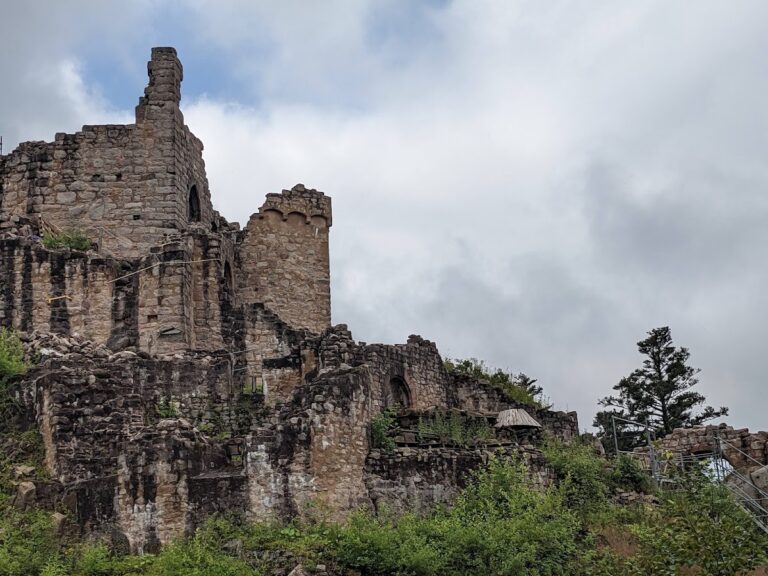
Château du Hagelschloss occupies a projecting rocky spur at about 588 metres above sea level. The fortress stands on a red-sandstone outcrop at the northern tip of Hohenburgberg, at the entrance to the Hagel valley, a right-bank tributary valley of the Ehn. It lies north of and opposite Mont Sainte-Odile, near the Pagan Wall, an ancient stone defensive enclosure on and around the mountain.
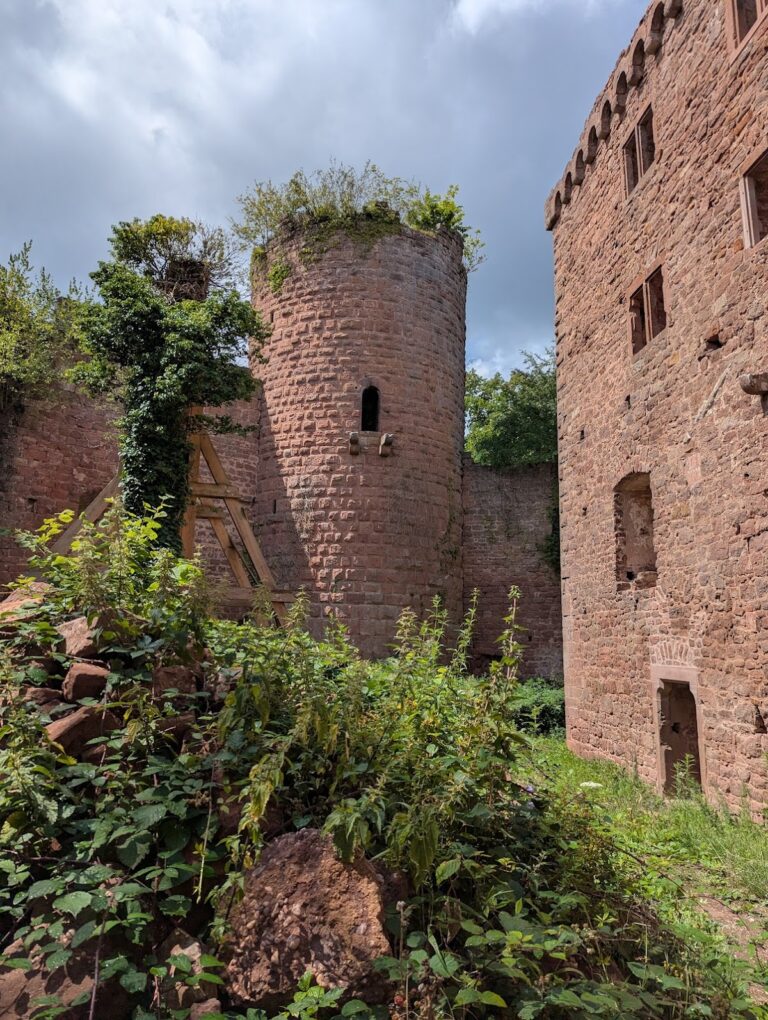
The complex has two apparently independent sections. A first neck ditch cuts off the outer courtyard from the mountain massif. A second, broad and deep ditch with a stepped floor separates the outer and main courtyards, an arrangement that appears to prevent a direct connection between them. A ramp approaches the entrance from the southwest. Beside it, a surviving wall section uses bossage masonry, formed from projecting stone blocks with raised outer faces, and dates from the late thirteenth or early fourteenth century. Little of the outer courtyard’s enclosing wall survives. On the eastern side, below the end of the rocky spur, another outer-courtyard area gives access to the main castle.
Main castle structures
The main castle contained an elongated residential building set behind an enclosing wall. That wall was built with bossage blocks dating from the late twelfth century. The most prominent surviving feature is a large masonry arch that spans a deep cleft in the rock, running from one rock face to another. The arch is made of smoothly dressed ashlar, using carefully squared and finished stone faces. Some stones in the castle appear to have been taken from the nearby Pagan Wall, although that reuse remains uncertain.
Nearby sites