Kanmuri Inari Shrine: A Shinto Shrine in Ota, Japan


Site at a Glance
- Rating
- 4.3
- Popularity
- Medium
- Country
- Japan
- Primary era
- Early Modern
- External website
- Open
- Eras represented
- Early Modern
- Civilizations
- Tokugawa
- Site type
- Religious
- Remains
- Sanctuary
On this page14 sections
History
Kanmuri Inari Shrine is a Shinto shrine in Ota, Gunma Prefecture, Japan, traditionally founded by Minamoto no Yoshikuni in 1125. Its principal deity is Inari Okami, a collective designation for Ukanomitama no Okami and four other deities associated especially with rice, agriculture, food, prosperity, and related occupations.
Origins and the Minamoto tradition
In 1174, Minamoto no Yoshitsune, a celebrated twelfth-century Minamoto military commander, is said to have brought a divided spirit from Fushimi Inari Taisha in Kyoto while traveling to Oshu and enshrined it at the shrine. According to this tradition, the shrine became known as Kanmuri Inari, meaning “Helmet Inari,” because the sacred spirit had been carried in his helmet.
In 1333, Nitta Yoshisada, a warrior leader associated with the overthrow of the Kamakura shogunate, reportedly prayed at the shrine before raising his army and seeking victory. Afterward, he is said to have dedicated a tiered-box lion, planted a fragrant olive tree, and donated land as the shrine’s sacred estate.
Religious and cultural traditions
The shrine was formerly revered as a deity of sericulture and held the former village-shrine rank. It also claims a place among Japan’s Seven Shrines, a group also known as the Seven Inari Shrines. Its major annual observance is the First Horse Grand Festival, held on a Sunday in late March. The festival includes a rite involving sacred Inari rice cakes, a children’s purification procession associated with Yoshitsune and Yoshisada, and the Hosoya Kanmuri Inari lion dance.
The lion dance is traditionally connected with Yoshisada’s dedication of the tiered-box lion. Its performance was temporarily discontinued and later revived. The tradition is identified as the Hakoda school and uses three individually performed lions representing a male lion, a female lion, and Hogen, a named figure in the dance. Ota City designates the Hosoya Kanmuri Inari lion dance an Important Intangible Folk Cultural Property. The shrine also holds Niiname-sai on November 23, a Shinto harvest thanksgiving rite in which newly harvested rice and other offerings are presented to the deities.
Buildings, designations, and learned traditions
The shrine’s honden, or main sanctuary, and its Shoten sanctuary are designated Gunma Prefecture Important Cultural Properties. The two sanctuaries received designation in 1972, while the worship hall received the same designation in 1990. Their designation as prefectural important cultural properties was also recommended to the prefectural governor in 2024.
The shrine preserves three votive mathematical tablets, or ema inscribed with mathematical problems and their solutions. They are associated with the Seki and Mogami schools, traditions of wasan, or traditional Japanese mathematics. One was dedicated in 1812 by a member of the Seki school, and two were dedicated in 1814 by three pupils of the Mogami school.
Remains
The surviving shrine complex includes three principal worship buildings, votive mathematical tablets, the flowering quince known for its scarlet blossoms, and the material traditions associated with the lion dance. The buildings combine several traditional roof forms, while the natural and cultural features remain part of the shrine grounds and its religious setting.
Sanctuary buildings
Main sanctuary
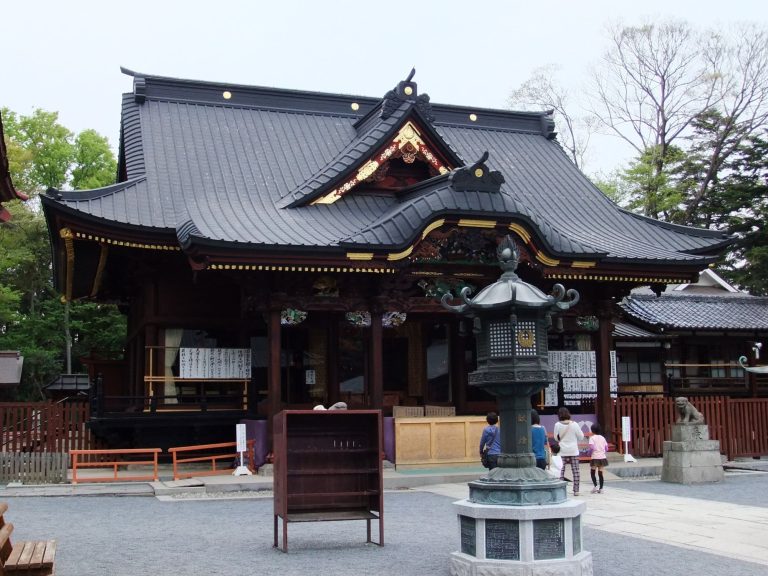
The honden, the main sanctuary where the principal deity is enshrined, is a three-bay building constructed in 1767. It follows the nagare-zukuri style, in which the roof extends forward over the entrance porch. A front-facing chidorihafu, or triangular decorative gable, rises above the front, and the porch has a karahafu, a distinctively curved gable.
Shoten sanctuary
The Shoten sanctuary was built in 1857. It has a tile roof with an irimoya form, a hipped-and-gabled roof, and a karahafu gable. Shoten is a Buddhist deity whose name is preserved in the sanctuary’s designation.
Worship hall
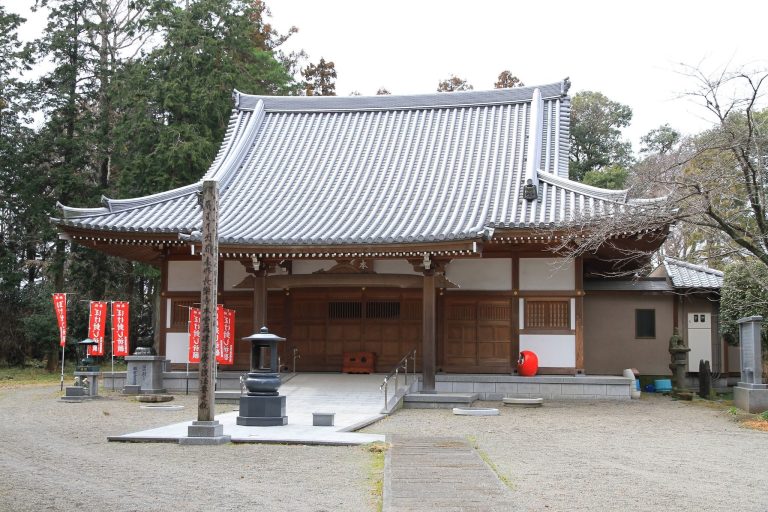
The haiden, or worship hall used by worshippers and visitors, was built in 1799. Together with the honden and Shoten sanctuary, it forms the principal group of designated historic buildings at the shrine.
Natural and inscribed features
Flowering quince
A scarlet-flowered flowering quince grows on the shrine grounds. It is approximately 3.5 metres high and has a root circumference of about 3 metres. Around 500 stems divide from its base, forming a dense semicircular clump. The plant flowers from mid-March to early April and produces fruit in autumn. Its age is estimated at 300 to 400 years, and it is designated a Gunma Prefecture Natural Monument.
Votive mathematical tablets
The three votive mathematical tablets date to 1812 and 1814. Their inscriptions represent the Seki and Mogami schools of traditional Japanese mathematics, linking the shrine’s surviving material culture with the practice of dedicating solved mathematical problems at religious sites.
Performing tradition
Hosoya Kanmuri Inari lion dance
The Hosoya Kanmuri Inari lion dance is performed by three dancers, each carrying an individual lion costume. Its figures are a male lion, a female lion, and Hogen. The dance is presented during the First Horse Grand Festival and preserves the Hakoda school tradition associated with the shrine.