Myōkō-ji Temple: A Nichiren Buddhist Temple and Birthplace of Japanese Wind-Band Music


Site at a Glance
- Rating
- 4.2
- Popularity
- Low
- Country
- Japan
- Primary era
- Modern
- External website
- Open
- Eras represented
- Modern
- Civilizations
- Japanese
- Site type
- Religious
On this page10 sections
History
Myōkō-ji Temple in Yokohama, Japan, is a Buddhist temple founded in 814 by Kūkai, the monk who established the Shingon school, and originally known as Tōkaiji, or Eastern Sea Temple. Its principal image was the Medicine Buddha. The temple later became a centre of Nichiren Buddhism and is remembered in modern history as the place where members of the Satsuma Band studied Western-style wind-band music.
From Shingon to Nichiren Buddhism
In 1264, the abbot of Tōkaiji became a follower of Nichiren, the 13th-century monk whose teachings gave rise to the Nichiren schools, and converted the temple to Nichiren Buddhism. It was renamed Renshōzan Myōkō-ji. At that time, the temple controlled an estate measuring eight chō on each side and had 49 subtemples. During the conversion, the subtemples were transferred to Hōshō-ji in Horinouchi, while the estate was confiscated. The local place-name Myōkōjidai derives from the temple’s name.
Around 1413, Myōkō-ji was revitalized by its tenth chief priest. From the early modern period, the Tokugawa family supported the temple, which received land in Honmoku producing ten koku, a traditional measure of rice production and land income. After Yokohama opened, its honorific mountain name was changed to Honmoku-san. Myōkō-ji belongs to the Nichiren school and was formerly affiliated with Nakayama Hokekyō-ji, the head temple of the Nakayama branch.
Land, music, and modern destruction
Until the Meiji period, Myōkō-ji possessed an extensive estate that included the area now occupied by Yamate Park. Part of the temple grounds was used to create the park, which opened in June 1870 as Japan’s first Western-style park.
Myōkō-ji also became connected with the introduction of wind-band music to Japan. In 1869, the Satsuma domain, a major feudal domain in southern Kyushu governed by the Shimazu family, sent 32 retainers to Yokohama to establish a Western-style military band. They lodged at Myōkō-ji and studied wind-band music under John W. Fenton, bandmaster of the British Army’s 10th Regiment stationed in Yokohama. This activity is regarded as the beginning of wind-band music in Japan.
In 1870, the Satsuma Band performed with the British military band at Yamate Park. That year, during an imperial military drill at Echūjima in Tokyo, Fenton’s ceremonial piece Kimigayo was performed for the first time. Its melody differed from that of the present national anthem.
The temple buildings were destroyed three times, in the Great Kantō Earthquake of 1923, a fire on January 10, 1927, and the Yokohama air raid of May 29, 1945. In 1935, a readers’ poll by the Yokohama Bōeki Shimpō selected Myōkō-ji as one of the 45 scenic and historic sites of Kanagawa Prefecture.
The Japan Band Directors Association erected a monument in the temple precincts in 1989 to commemorate Myōkō-ji as the birthplace of Japanese wind-band music. The association has since held an annual commemorative concert on the national holiday now called Sports Day, featuring Fenton’s composition Kimigayo. A 150th-anniversary event took place on October 14, 2019.
Remains
Temple buildings
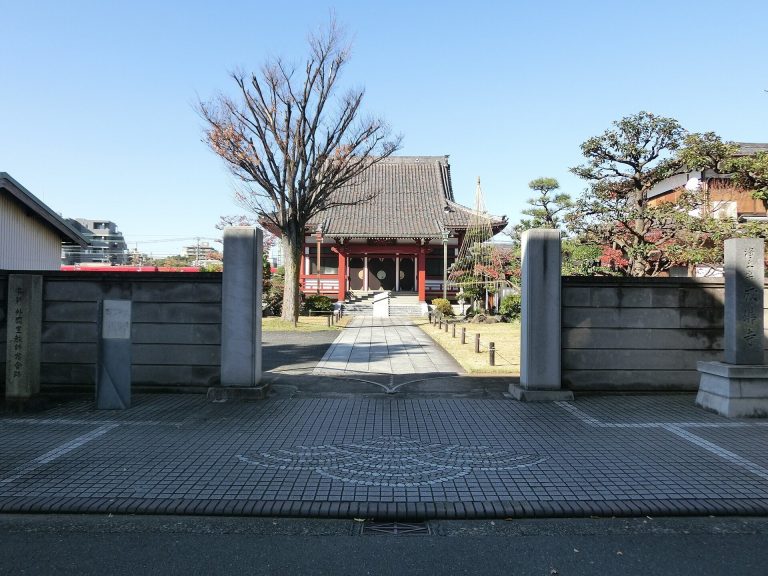
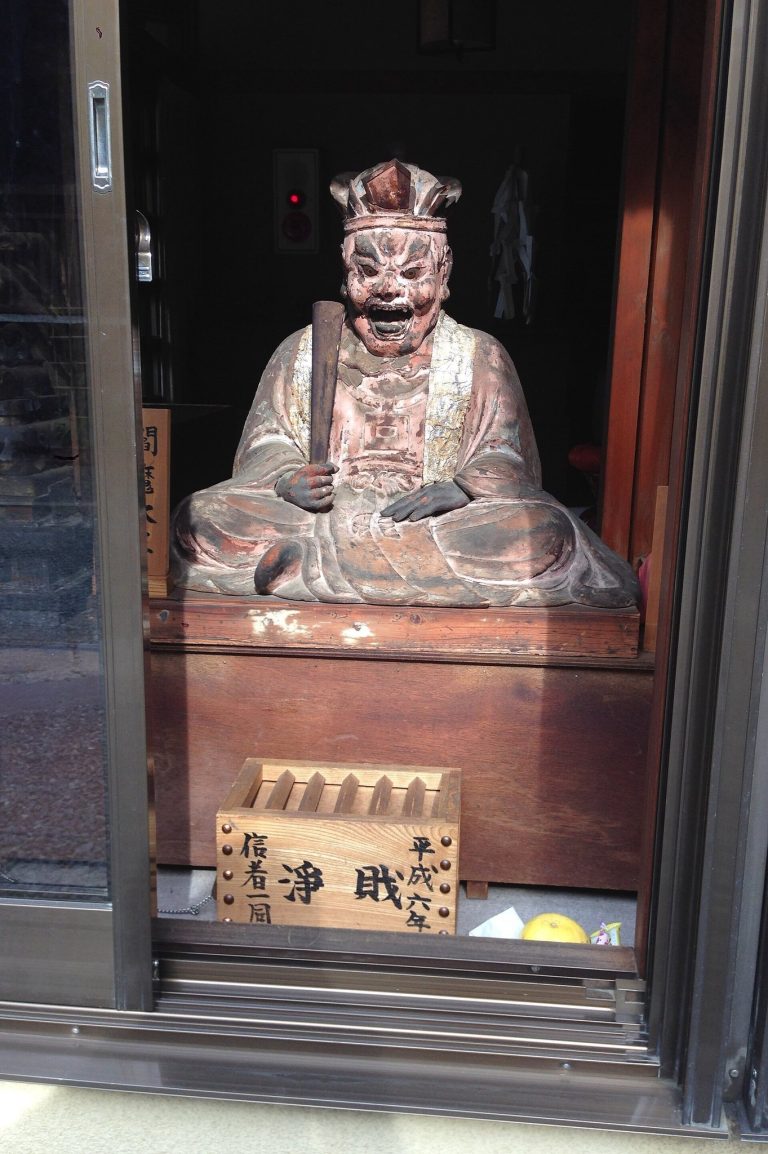
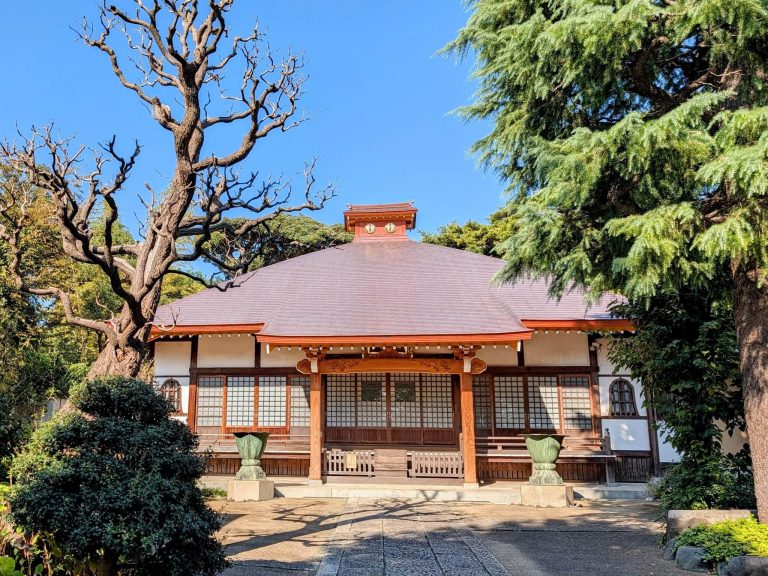
The precincts contain the main hall, a temple gate, a bell tower, and a Daikoku Hall. Daikoku, also called Daikokuten, is a Buddhist deity associated with prosperity and good fortune, so the hall is dedicated to this figure.
Main hall
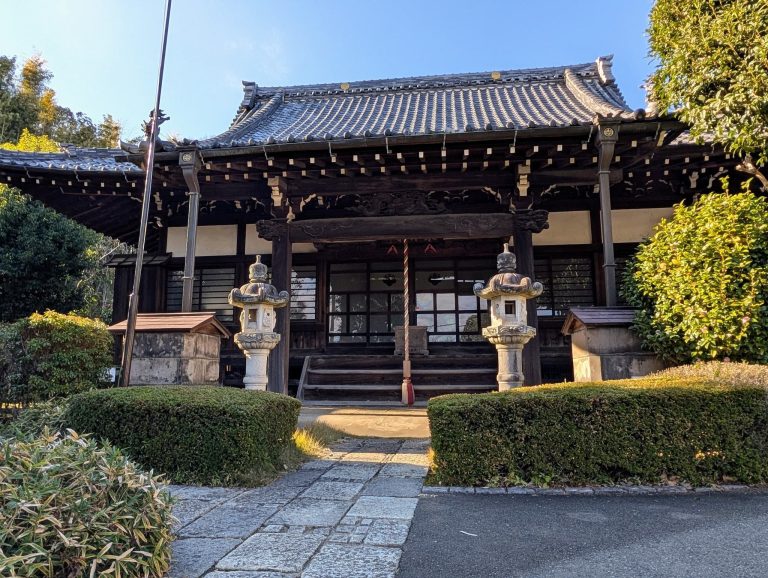
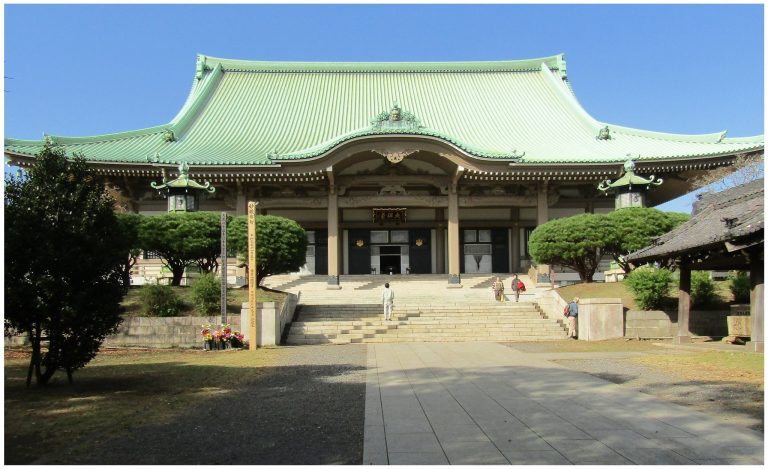
The present main hall was rebuilt in 1981 after the destruction of the temple buildings through earthquake, fire, and wartime bombing. It forms the principal surviving worship building within the precincts.
Gate, bell tower, and Daikoku Hall
The temple gate, bell tower, and Daikoku Hall complete the principal group of buildings in the precincts. Together with the main hall, they represent the surviving architectural organization of Myōkō-ji.
Commemorative monuments
Wind-band monument
One of the two stone monuments commemorates Myōkō-ji as the birthplace of Japanese wind-band music. It bears lettering by Shimazu Tadahide, identified with the lord of the Satsuma domain, and includes a carved depiction of Satsuma retainers performing music.
Kimigayo monument
The second stone monument commemorates Myōkō-ji as the birthplace of Kimigayo. It preserves the temple’s association with the ceremonial piece performed at the 1870 military drill, whose melody was distinct from that of Japan’s present national anthem.