Iyo Kokubun-ji Temple: A Nara-Period Provincial Temple in Japan


Site at a Glance
- Rating
- 3.9
- Popularity
- Low
- Country
- Japan
- Primary era
- Early Modern
- External website
- Open
- Eras represented
- Medieval, Early Modern
- Civilizations
- Tokugawa
- Site type
- Religious
- Remains
- Temple
On this page10 sections
History
Iyo Kokubun-ji Temple in Imabari, Japan, is the successor to the provincial temple of former Iyo Province, established within the Nara-period Buddhist network promoted by Emperor Shōmu. The temple belongs to the Shingon Risshu tradition, which combines Shingon practice with Risshu monastic discipline, and is formally known as Kongōzan Saishō-in Kokubun-ji. Its foundation is traditionally placed in 741, although the precise circumstances and date remain uncertain.
Foundation under the provincial temple system
In 741, Emperor Shōmu ordered a provincial monastery and nunnery for every province. Known as kokubunji temples, these institutions were intended to protect the state through Buddhism, support accepted Buddhist teaching in the provinces, and express the authority of the centralized Ritsuryō government, the ancient Japanese system organized through administrative laws and regulations. Iyo Kokubun-ji formed part of this nationwide program and served as the provincial headquarters of Buddhism in Iyo.
Temple tradition attributes the foundation to the Buddhist priest Gyōki, who is also said to have created the image of Yakushi Nyorai, the Buddhist figure associated with healing and medicine. The temple was traditionally conceived as a complete seven-hall compound and as an institution founded at Emperor Shōmu’s request. The Shoku Nihongi records that Buddhist implements were presented in 756 to provincial temples in 26 provinces, including Iyo. This provides evidence that the temple was probably complete by that time.
Religious and administrative development
According to temple tradition, Kūkai, also known as Kōbō Daishi, visited during the tenure of the third abbot, Chihō Risshi. Kūkai is said to have donated painted images of the Five Wisdom Kings, a group of wrathful Buddhist protective deities. Shinnyo later donated the Lotus Sutra. Alongside its religious role, Iyo Kokubun-ji carried out civil administrative functions. Regional military leaders and wealthy landholding families, including the Kōno and Ochi, supported the institution.
A Kasuga Shrine was invited to act as the temple’s guardian in 1050. The local castle lord rebuilt it in 1611. During the early Meiji period, a government policy separating Buddhism and Shinto made the shrine independent from the temple. Its separated precinct covered 167 tsubo, a traditional Japanese unit of area.
Warfare, decline, and rebuilding
The temple was repeatedly damaged during periods of warfare. It suffered during the Fujiwara no Sumitomo Rebellion in 939, the Genpei War in 1184, a fire associated with Hosokawa Yoriyuki in 1364, and Chōsokabe Motochika’s invasion in 1584. It was burned and entered severe decline, although it was revived repeatedly. Four attacks during the Tenshō era further reduced the complex, leaving little of its former scale.
Many provincial temples declined after the Ritsuryō system weakened, but Iyo Kokubun-ji continued, despite its precarious circumstances, as a center of Buddhist faith in Iyo. The present precinct is identified with the site of the Iyo provincial government offices. The original Kokubun-ji stood somewhat farther east before the temple was rebuilt on or near the former government-office site toward the end of the Edo period. The present main hall dates from a rebuilding in 1789.
Iyo Kokubun-ji is a special head temple within the Shingon Risshu tradition. In the pilgrimage tradition it is known simply as Kokubun-ji and is the 59th temple of the Shikoku 88-temple pilgrimage. It is also the seventh site of the Iyo Fuchū Thirteen Stone-Buddha Pilgrimage. The foundation stones of the former east pagoda were designated a National Historic Site on March 3, 1921. The temple’s shoin, a reception, study, or residential building in a temple complex, preserves temple treasures and cultural assets dating from the Nara to early Heian periods, together with material excavated from the original temple site.
Remains
Present precinct
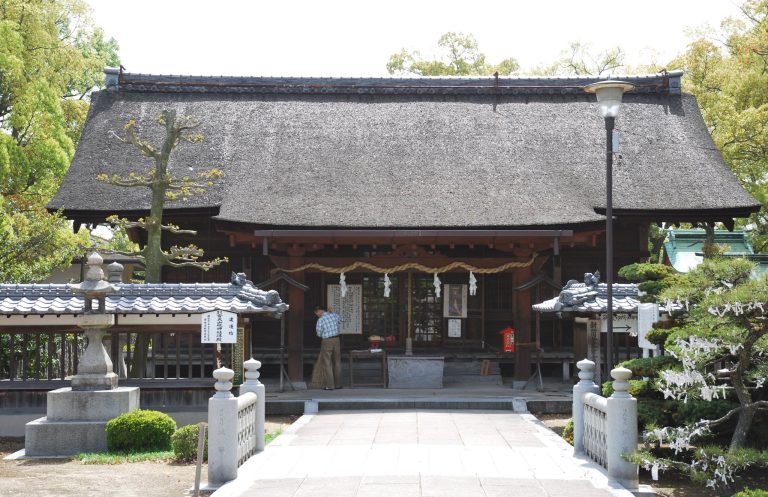
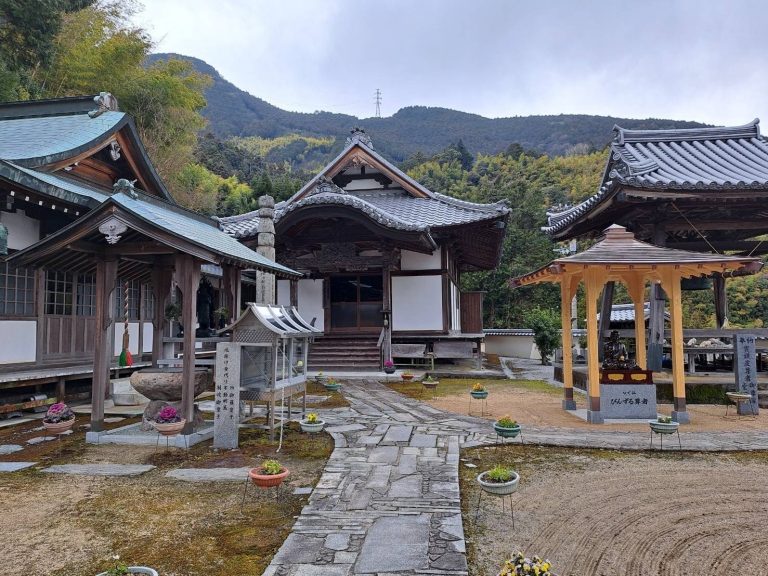
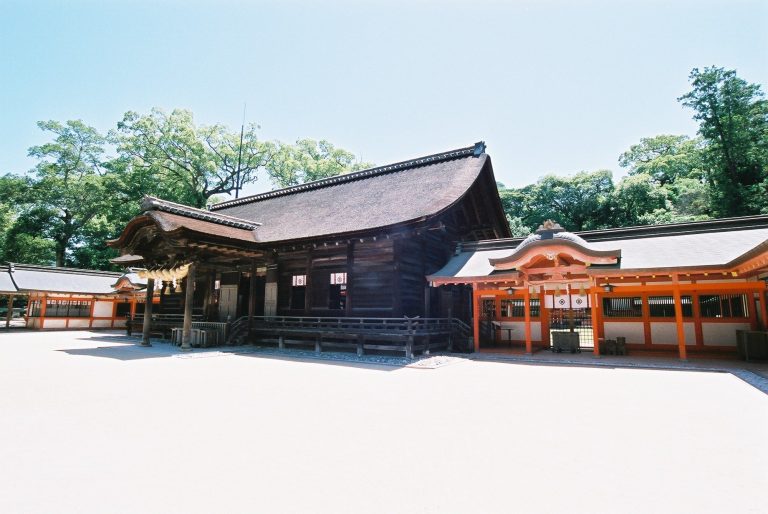
Iyo Kokubun-ji stands on or beside the small Kameyama hill. The approach rises by several stone steps to a bell tower on the right and a gate supported by stone pillars. Two cherry trees once stood beside the gate, and the tree on the right was later removed because of its age. Immediately inside the entrance is a purification basin through which water flows from a medicine jar. A separate medicine jar associated with Yakushi Nyorai and a statue of Kōbō Daishi used for a handshake practice stand on the right.
The main hall stands directly ahead, while the Daishi Hall is positioned to its right. The shoin and the office for registering sutras stand to the left. The main hall is the surviving building from the 1789 rebuilding. At the top of the hill stands the small Kasuga Shrine, which remains a distinct physical feature of the former temple landscape.
Former east pagoda area
Pagoda foundation
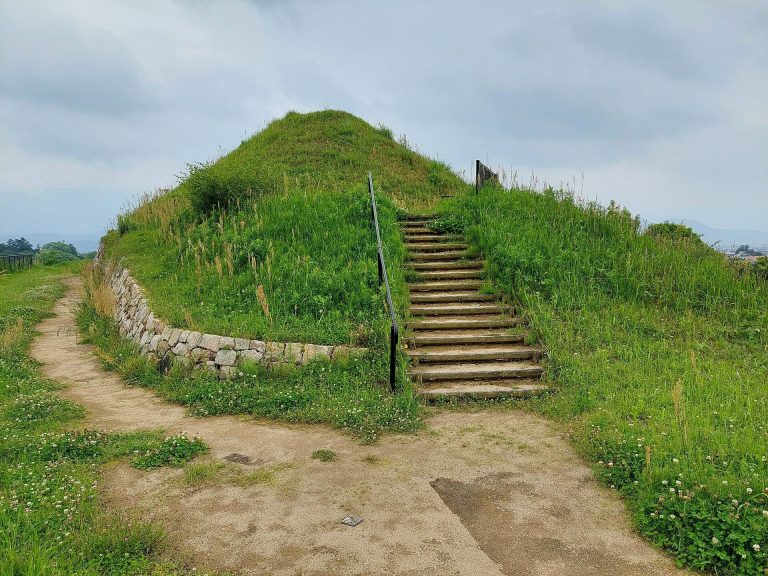
The former east pagoda stood approximately 100 meters east of the present temple. Its square foundation measures about 17.4 meters on each side, and twelve corner foundation stones remain. The central stone, three side-pillar stones at the northeastern corner, and four heavenly-pillar stones at the northwestern corner remain in their original positions. Other stones have shifted or tilted, while the foundation stones as a whole remain in situ.
Southern corridor
Archaeological investigation identified a level area about six meters wide, located 27 meters south of the foundation’s central stone. It is interpreted as the southern corridor of the original temple. The corridor lay between two ditches, approximately four meters wide on the north and six meters wide on the south, helping define the organization of the former compound.
Excavated temple materials
The shoin houses material excavated from the former temple site. These remains complement the surviving east pagoda foundations and preserve physical evidence of the earlier Kokubun-ji complex. The temple also retains treasures and cultural assets dating from the Nara through early Heian periods, linking the present institution with the provincial temple established under Emperor Shōmu’s eighth-century policy.