Musashi Mitake Shrine: A Mountain-Worship Shrine on Mount Mitake


Site at a Glance
- Rating
- 4.4
- Popularity
- Medium
- Country
- Japan
- Primary era
- Early Modern
- External website
- Open
- Eras represented
- Early Modern
- Civilizations
- Tokugawa
- Site type
- Religious
- Remains
- Sanctuary
On this page9 sections
History
Musashi Mitake Shrine is a Shinto shrine on the summit of Mount Mitake in Ome, Japan, whose traditions connect it with ancient worship and whose medieval development made it a center of mountain religion in the former Musashi Province. Its sphere of devotion extended across Musashi and Sagami.
Origins and Medieval Development
Tradition places the shrine’s foundation in 91 BC, the seventh year traditionally assigned to Emperor Sujin, regarded as Japan’s tenth emperor. In 736, the Buddhist monk Gyoki is said to have enshrined Zao Gongen, a Buddhist-Shinto deity associated with mountain asceticism, at the site.
In 1234, Ōnakatomi Kunikane rebuilt buildings that had fallen into disrepair. The shrine then became associated with Shugendo, a Japanese mountain-based religious tradition combining ascetic practice with elements of Buddhism, Shinto, and local mountain worship. Warrior governments and samurai in the Kanto region donated weapons and armor to the shrine.
Early Modern Buildings
The main shrine was built in 1605 under the direction of Ōkubo Nagayasu, a Tokugawa-period government official who served as construction magistrate. An offering hall and a worship hall were added in 1700, establishing the principal arrangement of buildings that remains associated with the summit complex.
Names, Deities, and Religious Status
During the Meiji period, the policy separating Shinto and Buddhism led to the renaming of Mitake Daigongen, also called Mitake Zao Gongen. The shrine was identified with Omatonotsu Tenjin Shrine, an ancient shrine listed in the Engishiki, a tenth-century administrative and ritual code containing registers of officially recognized shrines. Because another shrine was also identified with Omatonotsu Tenjin Shrine, the site was later renamed Mitake Shrine. It received the name Musashi Mitake Shrine in 1952.
The principal deity is Kushimachi no Mikoto. Zao Gongen is also enshrined, together with its sacred retainer Ōguchi Makami, a wolf-associated guardian deity linked with protection and mountain worship. Musashi Mitake Shrine is an independent shrine outside the Association of Shinto Shrines, is classified as a former prefectural shrine, and is identified by one theory with the small-ranked Omatonotsu Tenjin Shrine of the Engishiki.
Annual Observances
The yearly calendar includes the Spring Grand Festival on March 8, the Grand Festival and Hinode Festival on May 7 and 8, the Great Purification on June 30, and the Autumn Grand Festival on November 8.
The Yabusame Festival takes place on September 29. Although its modern form uses no horse, it functions as a shadow festival corresponding to the spring Hinode, or sunrise, festival. Offerings are made and the shrine doors are opened and closed before priests perform a bow-and-arrow rite before the mountain gate. After shooting gestures and an upward shot, the archer declares that evil has been struck.
Pieces of wood from the ritual fire are distributed to worshippers. Traditionally, families place grilled fish on the pieces at home as protection from illness during the following year. Some participants also take home the target or arrows.
Remains
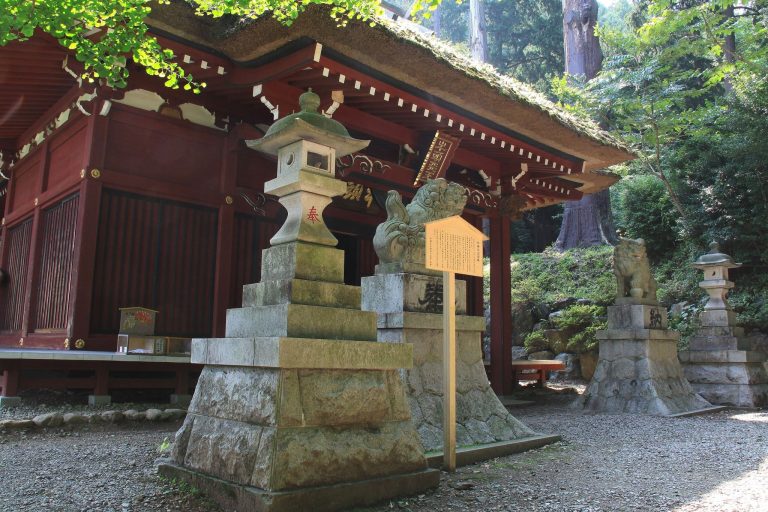
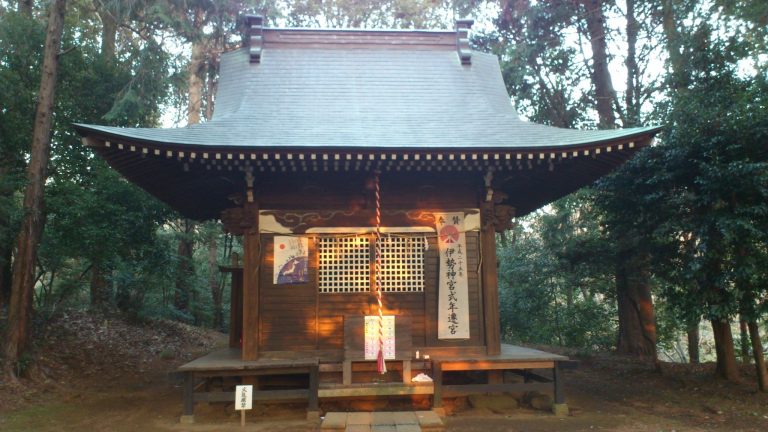
The shrine complex occupies the summit of Mount Mitake and is organized around its principal Shinto buildings. Its surviving architecture includes a one-bay main shrine in the Shinmei-zukuri style, an ancient form characterized by a raised floor, straight roof ridges, and strongly vertical proportions, together with an offering hall and a worship hall.
Principal Shrine Buildings
Main Shrine
The main shrine dates to 1605 and follows the one-bay Shinmei-zukuri form. Its raised-floor construction and vertical proportions express the simple architectural character associated with this style.
Offering and Worship Halls
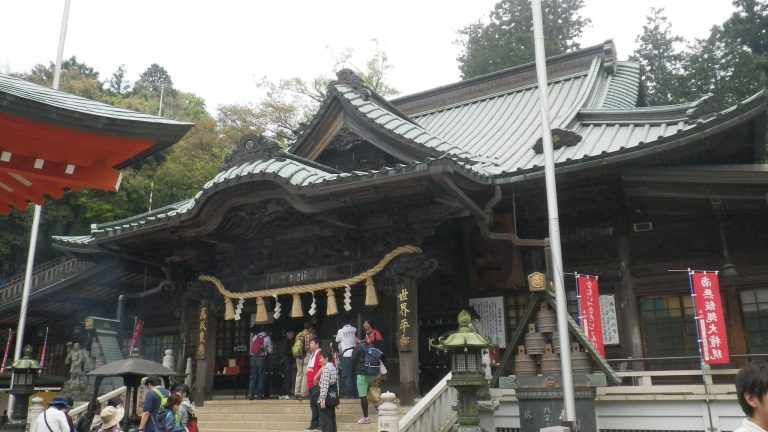
The offering hall and worship hall date to 1700. They form part of the principal building group at the summit, alongside the main shrine, and provide the architectural setting for offerings and acts of worship.