Tanjō-ji Temple: A Jōdo-shū Buddhist Temple at Hōnen’s Birthplace


Site at a Glance
- Rating
- 4.3
- Popularity
- Low
- Country
- Japan
- Primary era
- Early Modern
- External website
- Open
- Eras represented
- Medieval, Early Modern, Modern
- Civilizations
- Ashikaga shogunate, Japanese, Tokugawa
- Site type
- Religious
- Remains
- Temple
On this page15 sections
History
Tanjō-ji Temple is a Jōdo-shū Buddhist temple in Japan, founded in 1193 at the birthplace of Hōnen, the teacher who established the Jōdo, or Pure Land, tradition in Japan. Hōnen emphasized devotion to Amida Buddha through recitation of the nenbutsu, the practice of calling on Amida Buddha. The temple’s mountain name is Tochikosan, and its principal religious image is Enkō Daishi, the posthumous Buddhist title bestowed on Hōnen by the imperial court.
Foundation at Hōnen’s birthplace
The temple was established by Kumagai Naozane, a warrior from eastern Japan who became Hōnen’s disciple and entered religious life. Taking the name Hōriki-bō Renshō, he built the temple on the former residence of Hōnen’s father, Uruma Tokikuni. Tokikuni had served as the Kume oshōryōshi, a local military and administrative official with authority over a district or territory.
Tanjō-ji was formerly known as Tanjō Ritsu-ji. That earlier name remains on the plaque above the Mie-dō, linking the present institution with its former identity.
Reconstruction and institutional role
The Mie-dō was damaged twice before the present building was reconstructed in 1695. Its roof was repaired in 1998 after deterioration. The former Amida-dō was later dismantled because of its condition and replaced by a newly constructed building called Zuio-den in 2003.
Within the Jōdo-shū tradition, Tanjō-ji is designated a special temple, a high institutional rank. The temple precincts are a prefectural historic site. The Mie-dō and Sanmon are nationally designated Important Cultural Properties, while Muku Bridge is a nationally registered Tangible Cultural Property.
The temple is connected with several pilgrimage circuits, including the Twenty-Five Sacred Sites of Hōnen, the Chūgoku Thirty-Three Jizō pilgrimage, the Chūgoku Thirty-Three Kannon pilgrimage, the Sanyō Flower Temple circuit, and the 108 Kannon pilgrimage.
The Twenty-Five Bodhisattva Procession
Each year, on the third Sunday of April, Tanjō-ji holds the Tanjō-ji Twenty-Five Bodhisattva Procession. Its formal name is the Great Memorial Service of the Welcoming Procession of Twenty-Five Bodhisattvas and Heavenly Attendants for Hōnen’s Parents. A Buddhist welcoming procession, or renkuyō, is a ritual in which participants represent bodhisattvas and other Buddhist figures while enacting Pure Land devotional imagery.
The procession is said to have continued since the Muromachi period, the Japanese era spanning roughly the fourteenth through sixteenth centuries. It is regarded as one of Japan’s three major Buddhist welcoming processions and is designated an Important Intangible Folk Cultural Property of Okayama Prefecture.
Remains
The temple precincts contain historic halls, a main gate, a stone bridge, Buddhist images, and memorial monuments. These features reflect successive periods of construction from the Nanboku-chō period, the era of political division between rival Northern and Southern Courts, through the Edo period and into the twentieth and twenty-first centuries.
Temple buildings and entrance structures
Mie-dō
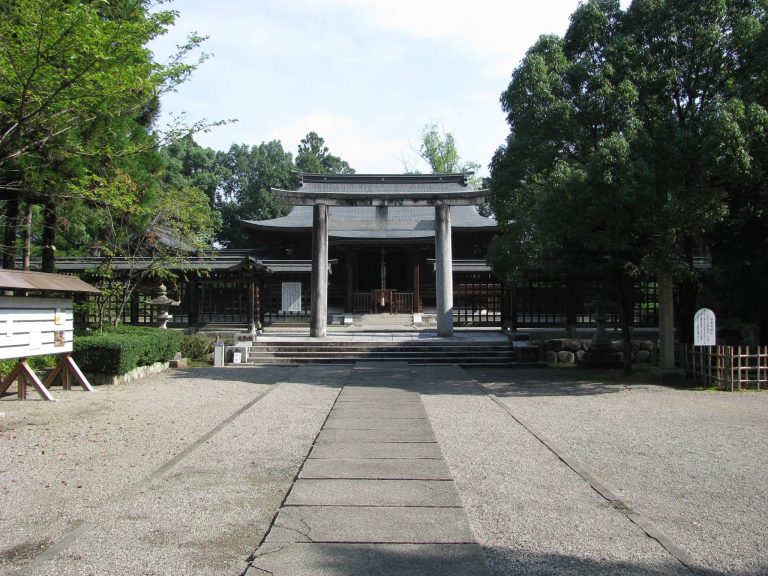
The Mie-dō is Tanjō-ji’s main hall and the present reconstruction of the building completed in 1695. It is designated an Important Cultural Property of Japan. The hall’s roof received repairs in 1998, preserving the building after deterioration had affected its fabric.
Sanmon
The Sanmon, or main gate, was built in 1716. Its attached striped mud wall was donated in 1857 by the Fushimi-no-miya, an imperial princely house of Japan. The gate and its associated wall form part of the temple’s historic entrance complex.
Zuio-den
Zuio-den is the building that replaced the former Amida-dō. The earlier hall was dismantled because of deterioration, and the replacement was reconstructed in 2003.
Muku Bridge
Muku Bridge is a stone bridge spanning the Katame River. Built in 1920, it measures 7.3 metres in length and 2.6 metres in width. It is registered nationally as a Tangible Cultural Property.
Buddhist images and memorial monuments
Large Buddha image
A large Buddha image cast in 1745 stands 6.42 metres high and weighs 450 kilograms. It is described as the largest Buddha image in Okayama Prefecture.
Stone pagodas
The precincts include a stone hōkyōintō pagoda from the Nanboku-chō period and a stone gorintō pagoda made in 1425. A hōkyōintō is a Buddhist memorial pagoda associated with the Hōkyō-in Dharani scripture, while a gorintō is a five-part stone monument representing the elements of Buddhist cosmology.
Associated cultural property
Religious and historical objects
The temple’s associated cultural-property inventory includes an early Muromachi-period embroidered hanging depicting the welcoming descent of Amida and two bodhisattvas. It also includes a Nanboku-chō-period wooden image of Shaka in the style of Seiryō-ji, a Kamakura-period standing wooden image of Amida, and an Edo-period turret clock.