Mulgrave Castle: Three Successive Estates near Whitby
Site at a Glance
- Rating
- 4.7
- Popularity
- Very Low
- Country
- United Kingdom
- Primary era
- Unclassified
- Eras represented
- Unclassified
- Civilizations
- Unclassified
- Site type
- Domestic
- Remains
- Castle
On this page8 sections
History
Mulgrave Castle is an estate of three successive structures at Lythe near Whitby in the United Kingdom, including an ancient castle linked to tradition, a Norman fortification, and a later castellated country house. The Norman castle was probably built after the Norman Conquest, the takeover of England begun by William, Duke of Normandy, after his victory at Hastings in 1066. It became the administrative center, or caput, of the feudal barony of Mulgrave.
The ancient castle and local tradition
Tradition attributes the earliest castle to Wada, a sixth-century ruler of Hälsingland. Around 1545, the antiquary John Leland recorded local legends that presented Wada as a giant responsible for building numerous castles and roads in Yorkshire. This tradition forms the legendary first phase of Mulgrave’s history.
The Fossard and Mauley baronies
The second castle was probably commissioned by Nigel Fossard, who acquired the estate after the Norman Conquest and died around 1120. The Domesday Book, the survey of English landholding and resources ordered by William the Conqueror in 1086, recorded Fossard as holding 114 Yorkshire manors. In 1088 he became a tenant-in-chief, meaning that he held land directly from the king. Mulgrave served as the principal seat of his extensive feudal barony.
The barony contained 33 and a half knight’s fees in the 1166 Cartae Baronum return. A knight’s fee was a unit of land or service associated with supporting a mounted knight. The inheritance passed from Nigel Fossard to his son Robert, then to William I and William II Fossard. William II’s heiress Joan transferred the barony through marriage to Robert de Thornham, who died in 1211.
Isabel de Thornham, the surviving heiress, subsequently brought the barony to Peter de Mauley. King John had granted Isabel to Peter in marriage after the barony had returned to the Crown. Peter, a native of Poitou, was reportedly rewarded for the murder of Prince Arthur in 1203, a rival claimant to John’s throne. He later served as governor of Corfe Castle and acted there as jailer of Arthur’s sister Eleanor.
Peter I de Mauley’s heir, Peter II de Mauley, lived from 1226 to 1279 and married Joan de Brus. During his tenure, the barony was held by knight service that required the provision of two knights for the king during wartime, for 40 days each year. Peter II was succeeded by Peter III de Mauley, who died in 1308. Peter III married Nicole de Ghent, a sister and one-third co-heiress of Gilbert V de Ghent, feudal baron of Folkingham.
The Mauley barony and later inheritance
Peter III was summoned to Parliament by a writ dated 23 June 1296, becoming Baron Mauley. His seal was among the 72 seals attached to the Barons’ Letter to the pope, sealed at the Parliament of Lincoln in January 1301. Peter IV de Mauley died in 1348. William Camden later stated that the first Peter de Mauley was followed by seven others of the same name.
The castle later passed to Sir John Bigod of Settrington through his marriage to Constance de Mauley, the eldest daughter and co-heiress of Peter VII de Mauley. Peter VIII de Mauley died without issue in 1415, after which the barony of Mauley became extinct by writ. Sir John Bigod was descended in the fifth generation from Hugh Bigod, 3rd Earl of Norfolk.
Through Dorothy Bigod’s marriage, the estate passed to the Radcliffe family and then, in 1625, to Lord Sheffield of Butterwick. King Charles I later created him Earl of Mulgrave. Successive owners modernized and altered the original Fossard castle before the events of the English Civil War.
Civil War destruction and the later country house
Royalists, supporters of King Charles I during the conflicts of the 1640s, garrisoned the castle. After Parliament’s victory, Parliament ordered its dismantling in 1647. Bricks were distributed after the destruction, and their pattern suggests that gunpowder may have been used, although the method of demolition remains uncertain.
The third structure was commissioned by Lady Catherine Darnley, also known as Lady Catherine Sheffield, Duchess of Buckingham and Normanby. She was an illegitimate daughter of King James II and Lady Catherine Sedley, Countess of Dorchester, and the wife of John Sheffield, 1st Duke of Buckingham and Normanby. The estate passed to the Phipps family in 1718, when the duchess’s daughter, Lady Catherine Annesley, married William Phipps. The family later held the titles Baron Mulgrave, Earl of Mulgrave, and Marquess of Normanby.
A summer house was also built on the estate. Legend associates it with a hermitage founded by William de Percy in 1150. Duleep Singh, the last Maharajah of the Sikh Empire of Punjab, which was annexed by the British in 1849, leased the country house in 1858. As of 2010, Constantine Phipps, 5th Marquess of Normanby, held the estate. The buildings have been Grade I listed since 1969.
Remains
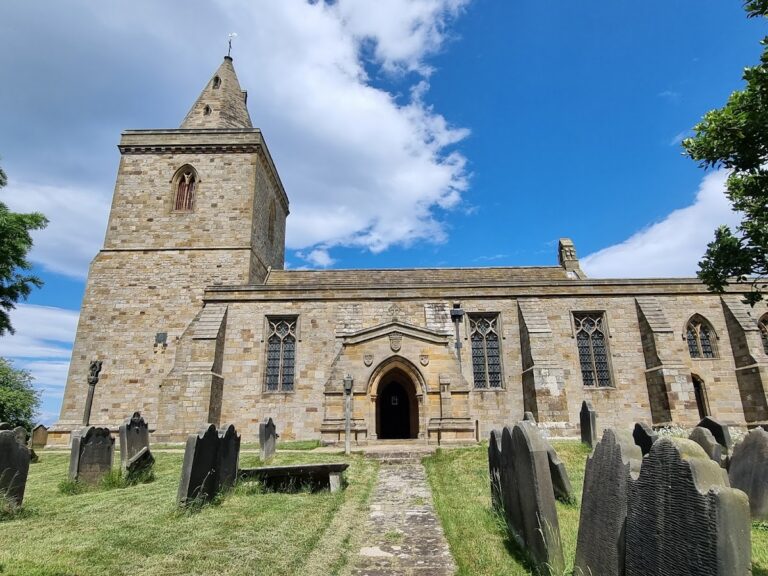
The physical features described at Mulgrave belong chiefly to the Norman castle and the later estate buildings. The Norman fortification occupied the full width of a ridge, with its main approach from the west. Moats protected the eastern side, while a drawbridge controlled the western approach. The later castellated country house forms the present manor or ancestral home associated with the Phipps family.
Norman fortification
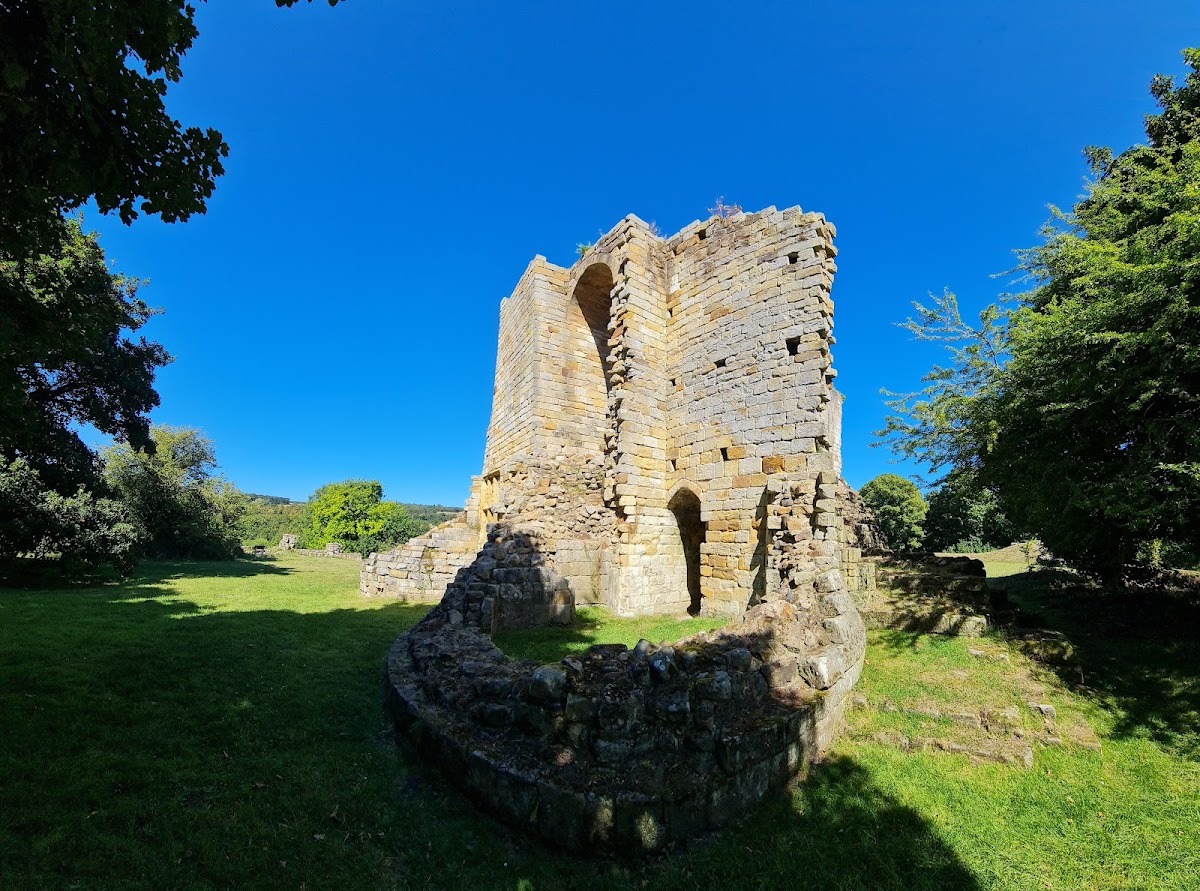
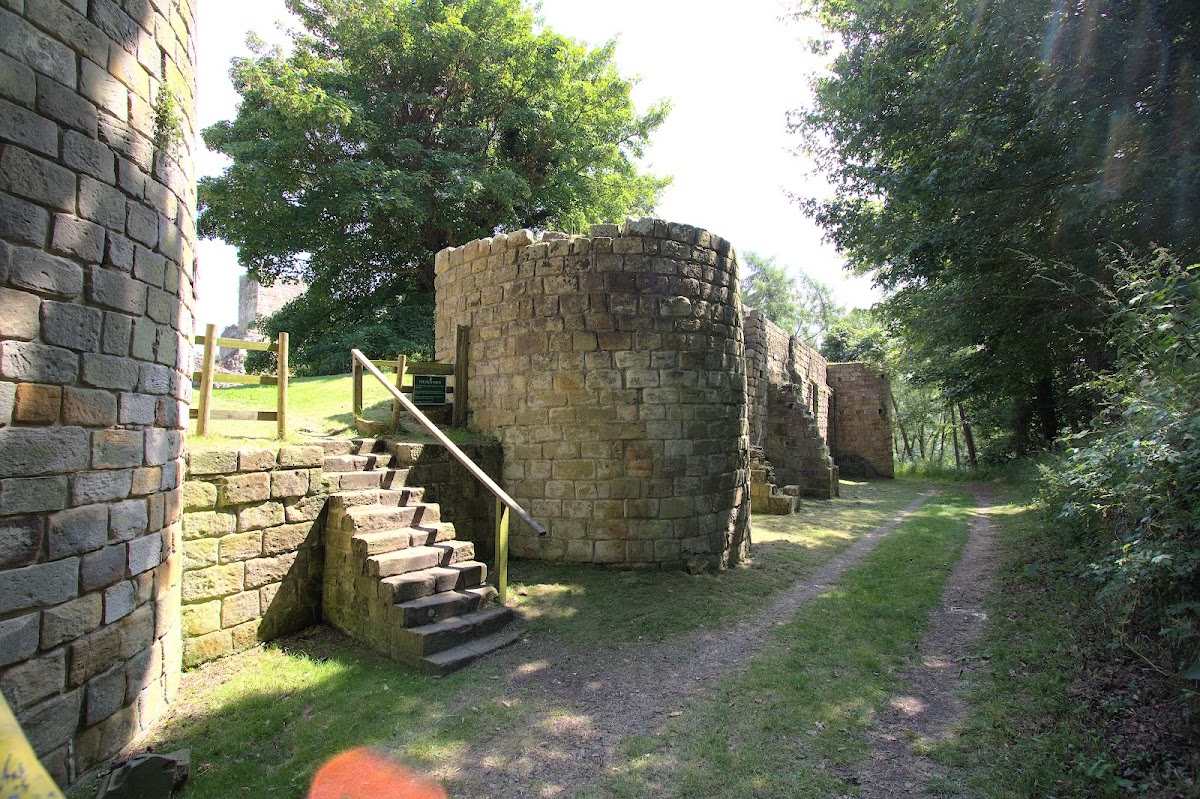
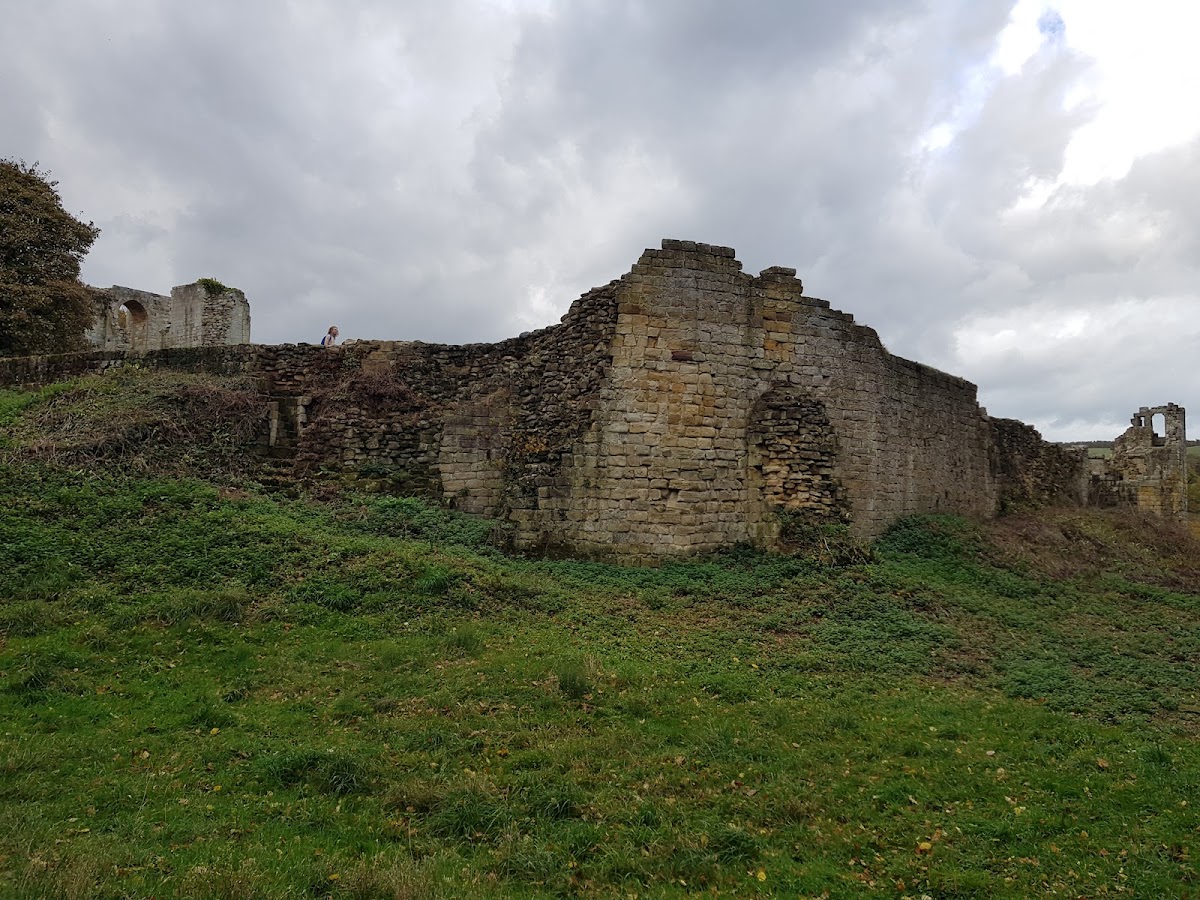
The Norman castle was arranged as a stronghold across the ridge. Two stone towers flanked its western entrance, and the drawbridge restricted access from that direction. Moats defended the eastern approach. Differences in ground level around the castle caused the curtain wall, the main enclosing defensive wall, to bulge outward, so external buttresses were added to support it.
Some bricks incorporated into the Norman castle were clearly Roman in origin. The fortification was dismantled in 1647 after its occupation by Royalist forces during the English Civil War. The distribution of bricks following its destruction indicates that gunpowder may have played a part in the demolition, though the precise method is uncertain.
Country house and summer house
The later structure is a castellated country house or mansion, described as the present manor and ancestral home of the Phipps family. A separate summer house stands among the estate buildings and is traditionally placed on the site of William de Percy’s hermitage of 1150. That association belongs to local legend rather than an established archaeological identification.