Grazer Mühlgang: A Historic Mill Channel in Graz
Site at a Glance
- Popularity
- Medium
- Country
- Austria
- Primary era
- Medieval
- Eras represented
- Medieval, Modern
- Civilizations
- Duchy of Styria, Holy Roman Empire
- Site type
- Infrastructure
- Remains
- Canal
On this page21 sections
History
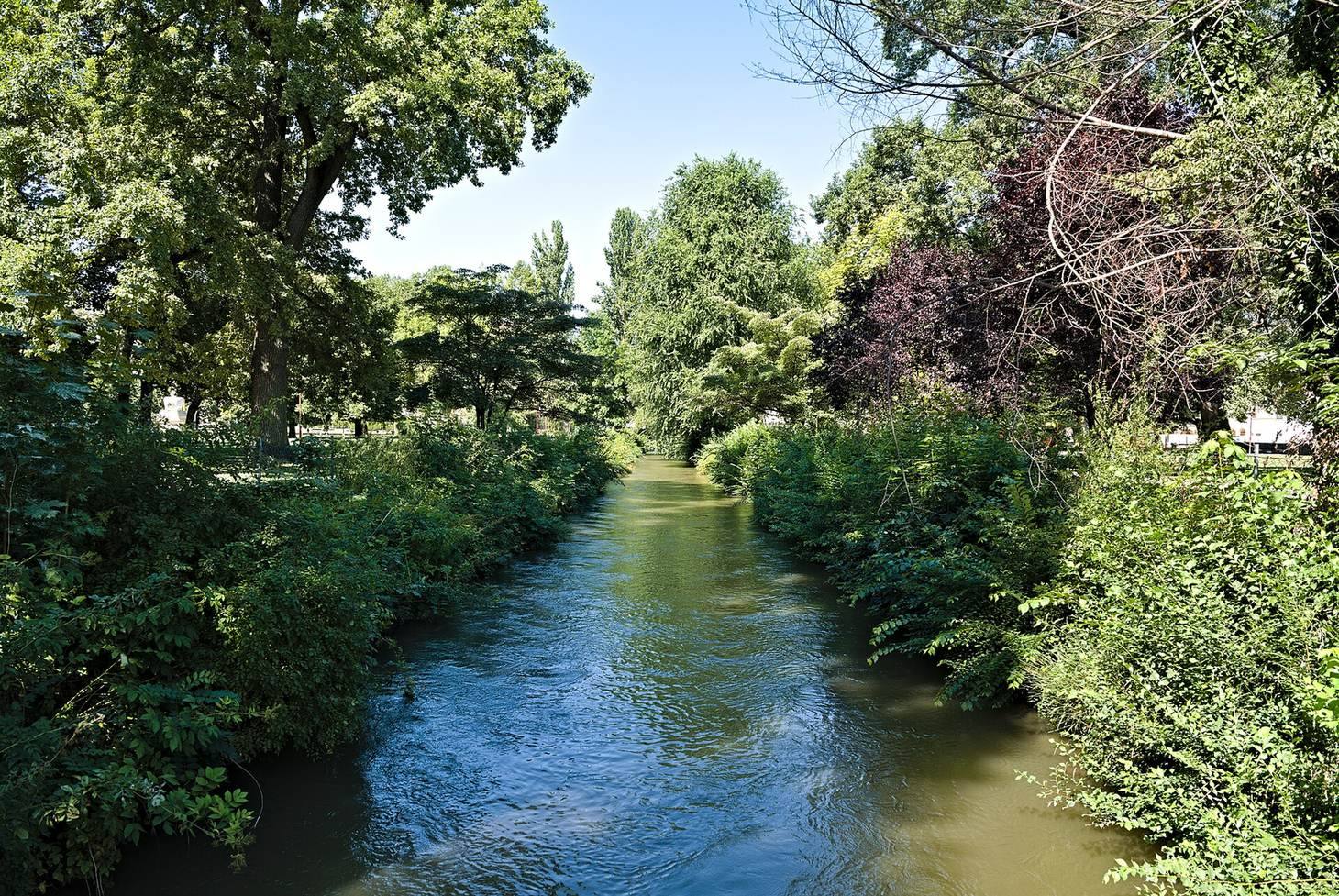
The Grazer Mühlgang is a mill race, a channel that carries water to mills and other machinery, on the right bank of the river Mur in Graz, Austria. Built in the 13th century, it powered mills and later supported a range of crafts and industries. Today, its water is used chiefly to generate electricity.
Medieval origins and industrial use
The channel’s long history of milling includes the Rösselmühle, first mentioned in 1270. It was described as Graz’s oldest mill and one of Austria’s oldest. Over time, the Mühlgang served grain mills, paper production and other businesses, including manufacturers of animal feed. A paper mill on the channel operated from the 16th century until 1956.
Water from the Mur also supported activities beyond factory production. Timber was floated down the river until around 1900, and firewood may have been carried from it into the Mühlgang. Outdoor swimming baths drew water from the channel: a swimming school near Wiener Straße was operating by 1910, and another bath stood north of Wartingergasse. Before the Second World War, residents used the narrow Wassergasse branch to wash and rinse laundry, a practice that declined after the war.
Power stations and changing channels
The canal’s industrial role expanded to include electricity generation. The Viktor Franz power station was built between 1903 and 1905, about 300 metres upstream from the former Jesuitenmühle, also known as the Ebenwaldner Mühle, at the Gösting toll gate. At a paper factory beside the Mur and Mühlgang, Austrian paper-industry businessman Viktor Czerweny von Arland acquired a majority shareholding in 1939; the factory also used the channel for water power.
Graz once had channels on both banks of the Mur. The lower left-bank branch, the Gössendorfer Mühlgang, was abandoned in 1916 after flood deposits buried it. The upper left-bank channel supplied electricity to the tram system from 1918 until 1975, then was filled in around 1976–77. The Rottalwerk on this branch had two turbines, which were replaced during the British occupation. By contrast, the right-bank channel remained in use.
Industrial closures and continuing use
Several mills ended production in the late 20th century and early 21st. The Marienmühle stopped milling in 1989 and was demolished in 2005. Milling at the Taggermühle had ended by about 2000. Its company had also made livestock feed, including products using fish meal, and operated silos and rail-loading facilities. After the company became insolvent, a bank took over the works; the plumbing and heating business Kossegg later acquired the buildings and began adapting them.
The Rösselmühle was the last mill in Graz to stop milling, in January 2014, although its turbines continued to produce electricity. At closure, its workforce numbered 22 and its output was mainly wheat flour, alongside rye flour, for retail sale and export. In early 2014, Pfahnl Backmittel GmbH took over the Polsterer mill, while the Rösselmühle name continued in marketing. Fires affected the mill buildings in 2017 and again in April 2023; three teenagers were later convicted of starting the 2023 fire.
The right-bank Mühlgang remains almost entirely in use for electricity generation, with 12 hydropower plants along the channel. New Mur power stations at Gössendorf and Kalsdorf entered service in 2012 and 2012–13, extending the Mühlgang south by about two kilometres. The Älteres Mühlen Consortium, an association of mill owners, owns the channel. Energy Graz operates three small hydropower plants on it.
Remains
The Mühlgang is about 25 kilometres long. It takes water from the upstream side of the Weinzödl power station in northern Graz, crosses the city and Feldkirchen bei Graz, and returns to the Mur near Großsulz, close to Kalsdorf. Its course passes industrial sites, power works and urban areas, while filled branches and former mills survive in altered forms or in traces of the earlier landscape.
Course and branches
Main channel
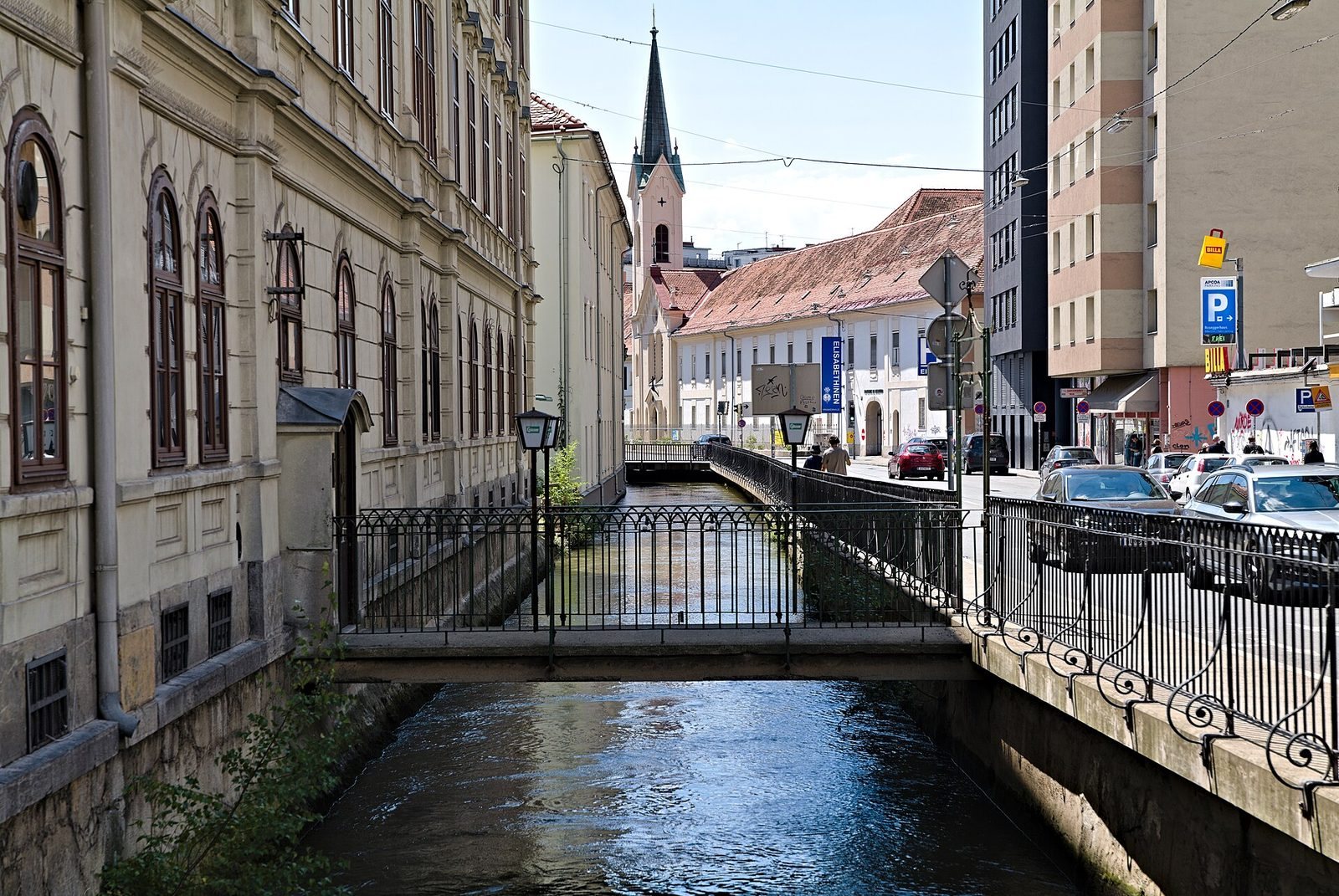
Within northern Graz, the channel runs for stretches east of and parallel to Wiener Straße. It passes through Friedenspark, formerly the Frauenbad, by the former paper mill and the Rondo at Marienplatz, and beneath the Stadtmühle between Volksgarten and Annenstraße. Farther south, it follows Elisabethinergasse through the Rösselmühle and past the Köstenbaummühle. It then passes a power station at Herrgottwiesgasse, skirts the west side of the slaughterhouse and the former Taggermühle opposite, and continues east of Puchstraße through Puntigam.
At the city boundary, some of the water flows back into the Mur while the remainder continues through Feldkirchen. In the north, the local stream Thaler Bach enters from the right. The Aubach and Schleifbach branch off to the left; the Aubach is also treated as a continuation of the Thaler Bach.
Intake and Schleifbach
At Weinzödl, water enters the Mühlgang through a small turbine. A concrete fish passage, built around 2015 to help fish pass the barrier, crosses the intake area and leaves about 50 centimetres of clearance above the water. The Schleifbach, about 1.25 kilometres long, descends roughly 10 metres before reaching the Mur. Six waterwheels once operated along it, none powering a grain mill. Since 2017, most of its water has run through a roughly 1.2-kilometre glass-fibre-reinforced pipe with an internal diameter of 1,200 millimetres, laid mainly in the former open channel. A small amount of water returned to the old channel in 2019, and a power station stands near its former outlet.
Hydropower and paddling features
Weinzödl power station and slalom course
Near Weinzödl, a small hydropower plant produces 215 kilowatts. Below its turbine outlet, the Kanu Club Graz slalom course uses wooden installations on alternating banks to create eddies. The club renewed gates and added a wooden entry and other structures that shape the water. The course was named the Gerhard-Peinhaupt-Slalom in 2016, after paddling world champion Gerhard Peinhaupt. The first crossing bridge can be passed beneath by boat; the second does not provide enough clearance.
Mugl-Wave
Near the Puchstraße roundabout, Kanu Club Graz members built the Mugl-Wave in 2015. Its upper adjustable weir, a low barrier that controls water level and flow, consists of two boards in a steel frame, with a tilting-board weir farther downstream. Four structures alternate along the banks to form eddies where paddlers can wait and practise moving upstream. The structures are about 50 centimetres wide and have underwater footholds; ropes are fixed to the side walls. A sloping, carpet-covered platform above the upper weir provides an entry point for playboating, an acrobatic form of kayaking on a wave or rapid.
Taggermühle channel arm
At the former Taggermühle, a channel arm that once turned the mill wheel is blocked a few metres upstream. Water now runs through a curved bypass about 20 metres to the east. Near a bridge, a partly surviving sluice, or water-control gate, and a lower board weir can be used to narrow the flow and create a short rapid.
Former mills and industrial sites
Rösselmühle
The Rösselmühle occupies a site at Elisabethinergasse 45 and Oeverseegasse 1, beside the former post garage. Part of the mill-owned Oeverseepark area is leased to the City of Graz. One old building has four storeys and a timber core. The 2023 fire damaged its upper two storeys and roof, as well as part of the roof of an adjoining silo.
Stadtmühle and Marienmühle
The Stadtmühle is now used as apartments. Its internal timber structure forms an open central space extending up to the roof. The Marienmühle stood on the site now occupied by the Rondo. Demolition briefly exposed the Mühlgang there in 2005, and large photographs in the Rondo recall the former mill.
Taggermühle
The Taggermühle’s undershot wooden wheel, driven by water flowing beneath it, measured about 3.5 metres across and two metres wide. A gear train in a cast-iron housing connected it to a generator marked as 50 horsepower. The wheel was removed around 2015 and placed on land, where it was deteriorating by 2020. The works also included a rectangular reinforced-concrete silo tower, truck-handling facilities, two rail sidings linked to the Graz industrial railway and the Eastern Railway, loading ramps inside a hall, and a heating house.
Volksgarten waterwheel
A waterwheel in the Volksgarten feeds the park pond. It recalls the channel’s earlier use to power craft and industry.
Traces of the left-bank channels
Upper Mühlgang
The former upper left-bank channel began at one of two weirs above the old Weinzödl Bridge and ran by Weinzöttlstraße, Lindengasse, Kahngasse and Körösistraße. Its sealed outlet beneath the present Elise-Steininger footbridge remains visible, including the outline of a granite arch in the riverbank structure. Other traces include bridges over the filled channel near Hasnerplatz, a stretch now used as a cycle path, and parts of the former bed near the Keplerplatz substation and beneath a lawn in a courtyard at Körösistraße 21–23. The short Wassergasse branch from this channel was no more than about a metre wide and 60 centimetres deep.
Lower left-bank channel
The lower branch was diverted from a Mur weir in the area of the Augarten. Its former course is reflected in the curved street Am Langedelwehr and the narrower, winding Mühlgangweg. Two parallel paths near Neuholdaugasse mark the line of its former banks.
Water management
The Mühlgang normally carries about 11 cubic metres of water per second. Before forecast heavy rain, the supply from the Mur is reduced, sometimes to roughly three-quarters of its usual level, to leave room for additional water from the Thaler Bach. The channel is drained twice a year for inspection and maintenance: a preliminary emptying takes place in late June and the main one in September. The September work removes gravel, silt and other debris, and workers from the fishing association rescue fish beforehand, using electrical equipment to temporarily stun them when needed. Normal flow takes three to four days to return after a full drainage.