Castle Neu-Wildon: A Medieval Hilltop Fortress in Austria


Site at a Glance
- Rating
- 4.5
- Popularity
- Very Low
- Country
- Austria
- Primary era
- Medieval
- Eras represented
- Medieval, Early Modern
- Civilizations
- Duchy of Styria, Habsburg, Holy Roman Empire
- Site type
- Military
- Remains
- Castle
On this page18 sections
History
Castle Neu-Wildon, also called Ober-Wildon, is a ruined medieval hilltop castle in Wildon, Austria, built by the Lords of Wildon at the beginning of the thirteenth century. It stands on Wildoner Schlossberg, a strategically placed height beside the Mur River and the old imperial road. The castle formed part of a group of four defensive installations on the hill, which also preserves evidence of settlement reaching back to about 4600 BC.
Earlier occupation and the medieval foundation
Wildoner Schlossberg occupied an important position near one of the few crossings of the Mur. Traces of settlement extend through the Middle Neolithic and Urnfield periods, the later prehistoric era associated with cremated burials placed in urns. The hill also produced ceramic finds indicating a defensive installation of the Carolingian-Ottonian period, dating from the ninth or late tenth century.
The early medieval Hengistburg, first mentioned in 1053, has not been precisely located. Archaeologist Diether Kramer used finds from the Schlossberg to support identifying the hill with that fortress. Historian Hans Pirchegger later proposed that Neu-Wildon occupied the former site of the Hengistburg. The earlier Castle Alt-Wildon, probably built around 1170, stood about a century before Neu-Wildon. A novum castrum, meaning “new castle,” was first mentioned on the Schlossberg in 1260.
The new stronghold was built on land belonging to the Archbishops of Salzburg. In the second half of the thirteenth century, Ulrich von Wildon transferred it, then known as the “new house at Wildon,” to Otto von Liechtenstein. Otto was the son of the minnesinger Ulrich von Liechtenstein, a medieval German-language poet and composer of courtly songs. He had married Agnes, the daughter of Ulrich von Wildon’s brother Leutold, who had died in 1249, and Neu-Wildon was probably included in Agnes’s dowry. Ulrich von Wildon himself probably lived at Alt-Wildon.
Conflict after the Babenbergs
The extinction of the Babenberg dynasty, which had ruled Austria and for a time Styria, created a struggle over the duchy. Otto von Liechtenstein and Herrand II von Wildon supported Friedrich von Baden-Austria, whom they regarded as the lawful heir. They opposed the Bohemian king Ottokar II Premysl, who had become duke of Styria in 1261. Around 1262, Ottokar took Neu-Wildon into his possession, although it remains uncertain whether he obtained it by force or through a legal claim. By 1265 at the latest, the castle was listed as belonging to the territorial ruler.
Ottokar II died at the Battle of Dürnkrut in 1278, a defeat that ended his contest with the Habsburg ruler Rudolf I. The Wildon family then seized Neu-Wildon, and Herrand II received the “Neuhaus.” He placed it under the administration of his burgrave Ulrich, an official responsible for the castle’s defense and government. A dispute between Herrand and his brother Hartnid III forced Herrand to surrender the fortress to Hartnid.
The castle apparently returned to Salzburg before Duke Albrecht I received it as a fief, property granted in return for service or allegiance. Albrecht entrusted its administration and protection to Leopold I, bishop of Seckau. In December 1291, Hartnid III tried to persuade the bishop’s burgrave to surrender Neu-Wildon. When the burgrave refused, Hartnid’s troops stormed the castle and captured him.
The Landsberg League and princely control
Hartnid, dissatisfied with Albrecht I’s rule, joined Archbishop Konrad IV of Fohnsdorf in the Landsberg League on 1 January 1292. This was a medieval political alliance formed against Duke Albrecht. Later that year, the archbishop granted Neu-Wildon to Hartnid as a fief. Supporters of Albrecht attacked the castle repeatedly, and Hartnid abandoned it only after the seneschal of Emmerberg surrounded the stronghold with a wooden palisade in 1293. The peace settlement required Hartnid to pay compensation and surrender the castles of Eibiswald and Waldstein to the territorial rulers.
The Archbishop of Salzburg made repeated efforts to recover Neu-Wildon. After Albrecht I defeated his opponents and reached peace with the archbishop in 1297, however, the castle remained with Albrecht. It stayed in the possession of the territorial princes until 1625. Minor knightly families administered it for much of this period, with short appointments that limited the accumulation of local power.
The recorded burgraves included Dietrich von Graschach in 1344, Ulrich Reisacher in 1359, Andree der Puchser in 1402, Wolfhart der Chitzwell in 1406, Friedrich der Hollenecker in 1411, Conrad der Pesnitzer in 1423, and Erhart Herberstorffer in 1433. During the late fourteenth-century attack on Styria by King Louis I of Hungary, the Counts of Cilli temporarily received responsibility for the castle before princely burgraves returned.
Pledges, sieges, and rebuilding
In 1435, Duke Friedrich V, later Emperor Friedrich III, pawned Neu-Wildon to Christof Wolfsauer for six years. Wolfsauer undertook to enlarge the castle, but he supported Albrecht II during the dispute between Friedrich and Albrecht and refused to return the pledge. A Styrian force stormed Neu-Wildon in 1440. The castle was granted in 1441 to Leuthold von Stubenberg and his son Friedrich, who had taken part in its capture. Friedrich III redeemed it a few years later and transferred it to Friedrich Herberstorffer in 1445.
The Baumkircher Feud, a fifteenth-century conflict between Andreas Baumkircher and Emperor Friedrich III, brought another period of military action. Baumkircher seized Neu-Wildon at the beginning of 1469 as a base in central Styria. Imperial troops recaptured it later that year, but Baumkircher regained the castle on 2 February 1470. After an agreed truce, it returned to the emperor, who appointed his councillor and captain, Count Wilhelm von Diernstein, as administrator.
During the Hungarian Wars, Lienhart Harracher held Neu-Wildon by 1490 at the latest. Christof Glojacher followed him in 1509, and Ulrich Leysser and his brother Maximilian held the castle from 1521. The Leysser brothers received it as a pledge in 1532 in return for construction funds and began rebuilding. In 1586, Georg Leysser and his brothers received the castle on similar terms, along with the right to collect the Wildon toll.
Despite this investment, the complex was described as dilapidated in 1591. After Georg Leysser died in 1595, his heirs’ guardian, Hans Christof von Gera, acquired the pledged lordship. Wilhelm von Gera followed in 1598, then Ulrich Christof von Scherffenberg in 1600, Alban von Mosheim in 1602, and Wolf Globitzer in 1612. The name Ober-Wildon first appears for the castle during this period.
From castle to palace and decline
Emperor Ferdinand II redeemed Wolf Globitzer and sold Ober-Wildon to Hans Ulrich von Eggenberg on 15 February 1624. The Eggenbergs expanded the former fortress into a palace while continuing to have it managed by officials. Wildon was heavily indebted, and in 1715 the palace was sold by its curator, Sigmund Rudolf Count von Wagensperg, to Johann Friedrich Baron von Stampfer.
After Johann Friedrich’s death, ownership passed first to his widow, Maria Anna, born Baroness von Königsbrunn, and then in 1751 to their son Leopold. By the time of that transfer, the palace was already seriously dilapidated. Leopold died in 1775, leaving a heavily indebted lordship. The decayed palace and its associated lordship then changed hands repeatedly, passing to Gewerke Mayerhofer in 1780, lawyer Josef Ritter von Griendl in 1792, Griendl’s son Franz Xaver in 1803, and Josef Edler von Neupauer in 1866. The lordship was deleted from the land register in 1880.
After the Second World War, Wildoner Schlossberg, including the remains of Ober-Wildon, passed to provincial building director Lui von Frizberg. His family remains the owner. In 2011, H. Siegert collected isolated surface finds dating from the thirteenth or fourteenth century through the sixteenth or seventeenth century. A LEADER project cleared the castle area of trees in 2019 and 2020 and carried out a digital survey.
Remains
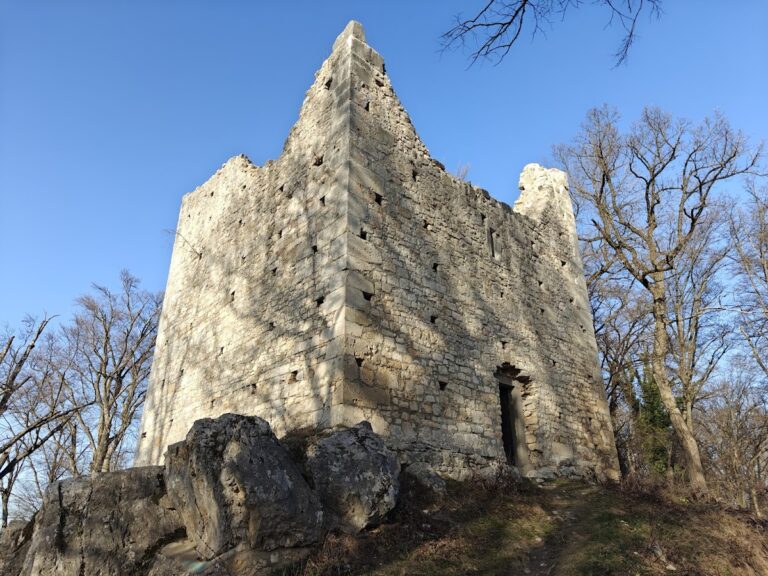
Neu-Wildon is a hill castle at about 450 metres above sea level, positioned on a wooded plateau in southern Wildon and the northern part of the Unterhaus cadastral municipality. The site lies about 300 metres southeast of the main settlement, while the plateau falls steeply to the north and south. A man-made V-shaped ditch separates the castle on the west from the remainder of the Schlossberg summit plateau, which is about 300 metres long and 80 metres wide. The ditch survives partly as a sunken track, and another artificial ditch follows the eastern edge before the ground drops away.
Approaches and outer defenses
Western approach
The western approach passes through a gate complex. A modern forest track climbs the Schlossberg from the southwest, follows the former V-shaped ditch of Alt-Wildon, and turns east towards Neu-Wildon. The route also reaches Alt-Wildon and formerly passed defensive remains associated with the Ful and Hengst castles. It ends at a flat, elongated rectangular area slightly northwest of Neu-Wildon, where wall remains define a space that some researchers interpret as a tournament ground. Its original function remains uncertain.
Barrier wall and gate tower
Two walls protected the western entrance. The outer barrier wall adjoining the western V-shaped ditch probably dates from the sixteenth century. Its net masonry consists of irregularly laid rubble stones with the gaps packed with smaller stones. The wall ends to the north at a small roundel, a circular or semicircular defensive structure, while a semicircular gate tower projects westward from it.
Curtain walls and eastern entrance
An older curtain wall, the enclosing defensive wall of the castle, stands east of the first barrier wall. Its relatively thin masonry is about 0.9 metres thick and consists of ashlar, regularly shaped dressed stones laid in courses. This construction probably belongs to the early thirteenth-century foundation of Neu-Wildon. A former gate in the western part of the wall provided the original entrance, and sections of the same wall survive on the southeast and east sides.
A gate hall was added to the eastern curtain wall during the sixteenth or seventeenth century. This later entrance shows that access to the complex was also arranged from the east in its later period. Immediately before the northern edge of the plateau stood a zwinger, an outer defensive space between or outside fortifications, entered through a gate in the northern wall.
Main castle and courtyard
Courtyard and water supply
The central castle was arranged around a small courtyard. A cistern or well occupied the courtyard, together with the surviving stump of a round pillar. Otto Piper described a surrounding cistern structure in 1907. The courtyard formed the central organizing space for the principal buildings and the freestanding chapel.
North and south walls
The main surviving walls stand on the north and south sides, with sections belonging to the early thirteenth-century construction. Several courses of ashlar masonry remain in the southern wall. During the first half of the sixteenth century, this wall was probably strengthened with a shell wall, an added outer layer used to reinforce an existing structure. Its masonry resembles that of the western barrier wall and probably belongs to the same building phase.
The repeatedly altered northern wall survives to its original height. Ashlar is especially visible in its lower section. On the exterior, a small oriel set on a console originally served as a smoke outlet. A stone in the same wall provided a drain or outlet from the kitchen behind it.
Northwestern building
A building was added to the original outer wall of the main castle in the northwest. Its irregular rubble masonry combined with brickwork places it in the sixteenth century. Rectangular window openings are set within flat-arched niches, providing a surviving indication of the building’s later architectural treatment.
Chapel and possible tower remains
Castle chapel
The western part of the courtyard contains the remains of a freestanding castle chapel. It was probably built in the sixteenth century on the foundations of an earlier church. The chapel originally had a barrel vault. Surviving features include Gothic buttresses and the coat of arms of Ulrich Leysser, installed in 1520.
Rubble heap west of the chapel
A large rubble heap west of the chapel ruin may represent the remains of a tower shown by Georg Matthäus Vischer in an engraving of 1681. The feature provides a possible connection between the surviving ground remains and the early modern depiction of the castle complex.