Muhammad Mosque: An Eleventh-Century Mosque in Baku


Site at a Glance
- Rating
- 4.5
- Popularity
- Low
- Country
- Azerbaijan
- Primary era
- Medieval
- Eras represented
- Medieval
- Civilizations
- Shirvanshah
- Site type
- Religious
- Remains
- Mosque
On this page7 sections
History
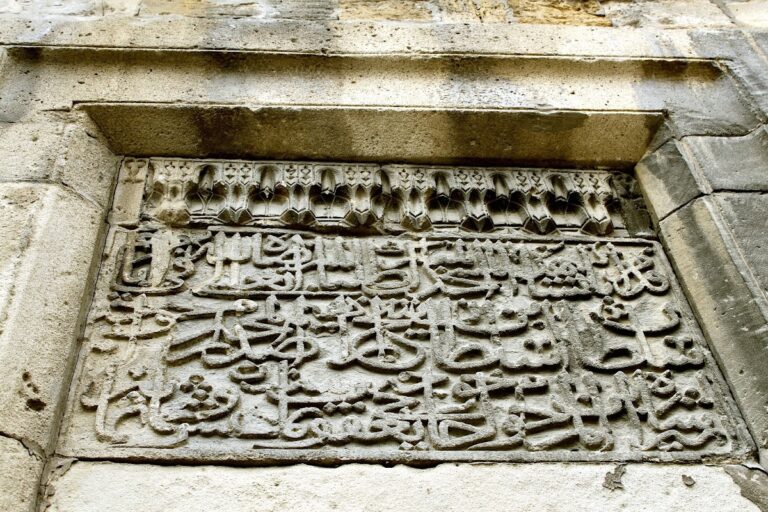
Muhammad Mosque is an eleventh-century mosque in Baku, Azerbaijan, built in the Shirvan-Absheron architectural tradition. An Arabic inscription near the doorway in the northern wall dates its construction to 1078–1079 and identifies Muhammad, son of Abu Bakr, as its builder.
Foundation and early identity
The inscription gives Muhammad the titles ustad, meaning master craftsman, and rais, the head of a corporation of artisans. The mosque was built on the site of an earlier mosque and followed the plan of that predecessor. It is regarded as the first Islamic building in Azerbaijan whose date is established by a construction inscription.
The mosque is also known as Siniggala Mosque, a name translated as “Damaged Tower.” The Brockhaus and Efron Encyclopedic Dictionary called it the “Shah’s Mosque.”
The 1723 bombardment
In 1723, during the Russo-Persian War, a conflict between Russian and Persian forces, a Russian squadron of 15 warships commanded by Matyushkin approached Baku by sea and demanded the city’s surrender. When the demand was rejected, the ships bombarded Baku, and a shell struck the mosque’s minaret.
A storm subsequently forced the Russian sailing ships back out to sea. Baku’s inhabitants interpreted the event as divine protection from foreign invaders, while the damaged minaret became associated with resistance. It was not restored until the middle of the nineteenth century, when its upper, lighter-colored masonry was rebuilt.
Muhammad Mosque forms part of the Walled City of Baku together with the Shirvanshah’s Palace and Maiden Tower. This cultural ensemble was added to the UNESCO World Heritage List in 2000 under criterion (iv), which recognizes outstanding examples of building types, architectural ensembles, or landscapes illustrating an important period of human history.
Remains
Stone mosque and minaret
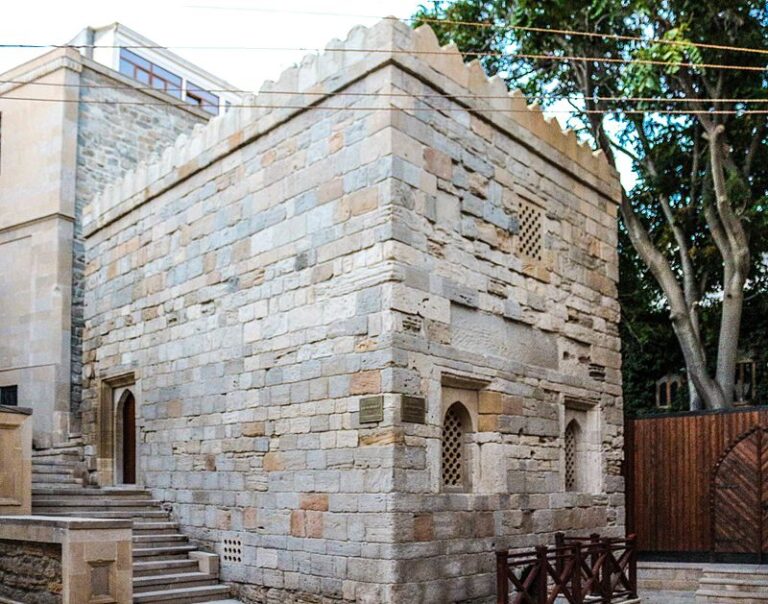
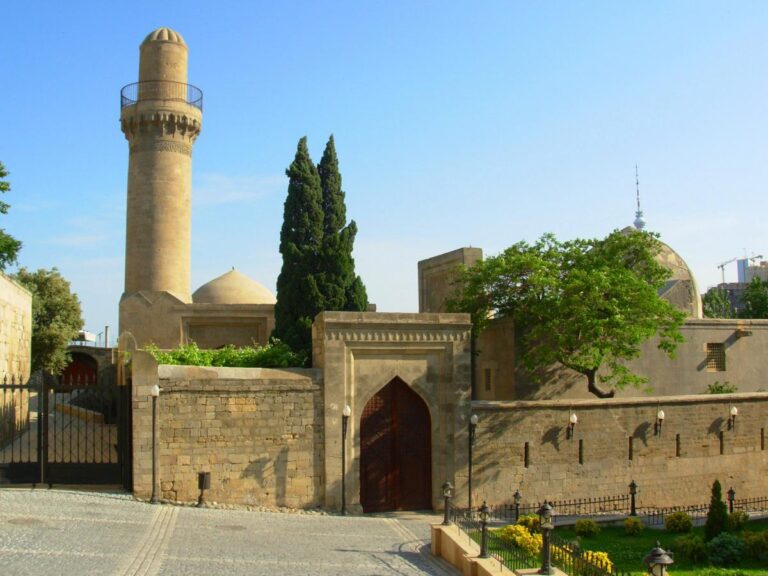
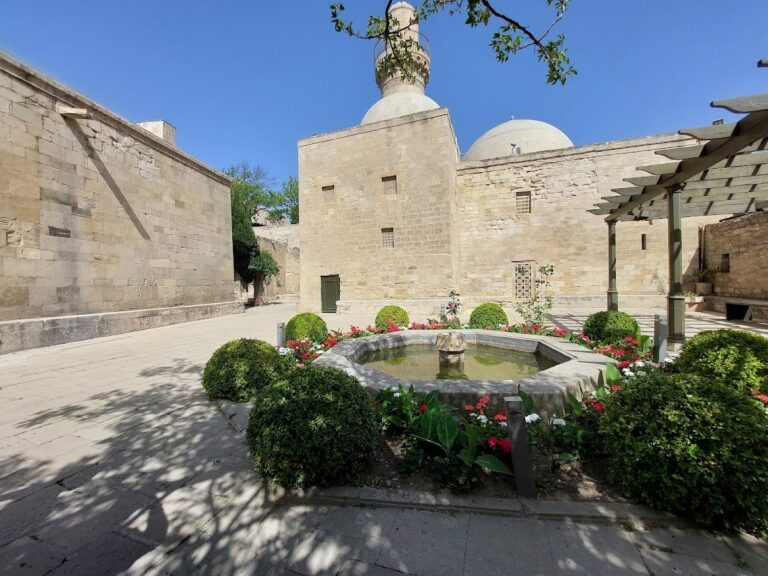
The surviving mosque is a stone building with a single adjoining minaret. Its layout follows the earlier mosque that occupied the site, while the minaret preserves the principal vertical feature of the complex and displays the careful masonry associated with the Shirvan-Absheron architectural school.
Mosque
The mosque was constructed from stone, with the minaret attached directly to it. The northern wall retains the Arabic construction inscription near the doorway, providing the date of 1078–1079 and naming Muhammad, son of Abu Bakr. The building’s plan follows that of the earlier mosque on the site.
Minaret
The minaret has a sturdy shaft that tapers slightly upward. It is built from carefully dressed local limestone laid in lime mortar, with masonry courses of varying height. A narrow spiral staircase winds through the shaft. The upper portion, distinguished by its lighter color, belongs to the nineteenth-century restoration after the 1723 bombardment.
At the top, a stone-slab-enclosed sherefe, the balcony from which the call to prayer is traditionally proclaimed, projects beneath the cornice. Coarse, flattened stalactite-like elements support the balcony, and a ribbed dome crowns the shaft. Beneath the cornice, a Quranic inscription appears in archaic Kufic, an early angular form of Arabic script used for Quranic and monumental writing. Interlaced geometric ornament decorates the parapet slabs.
Nearby sites