Morticelli: Site of the Abbey of San Lupo in Benevento
Site at a Glance
- Popularity
- Low
- Country
- Italy
- Primary era
- Medieval
- Eras represented
- Medieval, Early Modern
- Civilizations
- Lombard, Papal States
- Site type
- Religious
- Remains
- Monastery
On this page14 sections
History
Morticelli is the former site of the Abbey of San Lupo, a Benedictine monastery in the Triggio district of Benevento, Italy. Its monks followed the Rule of Saint Benedict. The district lay within the expansion of the city’s late-antique walls, ordered in the eighth century by Arechis II, duke of Benevento. Late antiquity was the transition from the ancient world to the medieval period. The Lombards, who ruled much of Italy in the early Middle Ages, were a Germanic people. The monastery’s foundation date is uncertain, but construction is assigned to the ninth or tenth century.
Lombard foundation and monastic estate
The monastery was first dedicated to Lupolo, a Capuan martyr, and Zosimus, bishop of Syracuse. A record from 837 describes their church passing from the jurisdiction of the Abbey of San Vincenzo al Volturno to Prince Sicard of Benevento as part of an exchange. In 949, Abbot John I asserted the monastery’s claim to lands near Alife that he believed had been taken from it.
At some point before or by 1228, the monks shifted the dedication to Saint Lupus, bishop of Troyes, and that became the monastery’s established patronage. Local tradition held that the abbey possessed relics, bodily remains or objects associated with a saint and venerated by Christians, of Saint Lupus. A medieval hymn reflects the claim. The relics were later believed to be at Benevento Cathedral, including in 1723, a tradition that differed from the French account of their location.
A privilege issued on 7 October 980 by princes Pandulf I and Landulf IV allowed Abbot John II to establish a fortified settlement for free people living on the monastery’s lands. The proposed settlement was to be created at the scattered rural holding of Ponte di Sant’Anastasia and made dependent on the abbey. Although the castle in the privilege is often associated with Ponte, historian Carmelo Lepore proposed nearby San Lupo instead. San Lupo took its name from the monastery; its two churches served as monastic dependencies, and the abbey held secular authority there. It may later have owned more than half the settlement’s property.
From at least the eleventh century, the abbey answered directly to the Holy See, the central governing authority of the Roman Catholic Church, and retained considerable formal autonomy. Its community was small. By the fourteenth century, its lands were less extensive than those of Benevento’s monasteries of San Modesto and Santa Sofia. Holdings included property in the Alifano area and dependencies at Bojano and near San Severo, while its main sphere of influence lay in the eastern Telesina Valley.
In 1022, Abbot Adelbert was forced to return many possessions to San Vincenzo al Volturno. Later, as Norman rule spread through southern Italy and the Lombard principality declined, the monastery’s properties were confiscated. They were recovered under the Swabians, members of the Hohenstaufen ruling dynasty. San Lupo’s church appears as a parish church in 1198. In 1288, after problems with monastic discipline, the abbot of Santa Sofia, a Franciscan friary leader, and a Dominican prior were sent to reform the community.
Decline and suppression
The monastery weakened sharply during the fifteenth century and was almost deserted by 1443. Pope Eugene IV decided to suppress it and assign its revenues to Benevento’s Metropolitan Chapter, the body of clergy attached to the archbishop’s cathedral. The process took several years. In 1450, the last abbot, Leonardo, gave up his title to Pope Nicholas V. The Observant Franciscans, members of a reform movement within their order, declined an offer to take over the decaying monastery. In 1454 it was definitively annexed to the Chapter, and its books were transferred to the Capitular Library.
The Chapter kept ownership of the site and secular authority over San Lupo until 1818. Under an agreement between the Kingdom of Naples and the Papal States, territories governed by the pope, that authority passed to Benevento’s archbishop.
Church, cemetery, and destruction
The abbey church was in ruins by 1579. It was formally taken out of religious use in 1628 and converted into a private residence. Following the 1688 earthquake, Archbishop Vincenzo Maria Orsini established an urban cemetery on the site and commissioned a new church, completed in 1696.
Around the time Archbishop Francesco Maria Banditi restored the church in 1792, the urban cemetery moved outside the city, beside the new church of Santa Clementina. Children continued to be buried at the former abbey. Their burials gave the place its popular name, Morticelli, which also came to designate the surrounding area.
US bombing during the destruction of Benevento’s historic centre in August and September 1943 damaged the church. After the war, the remaining parts of the building were levelled and human remains at the site were transferred to the municipal cemetery. Morticelli then fell into disuse, apart from occasional manual work in the area.
Remains
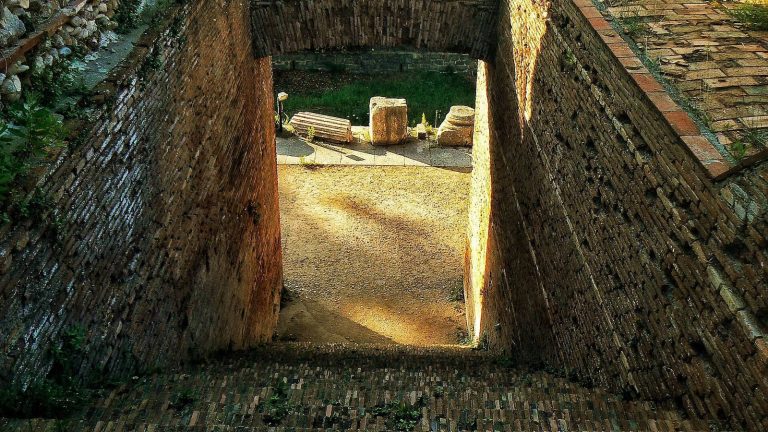
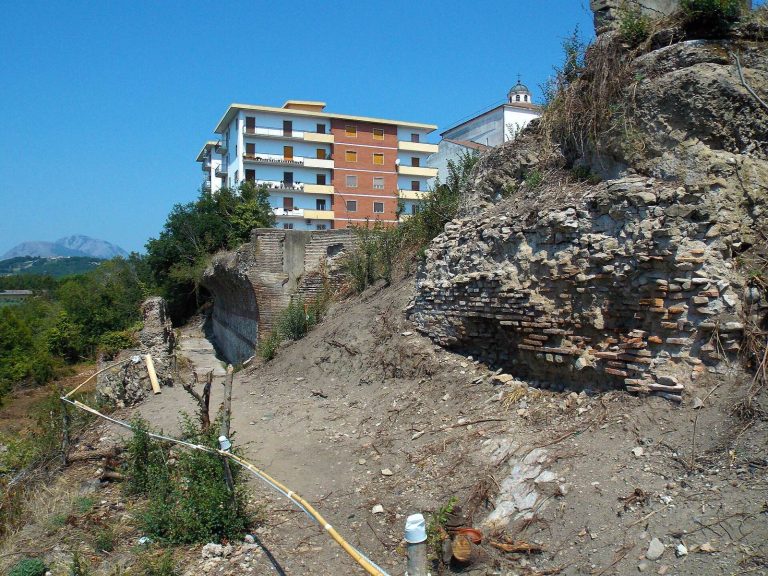
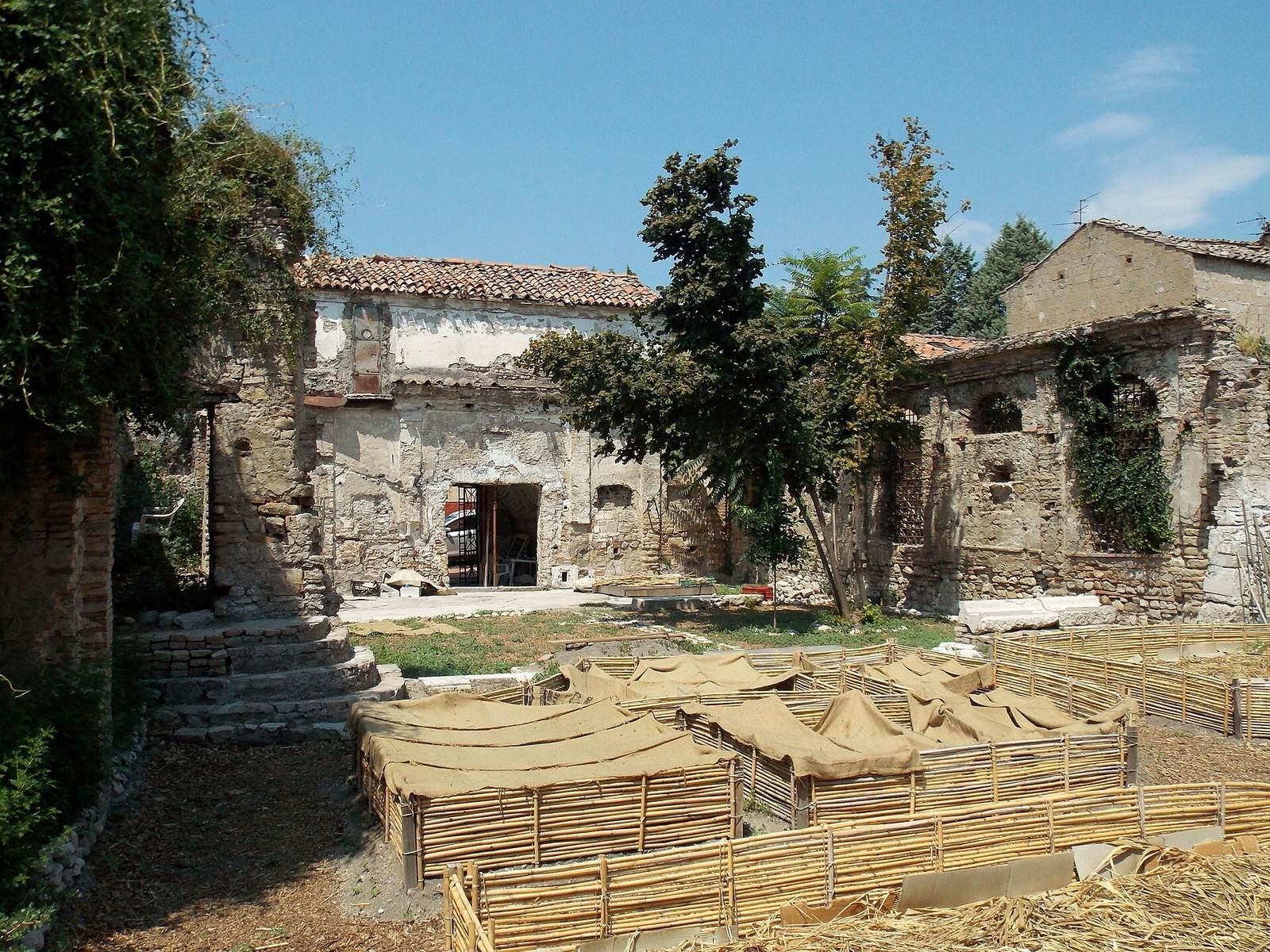
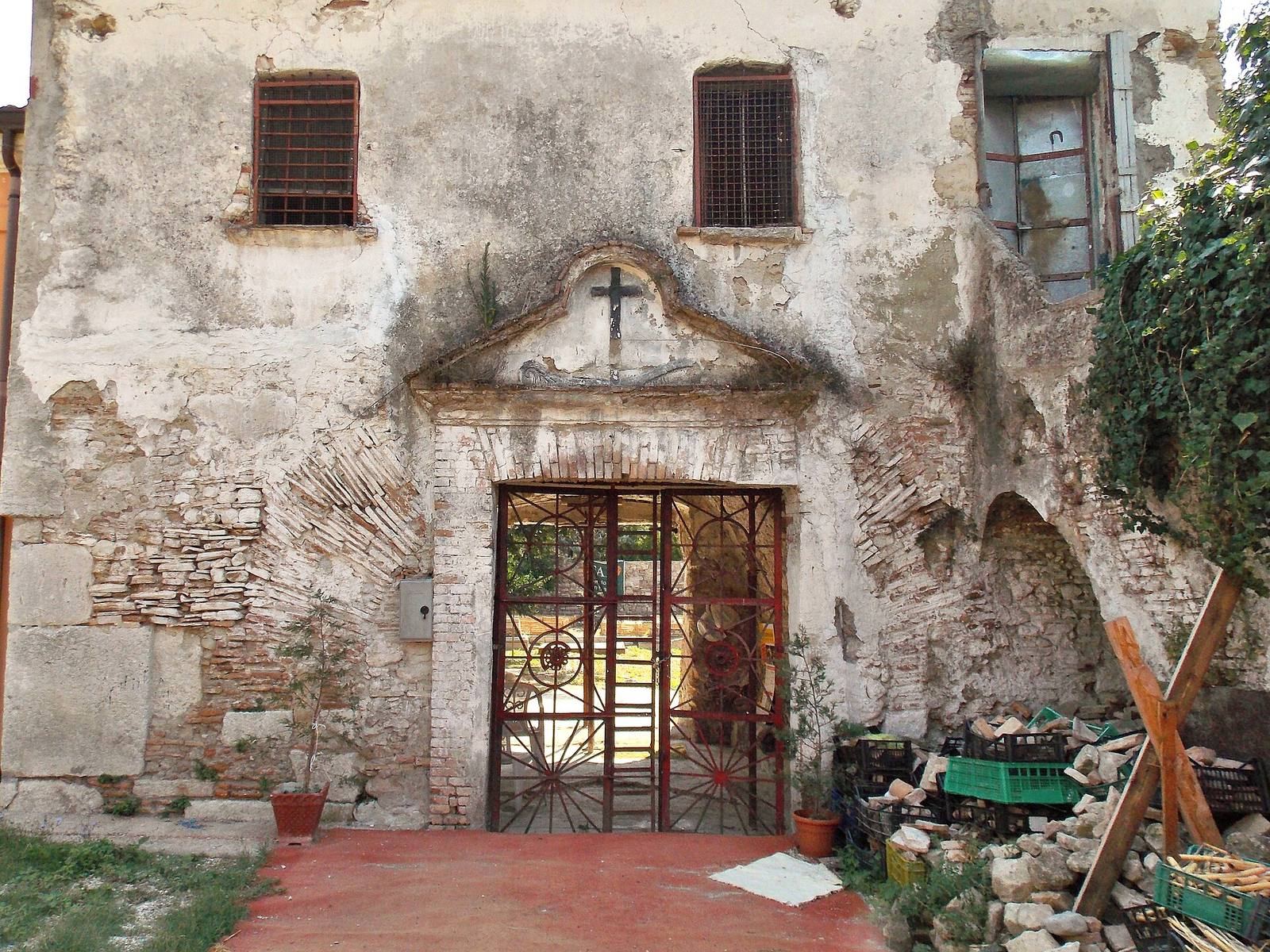
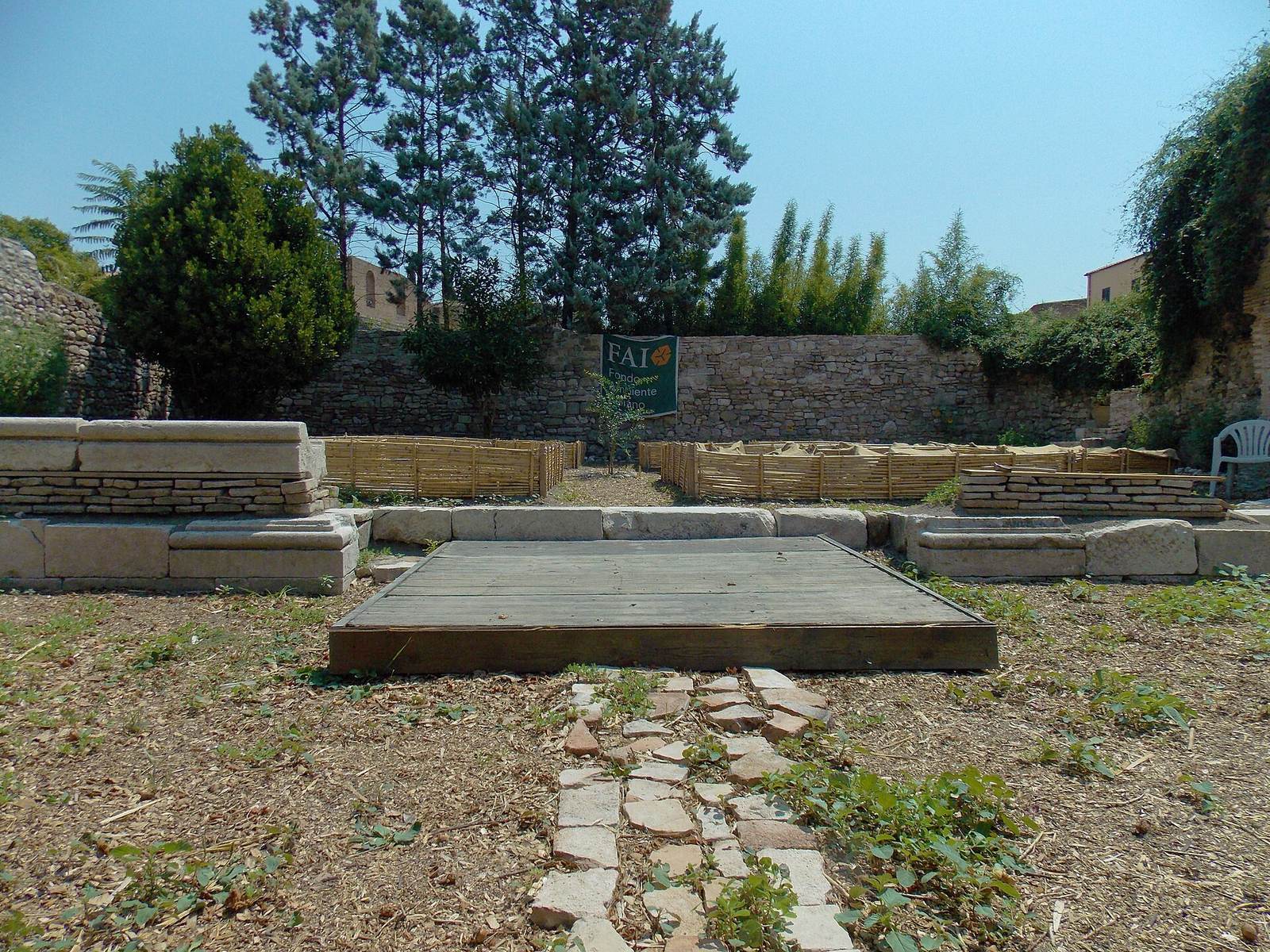
Morticelli occupies the end of an open square beside present-day Via del Teatro Romano. A granite column topped by a cross marks the square’s boundary; it may have been reused from the Temple of Isis, the ancient Egyptian goddess. The former cemetery and church together occupied a rectangular area about 15 metres wide from north to south. The cemetery extended around 14 metres across the western frontage, with the church behind it, about 13 metres deep. Two corridors along the cemetery’s north and south sides served as ossuaries, places for storing human bones. Each corridor has three windows facing the cemetery, and rows of tombstones were attached to the corridors’ outer sides. The former cemetery entrance was a shallow, two-storey building with an exterior staircase.
The Orsinian church
Plan and surviving fabric
The church followed a basilican plan, with a central nave flanked by side aisles. Those side spaces were much lower than the nave, and the roof was pitched. Three semicircular recesses, or apses, were aligned with the aisles. Their arrangement appears in an eighteenth-century land-record map and in aerial photographs taken before the 1943 bombing. Scattered portal stones survive around the site.
Facade and recorded form
A sketch from 1712 shows a front ending in a triangular gable. Its central doorway had a horizontal lintel, with a window and circular opening above; two side doorways appear to have had rounded arches. Later depictions show the central doorway flanked by two windows, without the circular opening. A painted, shrine-like structure once stood at the far end of the square.
Monastic complex
Residential buildings
The monastery’s residential area is associated with a building on the church’s left flank, arranged around an inner courtyard and now occupied by private homes. Vaulted underground rooms are visible to the right of the Morticelli entrance, behind the destroyed tabernacle.
Possible earlier church
Architectural scholar Silvio Carella considered that the church-and-cemetery arrangement established under Orsini incorporated substantial earlier remains. One possibility is that the monastery’s original church had a basilican layout, extended farther into the area later used as a cemetery, and had two rows of columns or substantial supports separating its central nave from the side aisles. Alternatively, the church’s arched doorways may indicate that the later building reused an earlier structure on the same, nearly square plan. The first reconstruction accords with early medieval basilican churches; the second fits evidence for early medieval churches with nearly square plans.
Manuscripts from the abbey
Lectionary and texts for Saint Lupus
A twelfth-century lectionary, a book of readings for worship, survives in the archive of Cava Abbey as manuscript 5. It may instead be a compilation of passages drawn from several books and comprises 120 leaves. Its tall, narrow opening letters are decorated with arabesque patterns or roughly painted flowers. The text preserves material for the Divine Office, the cycle of daily Christian prayers, for Saint Lupus, including a rare version of his life that differs in several respects from the version edited by the Bollandists, scholars who compiled collections of saints’ lives. The life follows a sermon attributed to Lupus and a processional hymn in six- and five-foot verse. Other sections include a hymn for Lauds, the morning prayer service, as well as antiphons and responsories, sung chants and responses. A long processional hymn and related pieces accompany a cantus firmus, an existing melody used as the basis for other music, dated to the ninth or tenth century. The book also contains sermons otherwise unknown and more accurate readings of texts preserved in other copies.
Antiphonary
A second monastic book, a late-twelfth-century antiphonary, a collection of antiphons and other sung worship material, is held in Benevento’s Capitular Library as manuscript V. 21. Its ordering of services and selection of saints for daily veneration differ in several ways from those of contemporary books from other parts of Europe.