Arch of Trajan: A Roman Triumph Monument in Benevento


Site at a Glance
- Rating
- 4.7
- Popularity
- Medium
- Country
- Italy
- Primary era
- Classical
- External website
- Open
- Eras represented
- Classical, Medieval
- Civilizations
- Lombard, Roman
- Site type
- Civic
- Remains
- Arch
On this page9 sections
History
The Arch of Trajan is a Roman triumphal monument in Benevento, Italy, erected in 114 in honor of Emperor Trajan for the opening of the Via Traiana. This imperial road provided a more direct route from Benevento, the ancient Beneventum, toward Brindisi, the Adriatic terminus of the southern route from Rome. Construction was completed in 117, probably during the reign of Trajan’s successor, Hadrian. The arch presents Trajan as both a victorious military ruler and a benefactor concerned with the welfare of Roman citizens and the provinces.
Trajan and the Via Traiana
Trajan ruled the Roman Empire from 98 to 117 and was associated with major imperial expansion, including the conquest of Dacia. The arch’s dedication links his rule to the new road and to the obligations of the emperor toward the state, the gods, the army, and the wider population. Its reliefs were arranged as a political program intended to be read from bottom to top and from right to left. The city-facing side emphasizes peace and benefits provided to Roman citizens, while the outward-facing side focuses on war, frontier security, and the emperor’s care for the provinces.
The city-facing scenes include Trajan’s formal entry into Rome in the summer of 99, his reception after returning from Germany, the dismissal of veterans, and the regulation of commerce in an unidentified port. The port scene has been associated with provisions for veterans in the Rhine and Danube regions. Other reliefs show Trajan welcomed by the Senate, the Roman People, and the Equestrian Order, the wealthy social order below the senatorial rank whose members often served in military and administrative roles. One scene on the Campus Martius shows Trajan, accompanied by Hadrian, receiving the two consuls before a temple, with the goddess Roma present. An attic panel depicts the gods of Olympus awaiting the emperor.
War, welfare, and imperial duty
The reliefs in the passage establish a local program connected with Benevento and its surrounding territory. They contrast pietas erga deos, dutiful respect toward the gods, with pietas erga homines, duty toward human communities. One scene shows a sacrifice often interpreted as the ceremony inaugurating the Via Traiana. Trajan appears as an emperor practicing pietas Augusti, while the Roman people and Senate act as witnesses.
The opposite passage relief presents the alimenta, welfare arrangements founded by Trajan to support children in need in Roman Italy. An inscription refers to an institutio alimentaria, and the scene portrays the emperor as a benefactor. The program connects Trajan with religious duty, the capital, and the welfare of the provinces. On the outward-facing side, other scenes show him confronting or negotiating with four barbarians, supervising the army in peacetime, and overseeing military recruitment. Personifications associated with fertility and protection extend the theme of imperial care beyond the city.
The outer-right attic relief represents Dacia, which Trajan annexed after two wars. The outer-left panel, preserved only in part, shows four protective provincial deities: Silvanus, Diana, Ceres, and Bacchus-Liber Pater. Their fertility symbolism brings the provincial theme to a conclusion. The five-line inscription repeated on both sides of the attic identifies Trajan as the son of the deified Nerva, Germanicus and Dacicus, chief pontiff, holder of tribunician power eighteen times, acclaimed Imperator seven times, consul six times, father of the country, and “most valiant prince.” It states that the Senate and Roman People erected the monument.
Medieval fortification and later preservation
In 545, during the Gothic War, Benevento was captured by Goths led by Totila. The city walls were destroyed, but the arch survived. During the Lombard period, it was incorporated into the northern side of the rebuilt city walls and became known as the Porta Aurea, or “Golden Gate.” Its use as part of the fortifications helped preserve the monument, which still served as a city gate in 1713.
The arch attracted attention from the Renaissance onward. The architect Sebastiano Serlio studied it, while eighteenth-century artists included it in their work. Antonio Joli painted a view of the monument during the 1750s, now preserved at the Reggia di Caserta, and Giovanni Battista Piranesi also drew it. Repeated interventions followed damage caused by age and earthquakes. Restoration took place under Pope Urban VIII and again in 1661, 1688, 1713, and 1792. In 1713, a marble architrave forming part of the gate collapsed. Benevento’s municipal council approved 212 ducats for its repair, with authorization granted on 1 December that year.
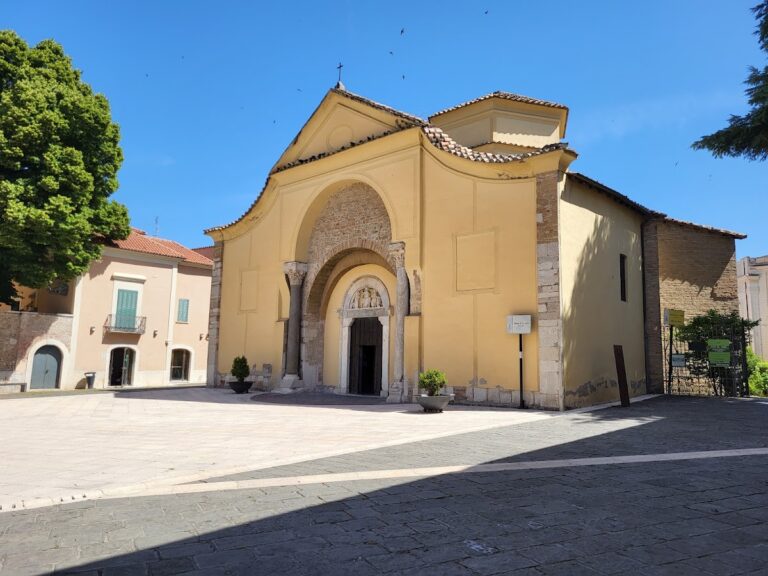
In 1850, during Pope Pius IX’s visit to Benevento, he ordered the adjoining houses demolished to clear the monument. The arch now stands apart from road traffic in a landscaped setting. A multimedia exhibition about the arch and Trajan’s life and works was established in the nearby church of Sant’Ilario, now used as the Museum of the Arch, or Videomuseum. In 2024, the monument was inscribed within the UNESCO World Heritage serial site “Via Appia. Regina Viarum,” together with Benevento’s historic city center.
Remains
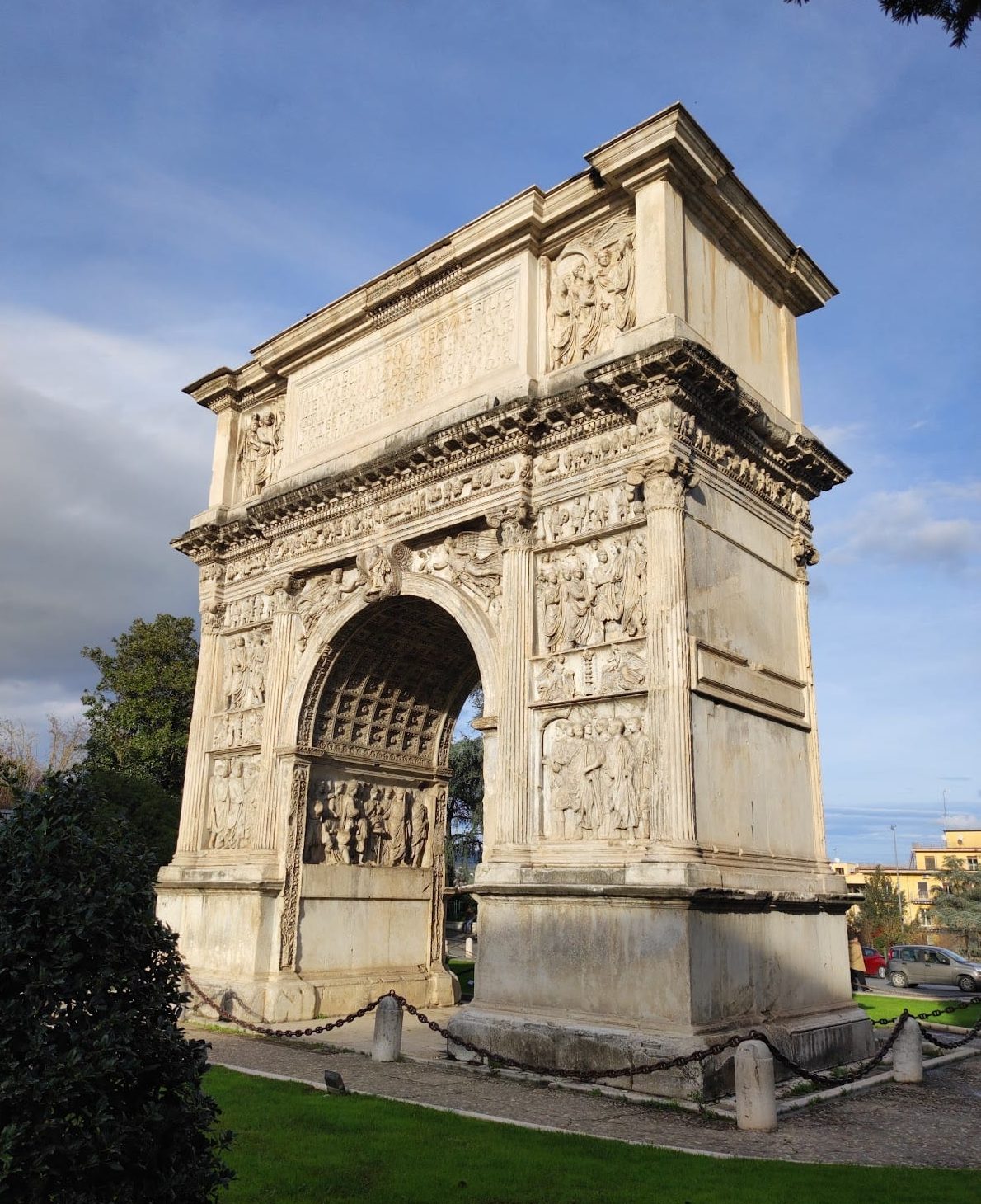
The Arch of Trajan is a single-passage structure measuring 15.60 metres high and 8.60 metres wide. Its barrel-vaulted opening is framed by limestone blocks faced with Parian marble. The blocks are laid in opus quadratum, a Roman masonry technique using regularly cut stones in horizontal courses. Four engaged Corinthian columns or pilasters stand at the corners of the two side piers and support the entablature. Above it, the attic projects farther at the center over the passage and contains an internal chamber covered by a barrel vault. The monument survives substantially intact, retaining almost all of the reliefs that decorated its faces.
Facades and attic
City-facing reliefs
The two principal facades are covered with richly carved high-relief scenes. Each pier has two narrower panels placed one above the other between the corner columns or pilasters. These show imperial activities including Trajan’s arrival at Rome, the grant of Roman citizenship to auxiliary soldiers, and his reception by the Senate, the Roman People, and the Equestrian Order. Narrow decorative panels separate the main scenes. Their central figures are Victories sacrificing bulls, with Amazons above them.
The attic carries the central dedicatory inscription and two lateral relief panels on each side. On the city-facing side, Trajan is welcomed by the Capitoline Triad, the three deities Jupiter, Juno, and Minerva, on one panel. The other shows him presiding over the annona populi Romani, the organized provision of grain and food for Rome’s population, in the Forum Boarium, the city’s cattle market and a major commercial and religious area beside the Tiber. The city-facing spandrels contain personifications of Victory and Military Loyalty, accompanied by the protective spirits, or genii, of the four seasons. Roma appears on the inner keystone.
Outward-facing reliefs
The outward-facing spandrels personify the Danube and Mesopotamia, while Fortune occupies the outer keystone. The attic panels continue the emphasis on the provinces. One shows Dacia, and the other, which is incompletely preserved, presents Silvanus, Diana, Ceres, and Bacchus-Liber Pater as protective rural deities. The arrangement combines images of conquered territory, provincial security, fertility, and imperial guardianship.
The entablature frieze shows Trajan’s triumphal procession after his victory over the Dacians in exceptionally high relief. The figures on the piers are heavy and treated in a relatively conventional manner. The reliefs in the passage handle crowded compositions more successfully, although they convey space and atmosphere less fully than the reliefs of the Arch of Titus. Their formal relationships with the Trajanic frieze of the Arch of Constantine have led to the proposed attribution of at least the two passage panels to the Roman workshop known as the “Master of Trajan’s Deeds,” whose master is identified with the sculptor of Trajan’s Column.
Passage and sculptural program
The passage contains two wide sculpted panels. On the left when leaving the city, Trajan performs a bull sacrifice in the presence of the Senate’s protective spirit, lictors, and other Roman citizens. Lictors were officials who accompanied senior magistrates and carried bundles of rods as symbols of judicial authority. The scene links the emperor with religious responsibility and is often understood as an image of the ceremony associated with the Via Traiana.
The panel on the right depicts the alimenta. Children in need, personifications of Italian cities, and other children appear around a central table bearing loaves or pieces of bread. The scene presents imperial welfare as a public act and gives physical form to the passage’s theme of duty toward human communities. Above, the barrel-vaulted passage ceiling is divided into coffers. At its center, a winged Victory crowns Trajan.
The monument is widely noted for what is regarded as the earliest representation of Italia as a turreted female personification. Together, its architectural framework, inscription, and nearly complete relief cycle create a continuous account of Trajan’s military achievements, religious obligations, road building, civic administration, and support for the Roman provinces.