Monterreal Castle: A Maritime Fortress in Baiona, Spain


Site at a Glance
- Rating
- 4.7
- Popularity
- Low
- Country
- Spain
- Primary era
- Early Modern
- Eras represented
- Medieval, Early Modern
- Civilizations
- Crown of Castile, Spanish
- Site type
- Military
- Remains
- Castle
On this page12 sections
History
Monterreal Castle is a fortified complex in Baiona, Spain, whose medieval and Renaissance phases developed on a site already occupied by a fortified settlement by the 2nd century BC. It formed part of the maritime defense of the Rías Baixas for several centuries, and its history includes Roman, Visigothic, and Muslim influences.
Roman and early fortified origins
The earliest recorded phase of the castle is associated with Julius Caesar’s conquest of Baiona in 60 BC. Caesar, a Roman general and statesman, extended Roman power into the western Iberian Peninsula, and rebels were pursued to their refuges in the Cíes Islands. The site had already contained a castro, a fortified settlement, or a castellum, a smaller fortified place or military stronghold, by the 2nd century BC.
Medieval conflicts and expansion
The medieval fortress continued the site’s defensive role. In 1331, the Portuguese fleet of Admiral Peñaza attacked it, and Fernando I of Portugal later took up residence there. The fortress also withstood attacks by the pirate Francis Drake.
In 1474, Pedro Madruga, a Galician nobleman and military figure, attacked Baiona and built a tower on Monte Boi. Vestiges of that tower remain within the later history of the fortified site. The Catholic Monarchs, Isabella I of Castile and Ferdinand II of Aragon, subsequently transformed the fortress into a settlement. They granted a charter allowing 200 families to live within the walls with the same privileges as Baiona’s residents.
Commercial prosperity and Renaissance rebuilding
Monterreal Castle reached its greatest prosperity during the 15th and 16th centuries, when Baiona became a commercial enclave. This development followed a privilege issued under John II of Castile, a 15th-century king, which authorized Baiona and A Coruña as the only Galician ports permitted to trade with foreign countries.
On 1 March 1493, the caravel La Pinta arrived at Baiona. Martín Alonso Pinzón, the Spanish navigator and commander associated with Christopher Columbus’s first voyage to the Americas, returned from the voyage, and Baiona became the first European town to learn of the discovery of the New World.
The castle developed through medieval and Renaissance phases. Its present appearance largely derives from a 16th-century reconstruction carried out by Diego Sarmiento de Acuña, Count of Gondomar, a Spanish nobleman and diplomat. He gave the fortress the name Monterreal in honor of the Catholic Monarchs.
Conservation and later use
In 1924, Ángel Bedriñana Meana, a Spanish emigrant who had made his fortune in Cuba’s sugar-cane industry, bought the property from an heir of Elduayen. He devoted the remainder of his life and fortune to restoring and conserving the castle. His heirs later sold it to the Spanish state.
Since 1966, the complex has housed the Parador del Conde de Gondomar. A Parador is a Spanish state-operated hotel established in a building or location of historic, architectural, or scenic interest. Monterreal Castle is also part of the Historic Ensemble of Baiona, a protected heritage designation for a group of buildings and spaces with recognized historical or cultural value.
Remains
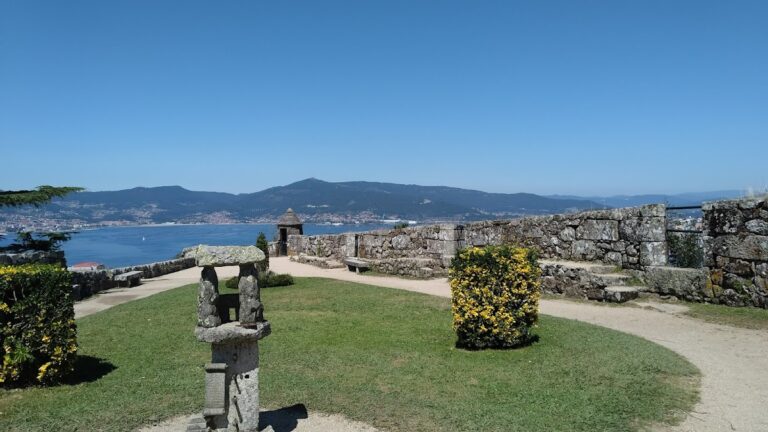
Monterreal Castle occupies Monte Boi as a fortified complex combining medieval and Renaissance components. Its defenses include the Puerta del Sol, a ramp with a drawbridge, and three preserved towers. A promenade surrounds the complex, with the castle architecture on one side and the sea breaking against the rocks on the other. The present complex also contains the Parador del Conde de Gondomar, including accommodation and a restaurant.
Entrances and defensive works
Puerta del Sol
The Puerta del Sol forms part of the castle’s fortified entrance system. It is connected with a ramp and drawbridge, features that controlled movement into the complex and remain part of its surviving defensive arrangement.
Preserved towers
Reloj Tower
The Reloj Tower is one of the three large towers specifically preserved within the fortifications. It forms part of the surviving medieval and Renaissance defensive architecture on Monte Boi.
Tenaza Tower
The Tenaza Tower is another preserved tower of the complex. Its heptagonal base distinguishes its form within the castle’s defensive system.
Príncipe Tower
The Príncipe Tower completes the group of three specifically preserved towers. Together with the Reloj and Tenaza towers, it remains part of the fortified structure that surrounds the site.
Nearby sites