Fortifications of Valença do Minho: A Portuguese Frontier Stronghold


Site at a Glance
- Rating
- 4.6
- Popularity
- Very High
- Country
- Portugal
- Primary era
- Early Modern
- External website
- Open
- Eras represented
- Medieval, Early Modern
- Civilizations
- Portuguese
- Site type
- Military
- Remains
- Fortified Town
On this page12 sections
History
The Fortifications of Valença do Minho are a Portuguese frontier stronghold whose origins date to the transition between the twelfth and thirteenth centuries. Standing on the left bank of the Minho River beside the border with Galicia, the fortification defended the town and the river crossing in this part of the frontier. It later became regarded as the most important fortification in the Alto Minho, the historic region of northern Portugal around the upper Minho River.
Medieval Frontier Defense
The original fortification was established to protect Valença and control movement across the Minho frontier. Its position gave the town a defensive role during a period when the river marked a politically important boundary between Portugal and Galicia.
Modernization during the Restoration War
During the Portuguese Restoration War, the seventeenth-century conflict in which Portugal re-established and defended its independence from the Spanish Habsburg monarchy, Valença was completely modernized. Work began in 1641 under a project by the French military engineer Miguel de l’Ècole. The plan enlarged the fortified perimeter so that it could enclose the expanded town.
The fortification resisted a Spanish incursion in 1643 while the rebuilding was still in progress. Spanish forces captured it in 1654, but Portuguese troops commanded by the Count of Castelo Melhor soon reconquered the position. Construction continued in 1661 and proceeded through further stages until 1713, when the architect Manuel Pinto de Vilalobos declared the works complete.
Later Military Conflicts
The defenses continued to be adapted after the main seventeenth-century rebuilding. At the end of the eighteenth century, the walls of the gunpowder magazine were reinforced, and the Paiol do Açougue, a military ammunition store, was built in 1774.
During the Peninsular War, the conflict involving Napoleonic France and the Iberian powers, French forces commanded by Marshal Jean-de-Dieu Soult captured Valença in 1809 after local resistance. During the assault, they blew up the Porta do Sol.
Valença also took part in the Liberal Wars, the Portuguese civil conflicts between liberal constitutionalists and absolutist royalists. The town joined the liberal side in 1828. Royalist forces besieged it during the Belfastada, and Valença surrendered after nine days. Liberal forces retook the town in 1830 with support from the English admiral Charles Napier.
Conservation and Protection
Several conservation and restoration interventions took place during the twentieth century. The fortification has been protected as a Portuguese National Monument since 1928. Its surviving structures remain in good condition, and the Municipal Council of Valença is identified as its occupant.
Remains
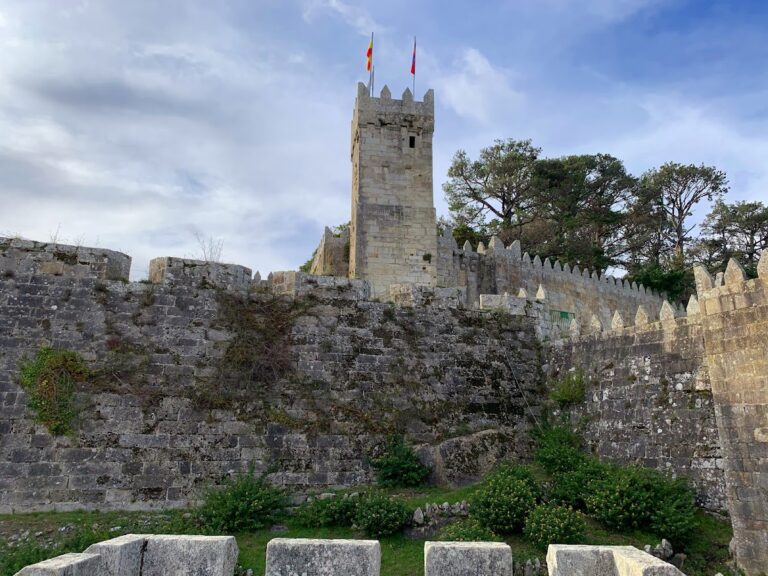
The surviving complex forms a fortified town separated from the Minho River by bastions, ditches, and underground passages. Its defenses are arranged in two principal areas linked by the Porta do Meio, or Middle Gate. The northern sector contains the old town, while the smaller and more open southern sector is known as the Coroada, or Crown. Together, these areas preserve an intricate defensive system of projecting platforms, outer defenses, excavated ditches, walls, earthworks, and subterranean routes.
The Coroada and Its Defensive Works
Principal Bastions
The Coroada contains the bastions of Santa Ana, São Jerónimo, and Santa Bárbara. A bastion is a projecting fortified platform from which defenders could fire along the faces of adjoining walls. The sector also includes the demi-bastions of São José and Santo António. A demi-bastion has one face and one flank, giving it a more limited projecting form than a full bastion.
Additional Bastions and Outer Defenses
The expanded perimeter added seven further bastions: Carmo, Esperança, Faro, Lapa, São Francisco, São João, and Socorro. Newly excavated ditches accompanied these works, while earthworks were raised on the slope. Ravelins, which are external triangular defenses placed before a curtain wall or gateway, protected certain sections of the walls.
Gates, Magazines, and Subterranean Features
Gates and Passages
The Porta do Meio connects the northern and southern sectors and forms the principal link within the fortified layout. The Porta do Sol preserves the physical consequences of the 1809 capture, when Napoleonic forces blew up the gate. Underground passages form part of the wider defensive network and connect with the system of walls, ditches, and fortified projections.
Military Magazines
The Paiol da Pólvora retains the late-eighteenth-century reinforcement of its walls. The Paiol do Açougue, built in 1774, is another surviving military magazine within the complex. These structures belong to the later adaptation of the fortification for the storage of gunpowder and ammunition.
The walls, bastions, ravelins, ditches, earthworks, gates, magazines, and underground passages together preserve the form of Valença’s rebuilt defenses. The surviving structures are in good condition, allowing the fortified town’s divided layout and layered military construction to remain legible.
Nearby sites