Montelupi Palace: A Historic Royal Reception Site in Krakow


Site at a Glance
- Rating
- 4.7
- Popularity
- Very Low
- Country
- Poland
- Primary era
- Modern
- Eras represented
- Early Modern, Modern
- Civilizations
- Habsburg, Polish–Lithuanian Commonwealth
- Site type
- Domestic
- Remains
- Elite Residence
On this page8 sections
History
Montelupi Palace is a historic palace in Krakow, Poland, built for the Italian-origin Montelupi merchant family during the late sixteenth and early seventeenth centuries. A foundation document and the first reference to the palace date to 1574, while its first palace buildings were completed in 1613. The building stood in the Kleparz area immediately north of Krakow’s historic centre and became associated with royal arrivals and funeral ceremonies.
The Montelupi family and royal connections
The Montelupis were merchants and bankers who became part of the Polish nobility during the sixteenth century. Sebastiano Montelupi served as a banker at the court of King Sigismund III Vasa, and Walerian Montelupi is identified as the palace’s first owner. The family also established Poland’s postal institution and held the office of Polish postmaster for more than a century.
Polish monarchs and members of royal families frequently visited the palace, which was often their final stop before entering Krakow. Royal funeral processions also departed from the building, giving rise to the popular name Royal Mortuary. King Władysław IV entered the palace on 3 February 1633. The funeral procession of King Sigismund III Vasa and Queen Consort Constance left from there the following day, and John Albert Vasa entered the palace on 27 February. Funeral processions for Queen Cecilia Renata in 1644 and Prince Sigismund Casimir on 21 September 1647 also began at the palace.
Changes of ownership and nineteenth-century rebuilding
The Jesuits, a Catholic religious order formally known as the Society of Jesus, acquired the palace in 1639. They received King John III Sobieski there on 30 January 1667. King Michael I visited on 27 October 1669, and in 1733 the Saxon elector Augustus received his election diploma as king of Poland at the palace.
The Badeni family acquired the building in 1773 and retained it until the middle of the nineteenth century. By then the palace had deteriorated substantially, and it passed to the Tarnowski family. The Tarnowskis commissioned a comprehensive rebuilding from Antoni Łuszczkiewicz, completed in 1878. During this period, the palace was the residence of Stanisław Kostka Tarnowski, a Polish historian and literary scholar who served as a professor at Jagiellonian University. The building later became known as Tarnowski Palace as well as Montelupi Palace.
War damage and modern ownership
Shortly before the Second World War, the palace passed to the Salvatorian Fathers, a Catholic religious congregation founded in the nineteenth century. During the German occupation, it housed the headquarters of Hitler Youth, the youth organization of Nazi Germany, and its interiors were consumed by fire.
After the war, the state took the building from the religious congregation and renovated it. From 1950 to 1998, it housed Radio Krakow. After the radio moved to a new building, the palace stood empty and deteriorated. The Tarnowski family pursued legal proceedings concerning ownership after the postwar expropriation. The building was entered into the Lesser Poland Voivodeship heritage register on 9 October 1989, and the Józef Tischner European University in Krakow purchased it in 2015.
The ownership disputes also involved the adjoining park. The Salvatorians recovered the park but withdrew from attempts to recover the palace when Tarnowski descendants began challenging the expropriation decision. The city later purchased the park from the Salvatorians, and it opened to residents on 1 January 2023.
Remains
Palace and grounds
Palace building
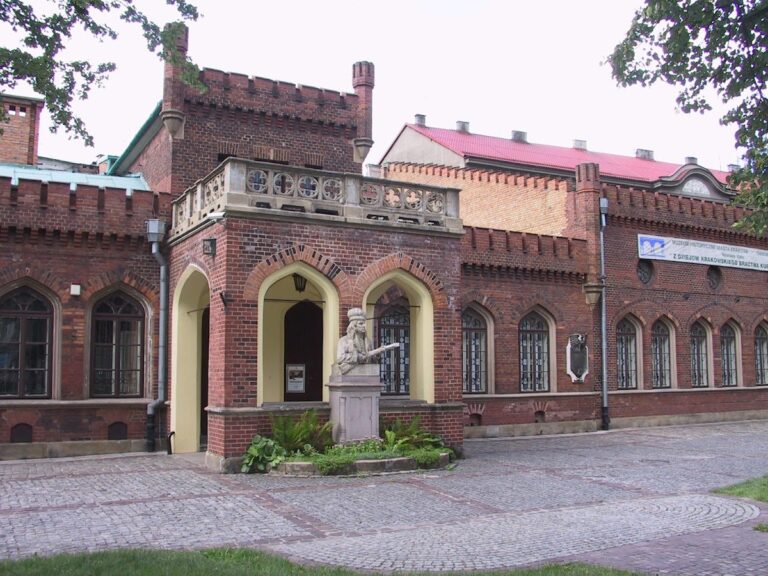
Montelupi Palace is a two-storey eclectic building at 71 Szlak Street in Krakow’s Kleparz district. Its original structure was enlarged with projecting sections known as risalits, which extend outward from the main wall, together with additional stonework. The present form derives from Antoni Łuszczkiewicz’s rebuilding and expansion of 1878. The palace has a portico with a balcony and is also described as a one-storey palace when the ground floor and its single upper storey are counted in that manner. The rebuilt structure survives to the present.
Former palace park
The palace formerly stood beside an adjoining park, which the Tarnowski family donated to Krakow. The grounds later became known as Jalu Kurka Park. After the Salvatorians recovered the park, the city purchased it from them, and the grounds opened to residents on 1 January 2023.