St. Florian’s Church: A Roman Catholic Parish and Collegiate Church in Kraków


Site at a Glance
- Rating
- 4.8
- Popularity
- Medium
- Country
- Poland
- Primary era
- Early Modern
- External website
- Open
- Eras represented
- Medieval, Early Modern, Modern
- Civilizations
- Habsburg, Kingdom of Poland, Polish–Lithuanian Commonwealth
- Site type
- Religious
- Remains
- Church
On this page10 sections
History
St. Florian’s Church is a Roman Catholic parish and university collegiate church in Kraków, Poland, dedicated to St. Florian and located at the northern end of Jan Matejko Square. Its present form is chiefly Baroque, an early-modern style known for elaborate decoration and dynamic spatial effects, while its origins reach back to the medieval period. The church stands at the beginning of the Royal Road, the historic ceremonial route linking Kraków’s northern approach with its principal royal and civic monuments.
Foundation and medieval role
Tradition connects the site with the arrival of St. Florian’s relics in Poland. St. Florian was a Christian martyr traditionally identified as a Roman military officer and is venerated in Poland as the patron saint of firefighters and chimney sweeps. According to the legend, oxen carrying his relics stopped here in 1184 and could not be moved until the decision was made to build a church dedicated to him. The tradition also links the foundation with Kraków’s wish to reinforce its political status as Poland’s capital.
The original church was built between 1185 and 1216. Its collegiate church was consecrated by Wincenty Kadłubek, the bishop of Kraków and a medieval Polish bishop and chronicler. Since the sixteenth century, the church has functioned as a university collegiate church, meaning that it has been served by a chapter of canons within a collegiate institutional structure rather than serving only as a parish church.
Fires and Baroque rebuilding
The church burned repeatedly during the twelfth, sixteenth, and seventeenth centuries. It survived Kraków’s citywide fire of 1528, even though it contained St. Florian’s relics. During the Swedish siege of Kraków, General Stefan Czarniecki, a seventeenth-century Polish military commander, ordered the suburbs burned. The church was later rebuilt in the Baroque form that defines its appearance today.
A major reconstruction took place from 1657 to 1684 with financial support from Andrzej Trzebicki, bishop of Kraków, and the Kraków Academy. Bishop Mikołaj Oborski consecrated the rebuilt church in 1686. After another fire and damage connected with fighting during the Bar Confederation, an eighteenth-century Polish noble movement opposed to Russian influence and the authority of King Stanisław II Augustus, further work was carried out from 1755 to 1779. The church was reconsecrated in 1779.
University, royal, and national associations
St. Florian’s Church held an important place in Kraków’s ceremonial life. It was the starting point of the royal coronation route, where the university senate’s rector welcomed newly crowned kings. Royal funeral processions also began here before continuing to Wawel Cathedral, Kraków’s principal royal cathedral and the traditional setting for Polish royal coronations and burials.
The church’s university connections include Jan Kanty, a fifteenth-century Polish theologian and university professor who became a canon and cantor there in 1439, and Marcin Wadowita, a theologian and academic who served as provost of the chapter from 1617 to 1641. The remains of Queen Marie Louise Gonzaga, wife of King John II Casimir, rested temporarily in the church in 1667. In 1818, a coffin containing the remains of Tadeusz Kościuszko, the Polish-Lithuanian military leader associated with the struggle for national independence, was deposited there.
Stanisław Wyspiański, a Polish playwright, poet, and visual artist, married Teofila Pytkówna in the church in 1900. From 1949 to 1951, Father Karol Wojtyła served there as a vicar. He later became Pope John Paul II, elevated the church to a minor basilica in 1999, and visited it during his papal pilgrimage to Poland in 2002. Cardinal Stanisław Dziwisz reactivated the collegiate chapter in 2011.
Modern restoration and status
The church was restored and modernized between 1902 and 1914 under designs by the architects Józef Kryłowski and Franciszek Mączyński. It was entered in the historic-monument register in 1931, designated a Historic Monument of Poland in 1994, and forms part of Kraków’s historic city complex.
Remains
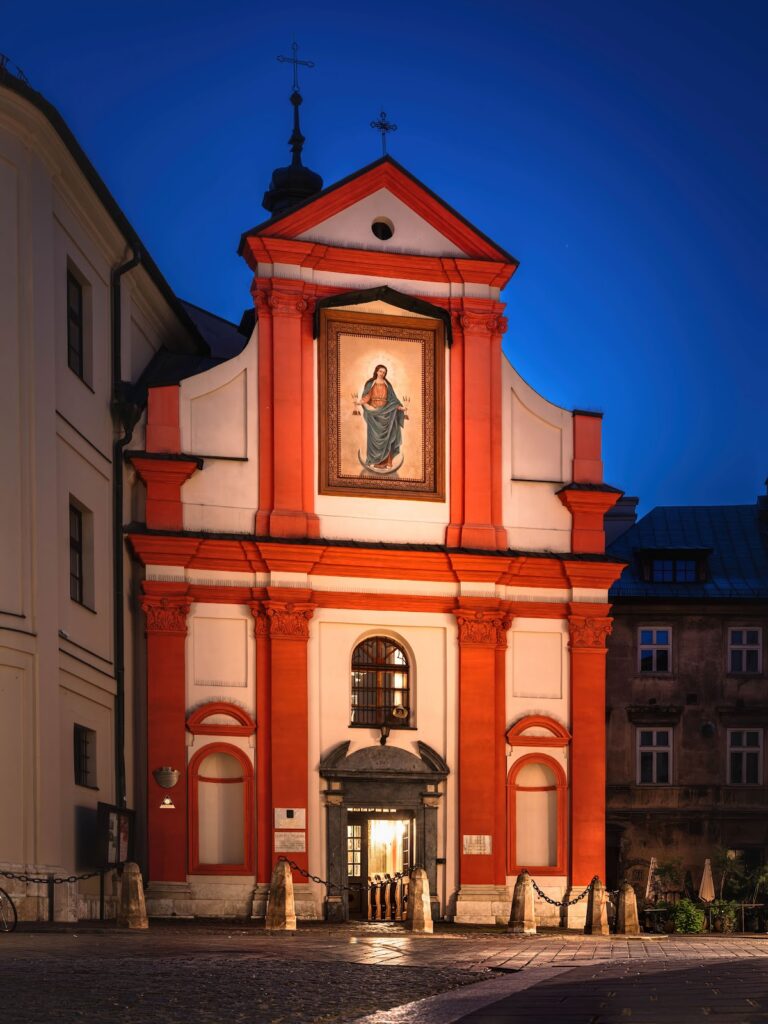
St. Florian’s Church is a Baroque stone-and-brick building with three naves, two towers, and five altars. Its position at the northern end of Jan Matejko Square places the church within the historic urban setting associated with the Royal Road. The surviving structure reflects the rebuilding carried out after seventeenth-century destruction and the later eighteenth-century campaign.
Church building and interior
The church’s three-nave plan and twin towers form its principal architectural framework. Five altars remain inside, together with an organ having 23 stops, two manuals, and a pedal division. The interior furnishings were expanded during the work of 1755 to 1779, when side altars were added alongside the two chapels beside the western facade.
Western chapels
The Chapel of the Holy Cross and the Chapel of Our Lady of Sorrows were added beside the western facade during the eighteenth-century rebuilding. They belong to the same campaign that introduced the side altars and other interior furnishings, giving the church’s western end its present arrangement.
Exterior works and adjoining buildings
A figure of St. Florian stands on the facade. The exterior wall of the presbytery carries Golgotha, a work designed by the architect and artist Aleksander Józef Veith in 1905. Beside the church, the parish house at 1b Warszawska Street was built from 1911 to 1913 to a design by Franciszek Mączyński.
Surviving cemetery evidence
The cemetery surrounding the church remained in use until the end of the eighteenth century. After it was removed, epitaphs from the former burial ground remained on the church walls. The former cemetery area is now occupied by a parking area, while the surviving epitaphs preserve evidence of the church’s earlier burial setting.