Monmouth Castle: A Norman Border Stronghold in Wales


Site at a Glance
- Rating
- 4
- Popularity
- Low
- Country
- United Kingdom
- Primary era
- Medieval
- External website
- Open
- Eras represented
- Medieval, Early Modern
- Civilizations
- English, Norman
- Site type
- Military
- Remains
- Castle
On this page12 sections
History
Monmouth Castle is a Norman border fortress in Monmouth, United Kingdom, established by William FitzOsbern, the first Earl of Hereford, between 1066 and 1069, with 1067 given as its construction date. Built in the aftermath of the Norman Conquest, it occupied a strategic position in the Welsh Marches and formed a counterpart to FitzOsbern’s major castle at Chepstow.
A Norman Marcher stronghold
The castle was created as part of the Norman effort to secure the frontier and expand into Wales. The earldoms of Chester, Shrewsbury, and Hereford provided bases for this activity, while Monmouth was administered by a Marcher Lord, a lord responsible for the defence and expansion of a border territory. The early fortress had the character of a Norman border castle and was comparable in style and status to castles at Grosmont, Skenfrith, White, and Abergavenny.
Monmouth Castle appears in the Domesday Book of 1086, the great survey of landholding and resources commissioned by William the Conqueror. Its original form was an earth-and-timber ringwork, a circular fortified enclosure formed by an earth bank and ditch and initially protected by timber structures. Stonework was added before 1150, marking an important stage in the development of the fortress.
Lancastrian redevelopment
After a brief period under the control of Simon de Montfort, a thirteenth-century English nobleman and political leader, the castle passed in 1267 to Edmund Crouchback, Earl of Lancaster and son of Henry III. Edmund redeveloped the site, constructed the Hall, and made Monmouth Castle his principal residence in the area.
The castle was improved again in the early fourteenth century, probably under Edmund’s grandson, Henry of Grosmont, Duke of Lancaster. The upper Great Tower received large decorated windows and a new roof during this phase. The site was also associated with important members of the royal family. Edward II, king of England from 1307 to 1327, was briefly imprisoned at Monmouth before being transferred to Berkeley Castle, where he died.
Monmouth was a favoured residence of Henry Bolingbroke, later King Henry IV. His wife, Mary de Bohun, gave birth at the castle in 1386 to the future Henry V, who later became known for his military campaigns during the Hundred Years’ War.
Rebellion, town growth, and changing use
Monmouth Castle was not directly attacked during the ten-year rebellion led by Owain Glyndwr, a Welsh nobleman who began a major revolt against English rule in 1400. Its strength helped it remain a regional stronghold while other local settlements and castles suffered. Grosmont and Abergavenny were devastated, while Crickhowell and Newport castles were successfully attacked.
As the castle’s defensive purpose declined, its outer bailey, an enclosed area used for supporting buildings and activities, increasingly became a market. The bailey developed into the market area now known as Agincourt Square. In the sixteenth century, Monmouth became the county town of the newly created shire of Monmouth, and the county’s Assize Courts began meeting in the castle’s Great Hall. These travelling royal courts heard important civil and criminal cases in county centres.
Civil War destruction and later occupation
During the English Civil War, the castle changed hands three times before finally falling to the Parliamentarians in 1645. Oliver Cromwell, a Parliamentarian military commander and political leader, visited in 1646. Tradition attributes to him the order for the castle to be slighted, meaning deliberately partly demolished so that it could not be fortified again.
The House of Commons formally ordered the town and castle to be disgarisoned and the works slighted on 1 March 1647. Demolition began with the round tower on 30 March, continued for months, and ended with the tower’s collapse on 22 December 1647. The destruction made the castle unusable as a fortified stronghold.
Great Castle House was built on the site of the former round tower in 1673 by Henry Somerset, 1st Duke of Beaufort. The building later housed the Assize Courts until their transfer to the new Shire Hall in 1725. Castle House and Great House were also built on former parts of the castle site.
In 1875, the Royal Monmouthshire Royal Engineers Militia established its headquarters at the site. The regiment, now known as the Royal Monmouthshire Royal Engineers, continues to use it, giving Monmouth one of the few British castles in continuous military occupation. The site is a Grade I listed building and a scheduled monument in the care of Cadw, the Welsh historic-environment service. Great Castle House is also Grade I listed.
Remains
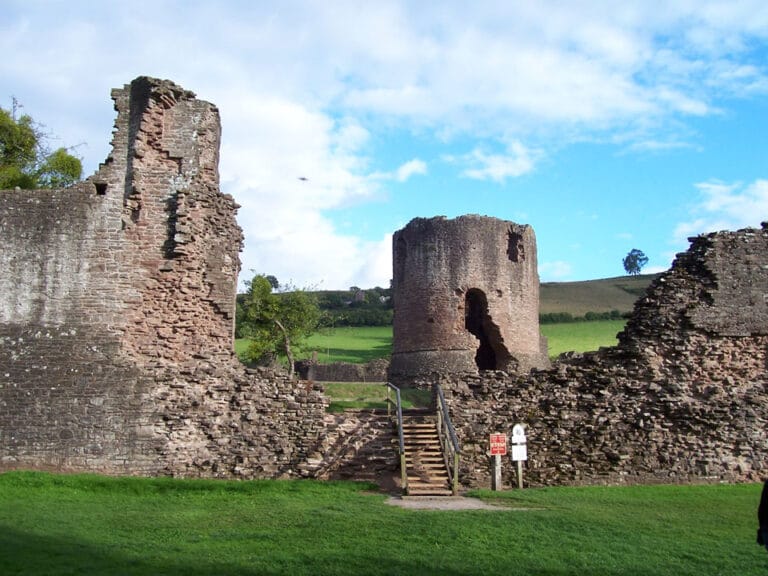
Monmouth Castle stands on relatively high ground near the centre of Monmouth, overlooking the River Monnow and the confluence of the Monnow and River Wye. The fortress was positioned behind the town’s shops, streets, and main square. Its surviving remains consist of fragments of the Great Tower and Hall, portions of the castle walls, and later buildings occupying parts of the former castle ground.
Medieval castle remains
Great Tower and Hall
The Great Tower and Hall survive only in fragmentary form. The tower began as part of the stone development that followed the original earth-and-timber ringwork, and its architecture shares similarities with the tower at Chepstow Castle, another stronghold established by William FitzOsbern farther south on the lower River Wye. During improvements in the early fourteenth century, the upper level gained large decorated medieval windows and a new roof. The Hall, constructed during Edmund Crouchback’s redevelopment, also survives as fragments.
Walls and outer bailey
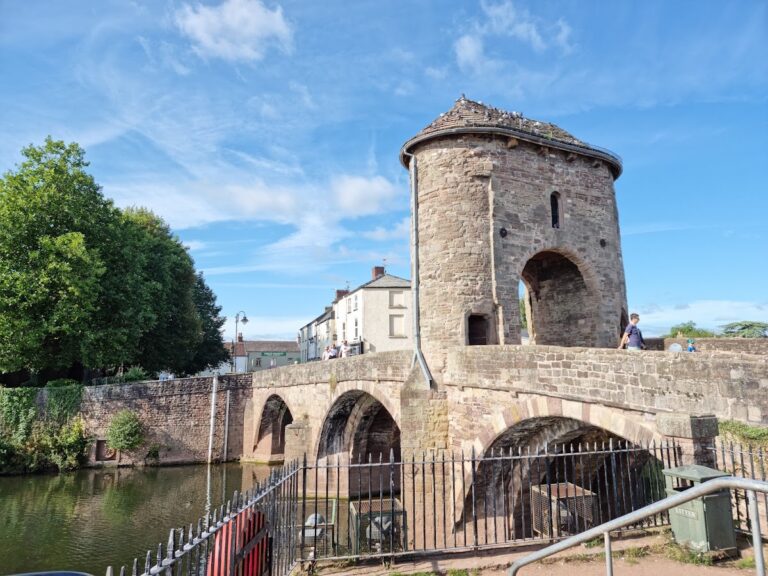
Portions of the castle walls remain, while other parts of the former fortress collapsed, were demolished, or were built over. The outer bailey later became the market area known as Agincourt Square. As the surrounding town developed, the castle’s defences were supplemented at the end of the thirteenth century by a town wall and a fortified bridge, extending the defensive system beyond the castle enclosure.
Later buildings on the castle site
Great Castle House
Great Castle House occupies the former site of the castle’s round tower, whose demolition began in 1647. Built in 1673 by Henry Somerset, 1st Duke of Beaufort, it later accommodated the Assize Courts before they moved to the new Shire Hall in 1725. Great Castle House is a Grade I listed building.
Stable block and museum
The stable block attached to Great Castle House contains the Royal Monmouthshire Royal Engineers Museum. The museum presents the history of the regiment from 1539 to the present, linking the later military use of the site with the continuing role of the Royal Monmouthshire Royal Engineers.