Grazzano Visconti Castle: A Restored Medieval Fortification in Italy



Site at a Glance
- Rating
- 4.5
- Popularity
- High
- Country
- Italy
- Primary era
- Medieval
- External website
- Open
- Eras represented
- Medieval, Early Modern, Modern
- Civilizations
- Duchy of Milan, Duchy of Parma and Piacenza, Holy Roman Empire, Italian
- Site type
- Military
- Remains
- Castle
On this page12 sections
History
Grazzano Visconti Castle is a restored medieval lowland fortification in Italy, built in 1395 by Giovanni Anguissola after his marriage to Beatrice Visconti, sister of Gian Galeazzo Visconti, Duke of Milan. The castle may have replaced an earlier structure. Its history reflects the rivalries of the Anguissola, Visconti, Sforza, and Farnese families, whose political authority shaped its ownership, jurisdiction, and military role.
Origins and feudal authority
The locality of Grazzano was first mentioned around the year 1000, when land there was donated to the monastery of San Savino in Piacenza. The castle entered the political history of the region in 1414, when Sigismund of Luxembourg, a medieval king who later became Holy Roman Emperor, formally granted Bernardo Anguissola the castle and the neighbouring castles of Riva and Montesanto, together with the villages of Carmiano and Ponte Albarola.
Opposition from the Piacenza nobility prevented Bernardo from establishing authority over the territory until 1438. In that year, Filippo Maria Visconti added regalian rights and the “power of the knife,” meaning high criminal jurisdiction that could include severe corporal or capital penalties. He also removed the territory from Piacenza’s judicial jurisdiction. In 1459, Francesco Sforza confirmed the Anguissola family’s ownership of the fief through Giovanni Anguissola.
Conflict and dynastic change
A peasant revolt against Sforza rule reached the area in 1462. Five hundred soldiers sent to suppress the uprising fought the rebels near the castle. Many insurgents, including Count Onofrio Anguissola, were captured, while the revolt’s leader, Giacomo Pelizzari, known as “Pelloia,” was forced to commit suicide.
Grazzano suffered further destruction during the wars of the early sixteenth century. In 1521, French troops led by Lautrec, a professional military commander, razed and burned the settlement after being ordered to attack fortifications allied with the Scotti family, which was active in the wars against France. Troops of Landsknechts, German-speaking mercenary infantry, attacked Grazzano again in 1526.
Meetings held in the castle in 1547 produced a conspiracy that culminated in the murder of Pier Luigi Farnese by Giovanni Anguissola of Grazzano. Giovanni later served as an official of Emperor Charles V and lived in exile before recovering property that had initially been confiscated. In 1576, he transferred the castle and all rights attached to the fief to his cousins Teodosio and Alessandro Anguissola, members of the family branch associated with Vigolzone, Folignano, and San Polo. In 1599, the Farnese dukes raised the Grazzano fief to a marquisate, a territorial lordship governed by a marquis.
Alteration and twentieth-century redevelopment
Work in 1689 replaced the original drawbridge with a masonry bridge. During the nineteenth century, the Anguissola family adapted the castle as a country residence. By the end of that century, parts of the building had fallen into ruin, with dangerous walkways and loggias, or open-sided galleries, while the stability of the whole structure had become compromised. Farm buildings and stables used by local peasants had also grown up around it.
The estate remained with the Anguissola family until Count Filippo died without heirs in 1870. It passed to his mother, Francesca, known as Fanny Visconti, and then in 1883 to her nephew Guido Visconti di Modrone. At the beginning of the twentieth century, Giuseppe Visconti di Modrone initiated a broad redevelopment. He commissioned architect Alfredo Campanini to restore and redefine the castle and to replace the nearby rural buildings with a planned fortified settlement.
The settlement was constructed in 1905 and 1906, with Giuseppe Visconti acting as its director, painter, and fresco painter. Restoration of the medieval castle was completed between 1906 and 1908, and the redevelopment continued until the main square was completed after 1915. In 1937, King Victor Emmanuel III granted Giuseppe Visconti di Modrone the title of Duke of Grazzano Visconti. The castle remains owned by the Visconti di Modrone family.
Remains
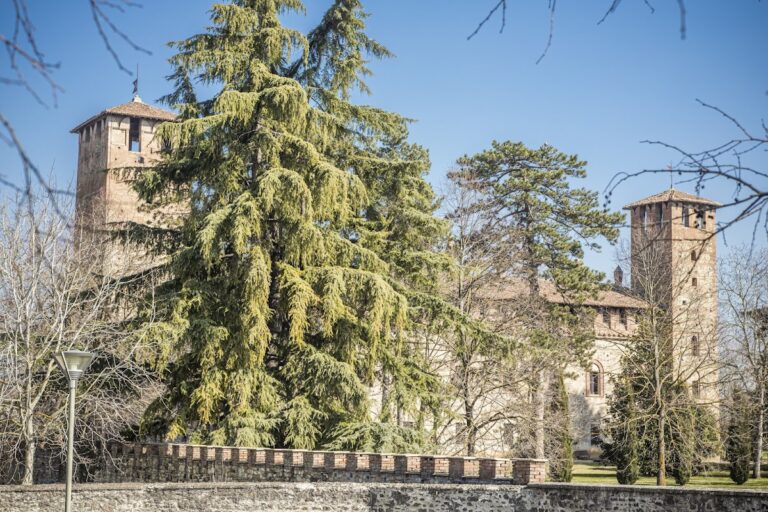
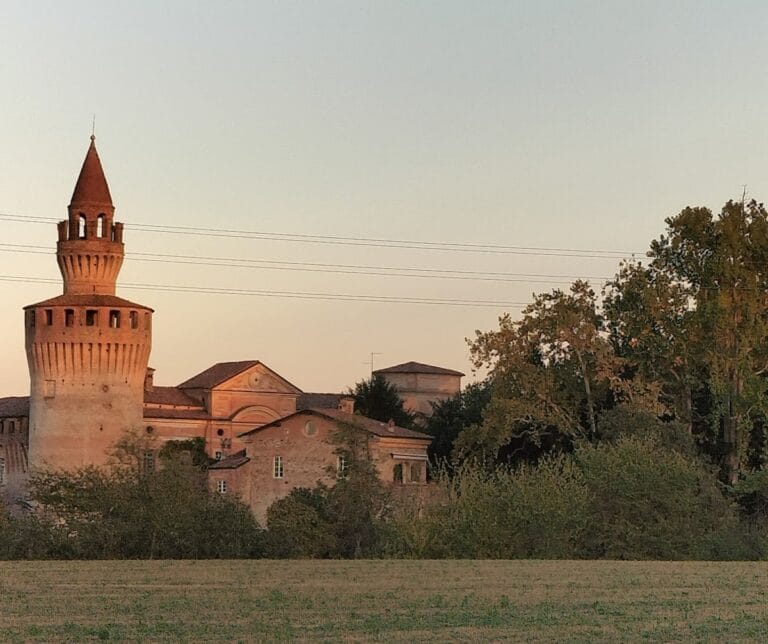
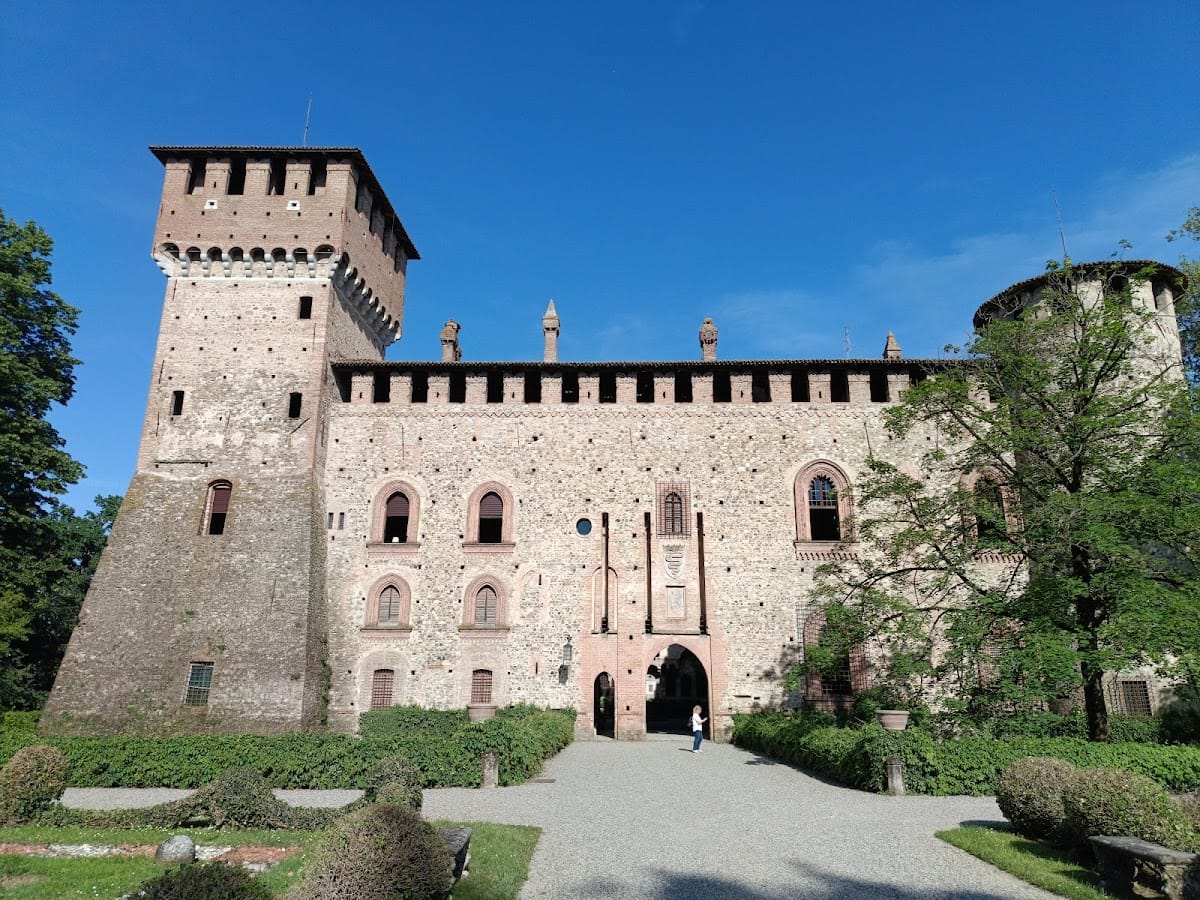
The surviving complex combines a rectangular stone-and-brick castle, a square internal courtyard, a surrounding moat, a landscaped park, and a nearby fortified settlement. Buildings occupy three sides of the castle, while a crenellated wall, whose parapet alternates raised sections with defensive openings, closes the fourth. The early twentieth-century restoration substantially reshaped the medieval building, while retaining its principal fortified arrangement.
Castle enclosure and entrance
Towers and courtyard
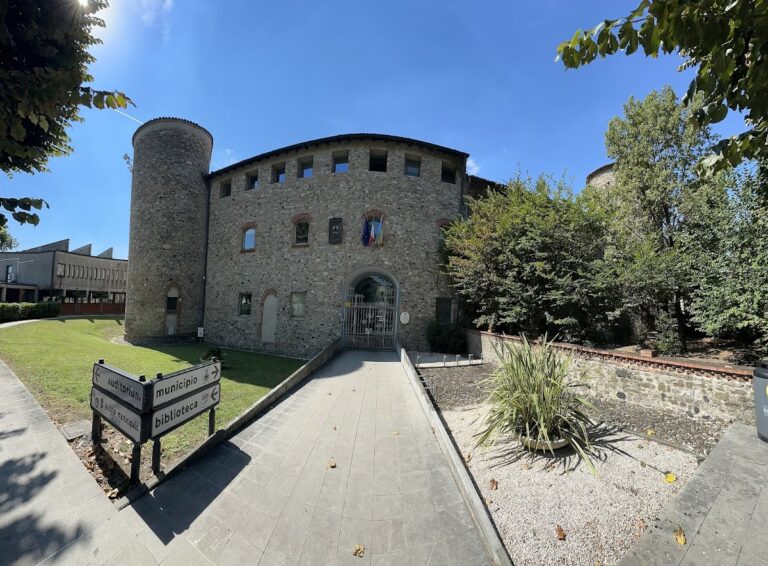
Towers stand at the four corners of the rectangular castle. Two are cylindrical and two are square in plan. Alternating bands of stone and brick, together with terracotta profiles set against stone surfaces, create a decorative pattern across the masonry. Within the enclosure, a square courtyard is bordered by porticoes, roofed walkways supported by columns or arches.
Moat and bridge
A moat surrounds the castle. The original approach crossed a drawbridge, which was replaced by a masonry bridge in 1689. Traces of the earlier bridge remain beside the later entrance structure.
Park and fortified settlement
Castle park
The park surrounding the castle was created between the late nineteenth and early twentieth centuries on Giuseppe Visconti di Modrone’s initiative. It covers approximately 120,000 square metres and contains native trees such as English oak, elm, black poplar, hazel, and field maple, alongside introduced cedar, American cypress, and bamboo. Cypress, pine, holm oak, and other evergreen species were also planted to improve movement through the park in all seasons. Several trees are more than a century old, including an American plane tree more than 150 years old.
Neo-medieval settlement
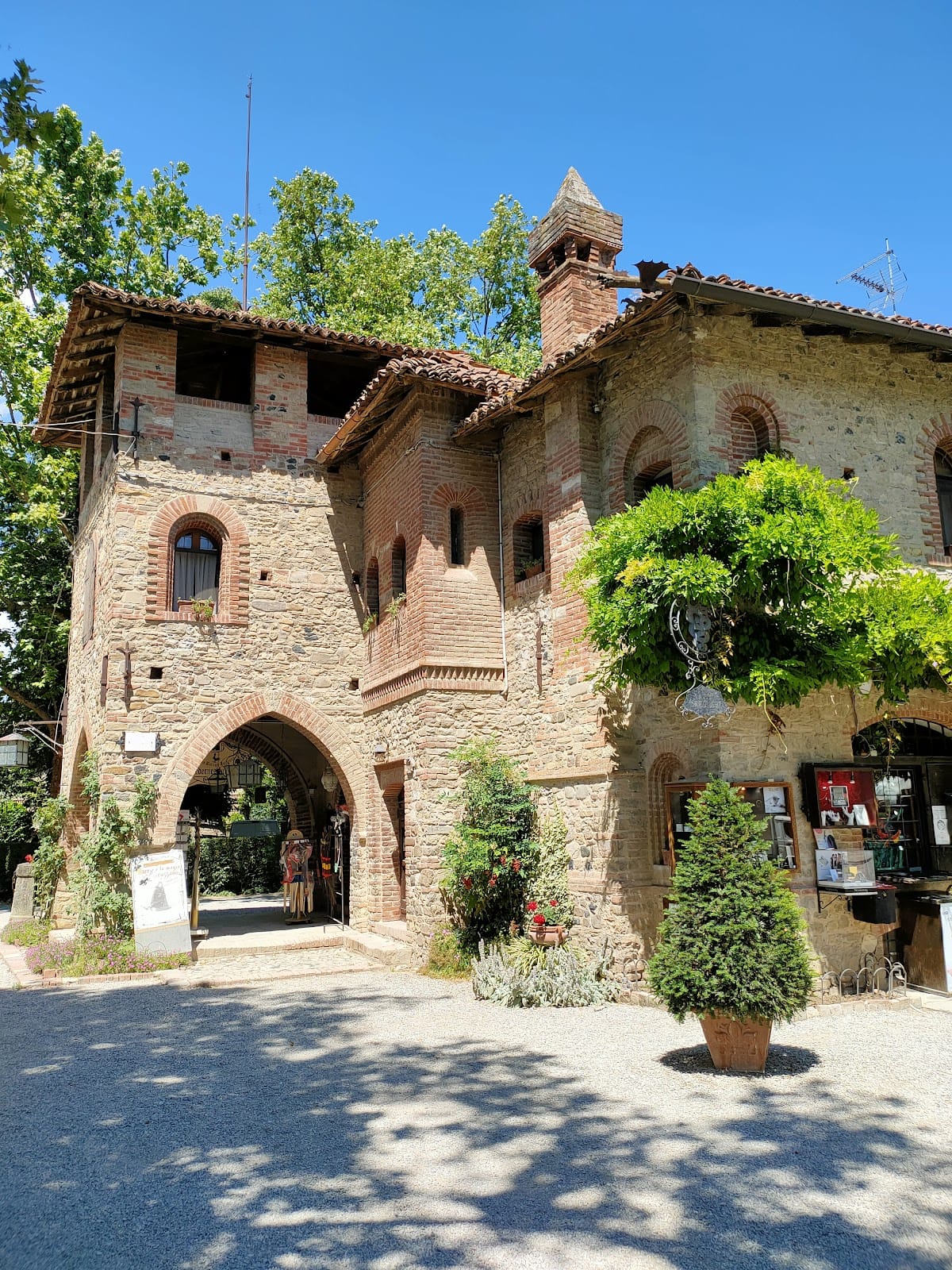
The fortified settlement near the castle was newly laid out during the first years of the twentieth century. Its design used neo-medieval forms together with neo-Gothic and Renaissance elements. Biscione Square, named for the Visconti family symbol, contains a crenellated tower, a fountain, a well made of terracotta and pink marble, and the Podesta’s Palace, a building associated with the podestà, a civic magistrate and chief judicial and administrative official in many Italian communes.
Parish church
The parish church dedicated to Saints Cosmas and Damian was built in 1650 on the foundations of an earlier building dating at least from the thirteenth century. It underwent limited renovation during the first half of the twentieth century, in contrast to the extensive alterations made to the castle.