Mongavlin Castle: An O’Donnell Stronghold on the River Foyle
Site at a Glance
- Rating
- 3.8
- Popularity
- Very Low
- Country
- Ireland
- Primary era
- Early Modern
- Eras represented
- Early Modern
- Civilizations
- English
- Site type
- Military
- Remains
- Castle
On this page5 sections
History
Mongavlin Castle is a ruined castle in Ireland, on the west bank of the River Foyle in County Donegal. It was formerly a stronghold of the O’Donnell dynasty, the Gaelic ruling family of Tyrconnell, and its present remains belong largely to a rebuilding associated with 1619. The site’s earliest foundation date is uncertain, and the castle was destroyed and rebuilt more than once.
The O’Donnell stronghold
During the sixteenth century, Mongavlin was the principal residence of Iníon Dubh, daughter of James MacDonald, 6th of Dunnyveg, and mother of Red Hugh O’Donnell. When she travelled to Ulster to marry Sir Hugh McManus O’Donnell, she brought 100 Scottish warriors as her bodyguard, including 80 Crawfords. After the O’Donnells abandoned the castle, these men settled in the district and married locally, leaving many descendants associated with the area.
The castle became involved in the conflicts that followed the Flight of the Earls, the 1607 departure of leading Gaelic lords from Ireland and the subsequent confiscation and plantation of their Ulster lands. In April 1608, Sir Cahir O’Doherty, the last Gaelic lord of Inishowen and a rebel leader, sent Sir Niall Garve O’Donnell to Lifford to stop English reinforcements from reaching Derry. Niall Garve instead seized Mongavlin, drove out Iníon Dubh, and plundered the surrounding district. Sir Cahir later expelled him and restored Iníon Dubh to the castle.
After sacking and burning Derry and killing its governor, Sir George Paulet, Sir Cahir was involved in the continuing upheaval that followed. Mongavlin was abandoned soon afterward amid internal conflict within the O’Donnell clan.
Rebuilding and later history
On 23 July 1610, Ludovic Stewart, 2nd Duke of Lennox, received Mongavlin Castle and its surrounding lands by royal patent. After his death on 16 February 1624, the property passed to his brother Esmé Stewart, 3rd Duke of Lennox. Esmé died in August 1624, and his widow, Katherine, 2nd Baroness Clifton, later married James Hamilton, 2nd Earl of Abercorn, around 1632.
The castle standing in the early seventeenth century was built for Sir John Stewart, an illegitimate son of Ludovic Stewart. Its completion is associated with 1619, when Captain Nicholas Pynnar included it in his inspection of Ulster lands confiscated by the Crown. A further survey in 1622 shows that work was still incomplete, with floors and internal partitions unfinished and window grilles prepared for fitting.
King James II and VII visited Mongavlin in 1690 while travelling to the Siege of Derry, a campaign in Ireland fought against forces supporting William III. From the castle, he sent a letter proposing surrender, but the proposal was rejected. In 1704, James Hamilton, 6th Earl of Abercorn and Viscount Strabane, placed a memorial plaque at Mongavlin in memory of his mother, the Honourable Elizabeth Hamilton. The castle is now a ruin, with only a small part of its structure still standing.
Remains
The castle and surviving fabric
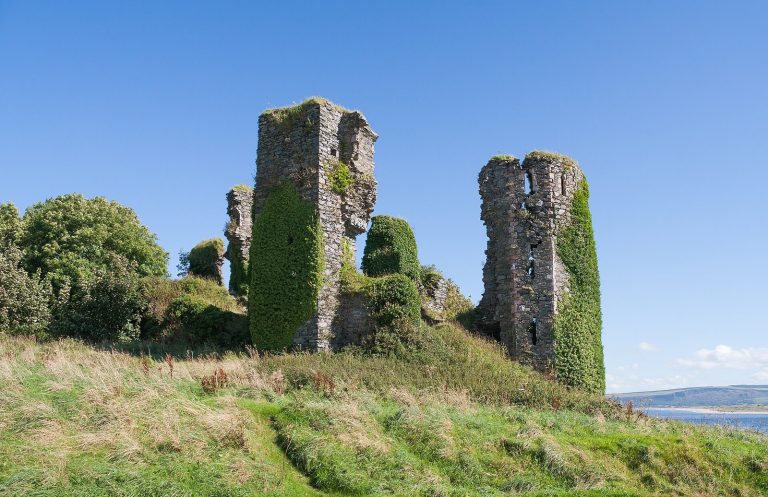
Mongavlin Castle stands approximately 3 kilometres south of St Johnston on the west bank of the River Foyle. The early seventeenth-century building was constructed from lime and stone and measured about 50 by 25 feet. It rose to three and a half storeys and had four flanking towers at the upper corners. These projecting towers provided defensive coverage along the sides of the castle.
The entrance was secured by an iron portcullis-style door, a vertically sliding gate reinforced with iron. Oak floor timbers and joists formed the internal floors, while iron grilles had been prepared for the windows. A flagstone above the entrance arch bore the inscription “J.S.-E.S.T.-1619,” linking the building to Sir John Stewart and the early seventeenth-century construction phase. The stone was lost in the early eighteenth century.
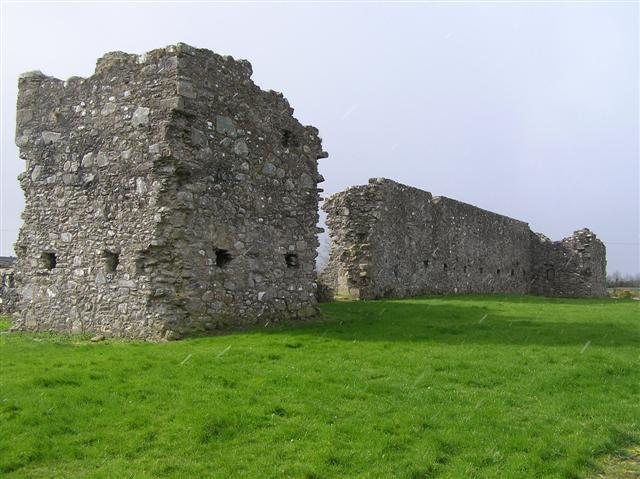
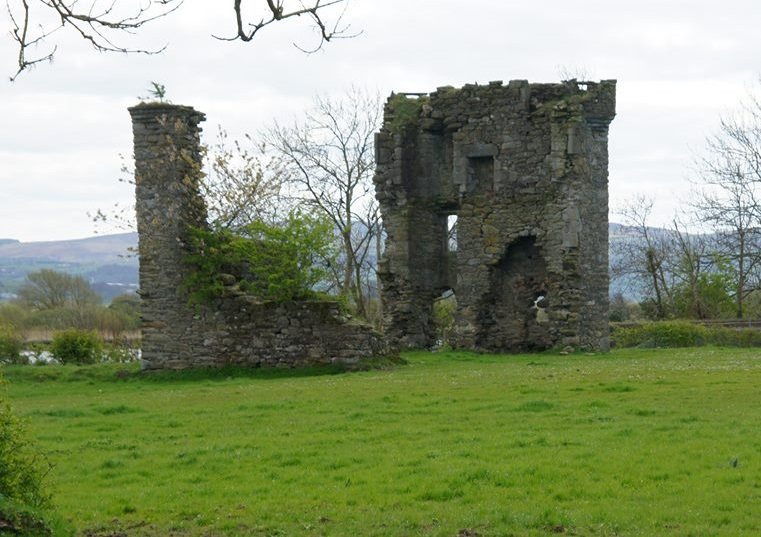
Only a small section of the castle survives, while the remainder has fallen into ruin. A pencil drawing preserves an image of the building during its early seventeenth-century phase and complements the surviving fragmentary structure.