St. Nicholas Church (Varoš): A Medieval Orthodox Church in Prilep


Site at a Glance
- Rating
- 5
- Popularity
- Very Low
- Country
- North Macedonia
- Primary era
- Medieval
- Eras represented
- Medieval
- Civilizations
- Byzantine
- Site type
- Religious
- Remains
- Church
On this page7 sections
History
St. Nicholas Church (Varoš) is a medieval Orthodox church in Prilep, North Macedonia, completed in 1298. It remains an active place of worship and belongs to the Prespa-Pelagonia Diocese of the Macedonian Orthodox Church–Ohrid Archbishopric, the Eastern Orthodox institution affiliated with the church. Its preserved paintings and distinctive architecture give it an important place among the medieval churches of the region.
Completion in the Byzantine period
An inscription above the southern window states that the church was completed in November 1298. It names Vega, the son of Kapza and Maria, as the patron or donor, and places the work during the joint reign of the Byzantine emperors Andronikos II Palaiologos and Michael IX Palaiologos, with Empress Irene associated with the imperial court. The inscription provides a firm date for the completion of the building and identifies the person who sponsored it.
The date of the wall paintings is less certain than that of the church itself. They have been placed broadly in the late twelfth or early thirteenth century, and 1191 is also given for their execution. Their artistic treatment is compared with the frescoes of St. Panteleimon at Nerezi, while the church’s architectural form is compared with medieval churches in Kastoria. St. Nicholas Church is protected as a cultural monument.
Remains
Building and exterior
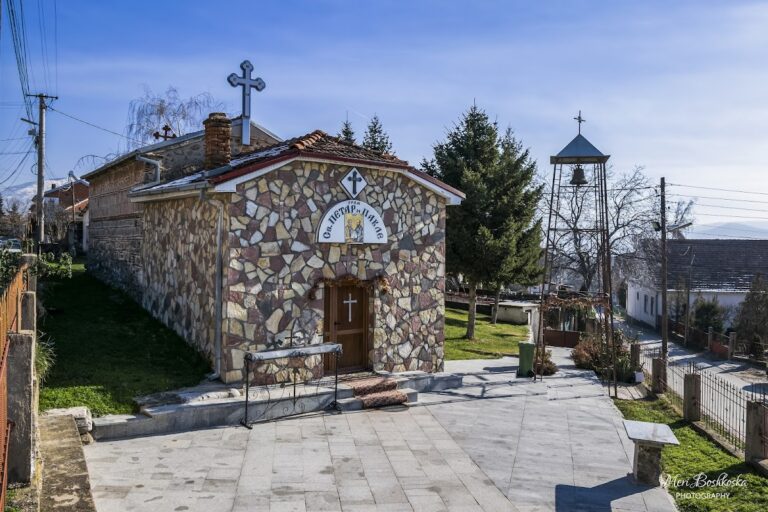
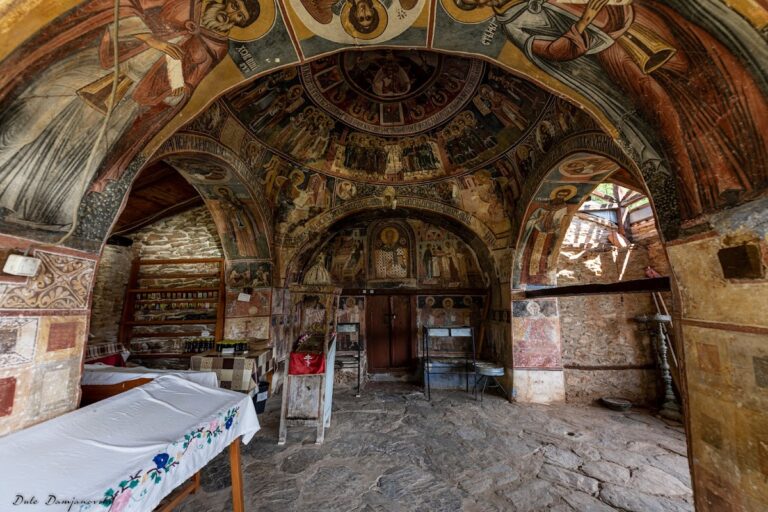
The church is a small, single-nave structure with a notably high and distinctive form. Its exterior apse has three sides, while the interior is covered by a semi-cylindrical vault, a continuous curved ceiling shaped like half a cylinder. Unhewn stone forms the main construction, and the upper parts are enriched with ceramoplastic decoration, ornamental patterns made from fired ceramic elements set into the masonry.
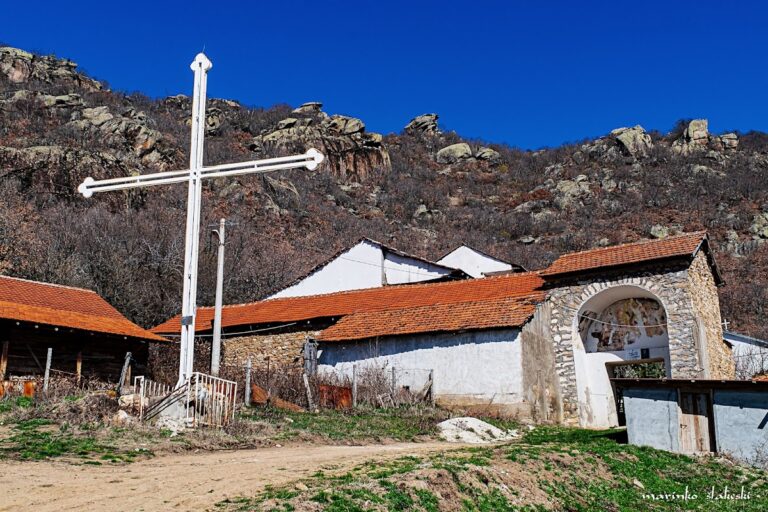
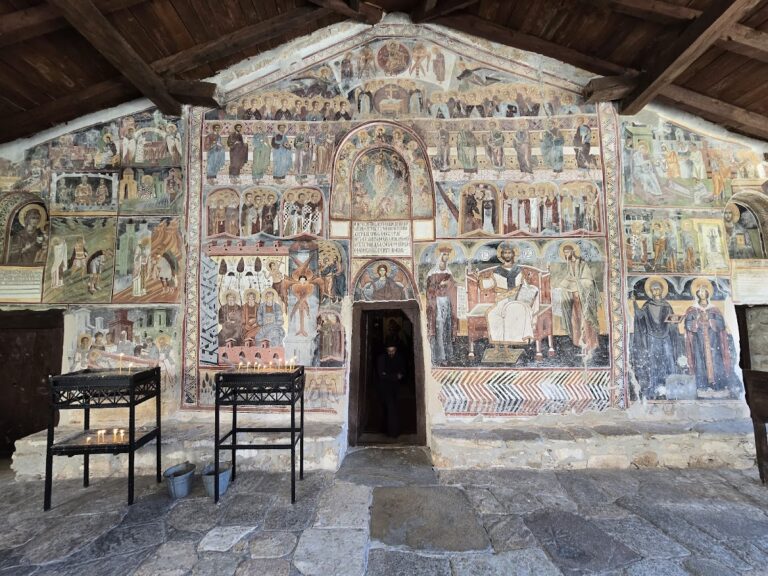
Fragments of frescoes survive on the exterior facade. Above the western entrance, a niche contains an image of St. Nicholas, the Christian saint traditionally identified as a fourth-century bishop of Myra and venerated as the church’s patron. The western facade also preserves a seventeenth-century fresco-icon.
Interior decoration
Frescoes
The interior frescoes are exceptionally well preserved and artistically significant. Their composition is arranged in three horizontal zones. Full-length warrior saints and other saints occupy the first zone, scenes from the Passion of Christ fill the second, and the third presents the Great Feasts. Full-length prophets appear on the vault.
Icons
The church preserves icons dating from the fourteenth to the nineteenth centuries. Among them is the fourteenth-century Child at Play, whose realistic treatment departs from the classical Byzantine image of the Virgin with Christ. A fifteenth-century icon of the Virgin of Tenderness is also preserved in the church.