Mondaye Abbey: A Premonstratensian Canonial Abbey in France


Site at a Glance
- Rating
- 4.7
- Popularity
- Low
- Country
- France
- Primary era
- Early Modern
- External website
- Open
- Eras represented
- Early Modern, Modern
- Civilizations
- French
- Site type
- Religious
- Remains
- Monastery
On this page13 sections
History
Mondaye Abbey, formally Saint-Martin de Mondaye, is a Roman Catholic Premonstratensian monastery in Juaye-Mondaye, France, founded in 1200. It remains the only active Premonstratensian canonial abbey in Normandy. Its community belongs to the Order of Saint Norbert, whose canons live under a common rule while also serving as parish clergy and chaplains outside the monastery.
From hermitage to abbey
In the mid-twelfth century, the priest Turstin withdrew to a wooded hill in Normandy and attracted disciples. After his death in 1200, the bishop of Bayeux placed the community under the Rule of Saint Augustine, a set of regulations followed by many communities of canons regular. Turstin’s brother-in-law, Raoul de Percy, donated the land on which the group lived.
La Lucerne Abbey took the community under its protection, and in 1210 Mondaye entered the Order of Saint Norbert. Donations from the de Percy and de Vassy families, other local nobles, and prosperous farmers supported its development. By the end of the thirteenth century, a church and conventual buildings had replaced the original hermitage.
War, plague, and renewal
From 1343, donations and the abbey’s prosperity were disrupted by the Hundred Years’ War, a long conflict between the English and French crowns and their allies. Fighting between lords who supported the two kings affected the Bessin. The Black Death, the fourteenth-century epidemic of plague, killed about one-third of the population in 1347. The abbey’s lands fell out of cultivation, armed bands devastated the surrounding area, and Richard FitzAlan, Earl of Arundel, ravaged Mondaye in 1389.
The abbey recovered under Abbot Jean Feray, who led it from 1512 to 1557. Its canons attended the University of Caen, and several became doctors of theology. During the French Wars of Religion, conflicts between Catholics and Huguenots, French Protestants principally associated with Calvinism, Mondaye was burned and its treasures dispersed. Abbot Julien Guichard was killed by Huguenots on 5 September 1564. After the Council of Trent, the Catholic reform council held from 1545 to 1563, the church was restored with support from Anne de Médavy.
Reform and eighteenth-century reconstruction
In 1631, Claude-Philippe Le Clerc du Tremblay became commendatory abbot. A commendatory abbot held the abbacy and its revenues without necessarily residing in or directly governing the monastery. He headed Mondaye for approximately 75 years. The community adopted the stricter Lorraine reform of the Premonstratensian rule in 1655. This movement sought a return to the order’s earlier discipline, while the chapter’s election of a prior partly limited the disadvantages of commendatory administration.
Three regular abbots appointed by Louis XIV and Louis XV governed Mondaye between 1704 and 1763. During this period, the abbey was rebuilt in the classical style as a unified complex of church, conventual buildings, entrance pavilion, and farm. Eustache Restout supervised the work from 1706 to 1743 and later devoted himself to decorating the church. Construction stopped when the abbey returned to commendatory administration in 1763.
Revolution and nineteenth-century return
The French Revolution deprived the Premonstratensian order of its property, and the seventeen religious at Mondaye were dispersed or imprisoned. Father Paynel, parish priest of Juaye, took the constitutional oath required under the Civil Constitution of the Clergy, the revolutionary measure that placed Catholic clergy under state regulation. He later abandoned the priesthood and became mayor. After reconciling with the Church, he saved the abbey church from destruction and sheltered as many as nine priests who had rejected the oath.
After the Revolution, Father Goujon, previously a clandestine prior, gathered the parishes of Juaye, Couvert, and Bernières-le-Bocage. The commune of Juaye-Mondaye originated during this period. From 1806 to 1812, the conventual buildings housed a college. Trappist nuns from Valenton occupied Mondaye from 1815 until 1854, when the cost of maintaining the buildings became too great. Later efforts associated with La Coudre included a resettlement that transferred to the newly founded Trappist nunnery of La Cour-Pétral in 1845.
Premonstratensian canons returned on 13 June 1859, when the bishop of Bayeux ceremonially handed the keys to canons from Grimbergen Abbey in Belgium. The community grew, expanded its parish missions, preaching, and retreats, and resumed work on the north and south wings in the classical style.
Expulsion, war, and continuing religious life
In 1880, the French Third Republic pursued a policy that reduced religious influence. Abbot Joseph Willekens was expelled as a foreigner, and the canons dispersed. They regrouped at Cottun Castle, returned to Mondaye in 1894, and were expelled again in 1902. The community went into exile at Bois-Seigneur-Isaac in Walloon Brabant, Belgium, and received authorization to return to Mondaye in 1921.
The Allied landings in June 1944 brought several days of bombing to the abbey. The buildings later underwent extensive restoration, although the walls remained marked by fighting in the surrounding area. Rebuilding of the most severely damaged part of the church began in 2007.
The General Chapter of Wilten, meeting between 1968 and 1970, sought to bring the order’s constitutions into line with the directives of the Second Vatican Council. Lay participation and information exchange subsequently increased, as did the role of work and the size of the farm. The former abbey farm, sold separately during the Revolution, was repurchased by the monastery in 2007. Its first restoration stage was completed in June 2012.
Mondaye remains a Premonstratensian community. Its canons live communally while serving as parish priests and vicars and as chaplains in hospitals, prisons, scouting, and youth movements. The abbey also maintains dependent priories at Sainte-Foy de Conques and Notre-Dame of Sarrance. Mondaye entered the register of historic monuments in 1927. The church, east conventual buildings, entrance pavilion, flanking wings, and south wing were classified in 1947 and 1999.
Remains
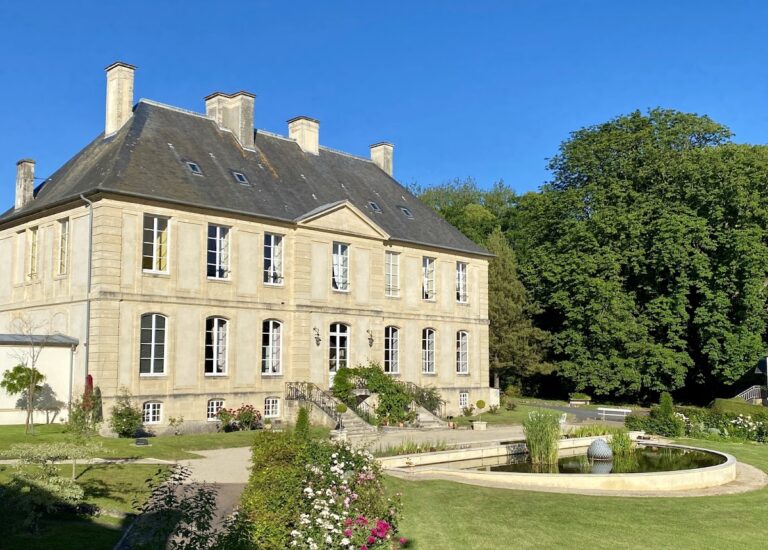
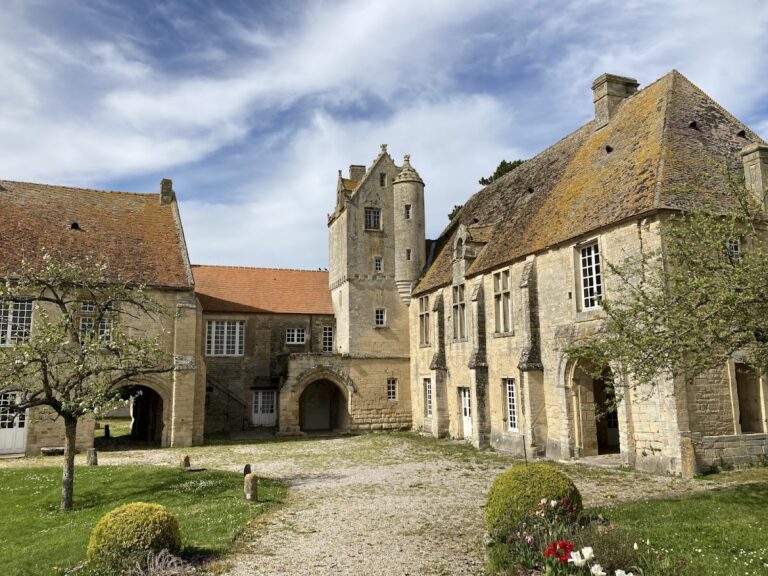
Mondaye occupies a rural site in the Bessin on the territory of Juaye-Mondaye. Its principal buildings are predominantly classical, reflecting the eighteenth-century reconstruction. The complex includes the church, conventual buildings, entrance pavilion, enclosing walls, former tithe barn, adjoining barn, and former abbey farm. The monastery’s traditional arms are azure with a silver cooking pot.
Church and artistic features
Abbey church
The abbey church is approximately 60 metres long and was designed wholly by Eustache Restout. A blind portal fronts the building, with the space before it occupied by the organ. Inside, a five-bay nave is carried by large pillars supporting round arches. The south side has twice as many openings as the north side. The altar stands centrally, and the transept arms are large in keeping with Premonstratensian tradition.
Restout created the church’s paintings and designed the choir woodwork. The dome above the altar copies the dome formerly painted by Charles Le Brun in the chapel of the Château de Sceaux, which has since disappeared. Extensive postwar and later restoration affected the church, and rebuilding of its most severely damaged section began in 2007.
Organ
Claude Parisot, an organ builder from Lorraine, made the organ in 1741. The Flemish artist Melchior Verly carved its case. The instrument has 27 stops and was restored in 1965 and 2004 by Jean-Baptiste Boisseau and Jean-Marie Gaborit. It continues to be used for concerts.
Monastic buildings and grounds
Cloister and interiors
The cloister began in the eighteenth century with the east wing and part of the south wing. It was continued and glazed in the nineteenth century. The staircase leading to the library and cells has wrought-iron railings, while the salle des pas-perdus contains a self-portrait of Eustache Restout. The library holds approximately 65,000 volumes, including books dating from the sixteenth century.
The eighteenth-century plan retained the order’s austerity through small cells and limited fireplaces. Fireplaces were provided in the prior’s lodging, the warming house, and the infirmary.
Entrances, enclosure, and farm
The abbey includes a postern gate, a small entrance through an enclosed structure, which formerly served as the principal entrance. It also retains the entrance pavilion, enclosing walls, former tithe barn, and adjoining barn. Restoration of the former farm followed its repurchase by the monastery in 2007. The first completed section restored the farm buildings and recreated the historic entrance perspective between the postern gate and the abbey church.