Château de la Ferrière: An Eighteenth-Century Estate in France


Site at a Glance
- Rating
- 4.4
- Popularity
- Very Low
- Country
- France
- Primary era
- Early Modern
- External website
- Open
- Eras represented
- Medieval, Early Modern, Modern
- Civilizations
- French
- Site type
- Domestic
- Remains
- Castle
On this page9 sections
History
Construction and Early Ownership
Château de la Ferrière is an eighteenth-century château in Vaux-sur-Aure, France, built in 1735 in the Louis XV period, the architectural and decorative era associated with the reign of Louis XV. Claude Jacqueline Piedoue de Nerval commissioned it on the remains of a fifteenth-century feudal castle. She was the widow of Michel Hemerel, a royal councillor, lord of La Ferrière, lord and patron of Vaux-sur-Aure, and an equerry to Louis XV. She was later buried in the church of Saint-Aubin at Vaux-sur-Aure.
In 1749, the estate passed to Pierre Jacques Mathieu Moisson d’Urville. His son, Gabriel Moisson de Vaux, lived there from 1762 to 1788 and transformed La Ferrière into a centre for botanical experimentation. A botanist from Caen, he cultivated exotic species and developed the grounds as a setting for studying the growth and acclimatization of plants.
Gabriel Moisson de Vaux and the Botanical Estate
Gabriel Moisson de Vaux cultivated American sassafras, Virginia persimmon, and other exotic plants. He became particularly associated with Magnolia grandiflora, which he was among the first, together with La Galissonnière, an eighteenth-century French naval officer and naturalist, to establish successfully in the open ground. The magnolias at La Ferrière attracted visitors from distant places, while Gabriel maintained extensive correspondence with Linnaeus, Buffon, Cels, and Thouin.
His interests extended from botany to agricultural reform. As a physiocrat, an eighteenth-century thinker who regarded agriculture as the main source of national wealth, and as a philanthropist, he cultivated potatoes in the estate’s walled kitchen garden. He deliberately encouraged people to steal potatoes at night, hoping that curiosity would lead to wider cultivation of the crop among communities suffering from famine.
The Revolution did not lead to his persecution. Gabriel later became president of the Bayeux district, served as a deputy for Calvados from 1797 to 1799, and became mayor of Caen. He was vice-president of the Caen Agricultural Society, which published an extensive eulogy of him in 1807. He is also credited with planting Bayeux’s “Liberty Plane” during the Revolution and with establishing the nucleus of the collections later associated with the city’s botanical garden. Several twin trees connected with that plane survive at La Ferrière.
The Toustain de Richebourg Estate
During the nineteenth century, the château first belonged to Count François-Joseph de Toustain de Richebourg and then to his son Henri-Marie. Henri-Marie was a historian associated with Viollet-le-Duc and a friend of Arcisse de Caumont. Between 1819 and 1855, the family greatly enlarged the estate by annexing the Vaux road and moving it approximately 50 metres north at its own expense. The relocated road follows what is now the Route des Écoles.
Henri-Marie also restored the church of Vaux-sur-Aure in the Neo-Romanesque style, a nineteenth-century revival of Romanesque architecture promoted by Arcisse de Caumont. He reshaped the surrounding Aure valley so that the village became part of the château’s park. The botanical grounds, settlement, and fields were brought together as an English-style “agricultural park,” an arrangement represented in an engraving by Maugendre.
Later Owners and Changing Uses
At the end of the nineteenth century, Château de la Ferrière became the property of Baron Alfred Issaverdens, who was born in Smyrna and served as an adviser to the khedive of Egypt. His son, Baron Georges Issaverdens, became mayor of Vaux-sur-Aure. The estate later passed to Monsieur Bauer, who also served as mayor of the village.
After the Second World War, Bauer’s heirs sold the château to the Benedictine nuns of Caen after bombing had destroyed their convent. The Benedictines are members of a Western Christian monastic order following the Rule of Saint Benedict. They remained at La Ferrière until 1958. That year, the Mutualité sociale agricole, France’s agricultural social-protection administration, acquired the property. It leased the estate to L’ADAPT, a French association supporting the social and professional inclusion of people with disabilities, from 1966 to 2007, and later sold it. The château has been privately owned again since 2008.
The botanical park is being restored, including a “New World Garden” intended to continue the estate’s historical connections with the United States. Château de la Ferrière is listed in the French General Inventory of Cultural Heritage, the national program that documents buildings, sites, and movable heritage throughout France.
Remains
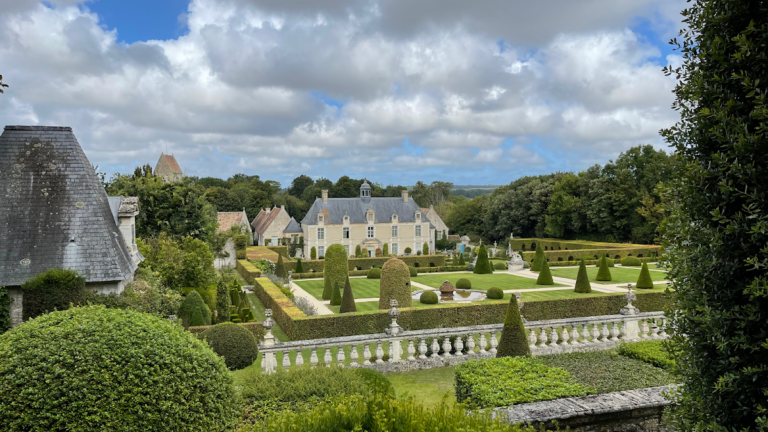
Château de la Ferrière stands in a landscaped estate above the village of Vaux-sur-Aure and the bridge over the Aure, approximately 350 metres east of the church of Saint-Aubin. The château is a classical building of the first half of the eighteenth century, constructed from blond Creully stone and accompanied by large service wings from the same period. Its grounds include the botanical park, the walled kitchen garden, greenhouses, and the later landscape park extending through the Aure valley. The estate is described as covering 18 hectares, while a separate description gives the botanical park an area of 17 hectares.
The Château and Service Buildings
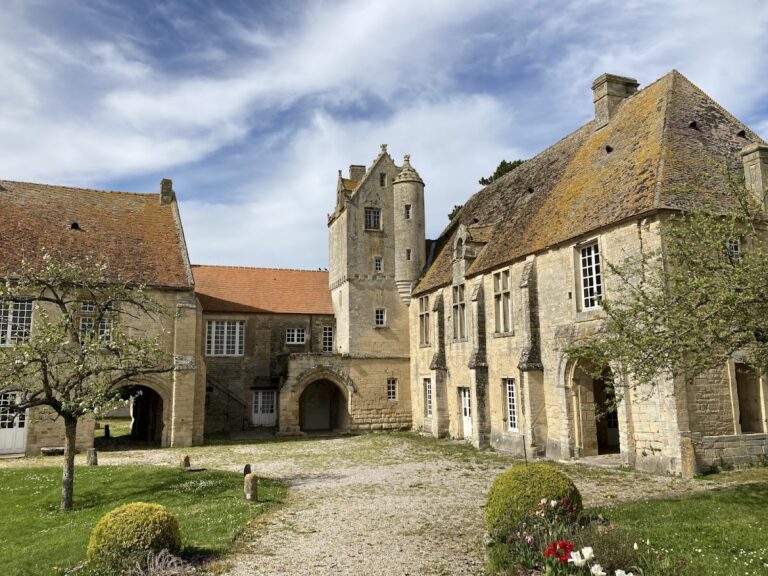
The main château belongs to the Louis XV period and has the formal character of an eighteenth-century classical residence. Blond Creully stone forms the principal construction, while large service wings flank the central building. The complex occupies the established heart of the estate, above the village and the Aure crossing, and retains the relationship between the residence and the grounds developed around it.
Botanical Grounds and Greenhouses
The estate retains a walled kitchen garden and both hot and cold greenhouses associated with Gabriel Moisson de Vaux’s botanical work. These facilities supported the cultivation of exotic plants, including American sassafras, Virginia persimmon, and Magnolia grandiflora. The botanical park is undergoing restoration, with the planned “New World Garden” continuing the historical association between the grounds and plant exchanges involving the United States.
The Nineteenth-Century Landscape Park
The nineteenth-century enlargement produced an extensive English-style landscape park. Its planting included giant sequoias and Lambert cypresses, some of which survive. The park was extended through the Aure valley so that the village and surrounding fields formed part of the wider estate landscape. This arrangement joined botanical grounds, settlement, and agricultural land into one continuous park setting, represented in Maugendre’s engraving.
The former Vaux road was absorbed into the estate and shifted roughly 50 metres north during the Toustain de Richebourg period. The park also contains surviving twin trees associated with Bayeux’s “Liberty Plane,” linking the landscape to Gabriel Moisson de Vaux’s activity during the Revolution.