Monastery of Santa María la Real of Oseira: A Cistercian Monastery in Spain
Site at a Glance
- Rating
- 4.7
- Popularity
- Medium
- Country
- Spain
- Primary era
- Medieval
- External website
- Open
- Eras represented
- Medieval, Early Modern
- Civilizations
- Crown of Castile, Kingdom of León, Spanish
- Site type
- Religious
- Remains
- Monastery
On this page15 sections
History
The Monastery of Santa María la Real of Oseira is a Cistercian monastery in Spain, founded by monks in 1137 in the high valley of the Sierra de Martiñá. It became part of the Cistercian Order in 1141, linking it with Clairvaux, a leading medieval center of Cistercian expansion, and receiving French monks sent through the influence of Bernard of Clairvaux. The monastery is a major religious and historical complex in Galicia, with a history shaped by royal patronage, regional administration, destruction, abandonment, and revival.
Foundation and Cistercian expansion
In 1131, Alfonso VII of León and Castile provided the site for hermits. Six years later, the monks García, Diego, Juan, and Pedro founded the monastery there. Its entry into the Cistercian Order in 1141 established Oseira within a wider network of monasteries that emphasized communal religious discipline and simplicity. The foundation became a royal institution and developed into an important economic and social center for surrounding districts and more distant territories.
Oseira’s domains extended across parts of the Sierra de Martiñá and Peña de Francia, the valleys of Oseira, Cea, Carballino, and Santa Cruz de Arrabaldo, areas along the Miño, and the town and port of Marín on the Ría de Pontevedra. The abbot held the title of count of Cea. At Marín, the monastery promoted fishing, administered justice, organized a fleet that supplied both the region and the community, and built a fort to protect the entrance to the Ría de Pontevedra.
The monastery also became associated with prominent churchmen and religious figures. Saint Famiano, a German pilgrim, entered monastic life at Oseira in 1142 and died at Gallese in Italy in 1150. He was the first canonized member of the Cistercian Order. Abbot Lorenzo, who led Oseira in the early thirteenth century, later became abbot of Clairvaux. Fernando Pérez, abbot from 1223 to 1232, served as dean of Santiago and chief chancellor at the court of Alfonso IX of León. His successor, Fernando Yáñez, helped restore monastic life at Alcobaça in Portugal after its community had been eliminated in 1195.
Late medieval authority and reform
Suero de Oca governed Oseira from 1485 to 1512 after entering the monastery when he was widowed for the second time. During his abbacy, a papal bull issued by Pope Eugene IV was confirmed, allowing the monastery to recover all its possessions. Suero later became archbishop of the titular diocese of Tarsus.
In 1513, external commendatory abbots were introduced. A commendatory abbot held the office of an abbey without belonging to its resident community and could administer its affairs while receiving its revenues. At Oseira, this arrangement nearly destroyed the community. The intervention of the Congregation of Castile in 1545 ended the period. The Congregation of Castile was an institutional grouping of Cistercian monasteries in the Crown of Castile, and Oseira subsequently became part of it. Extensive rebuilding followed, although the church and chapter house were not included in this first campaign.
Fire and early modern rebuilding
A major fire in 1552 destroyed every monastic building except the church. A proposal was made to build a new abbey in Valladolid and move the monks there, but Abbot Fray Marcos del Barrio secured the reconstruction of Oseira. The monastery was rebuilt mainly during the sixteenth and seventeenth centuries, with additional Baroque work after the fire. In the second half of the sixteenth century, the monks supplied provisions and money to support wars and to help people affected by famine. Philip II of Spain sent the abbot a letter praising this assistance.
Oseira was not directly damaged during the Napoleonic invasion, although some of its priories were sacked. Its secluded position and difficult access helped protect the monastery. It also sheltered displaced monks, the head of the Congregation of Castile, and Gerardo Vázquez, the Cistercian bishop of Salamanca.
Expulsion, abandonment, and revival
During the constitutional period of 1820 to 1823, the monks were expelled, and a mob stormed and completely looted the monastery. When the community returned in 1823, the buildings had been stripped of doors, windows, and furniture. Reconstruction began in 1824. Jerónimo Usera entered the congregation during this period and later founded the Congregation of the Sisters of the Love of God.
The dissolution of the monasteries in 1835 and the confiscation of church property under the Mendizábal laws led to another expulsion in 1836. The monks were forbidden to reassemble as a corporate community, and the Congregation of Castile permanently disappeared. Some monastic properties, including the mill and bakery buildings, were purchased by Ramón Villar Ulloa. The monastery then remained abandoned for almost a century, while its buildings approached ruin.
Florencio Cerviño González, bishop of Ourense from 1922 to 1941, initiated the restoration of Oseira and the revival of monastic life. Trappist monks from Notre-Dame-des-Neiges reoccupied the monastery in 1929. Trappists are Cistercians of the Strict Observance, a branch known for especially strict monastic practice. Restoration under the monastic community began in 1966. The large-scale restoration received the Europa Nostra Award in 1990, and the monks received the Gold Medal of the Provincial Government of Ourense in the same year.
Oseira remains a Trappist monastery of the Cistercian Order dedicated to Saint Mary and belonging to the Diocese of Ourense. It was declared a national monument and an Asset of Cultural Interest in 1923.
Remains
Church and principal monastic spaces
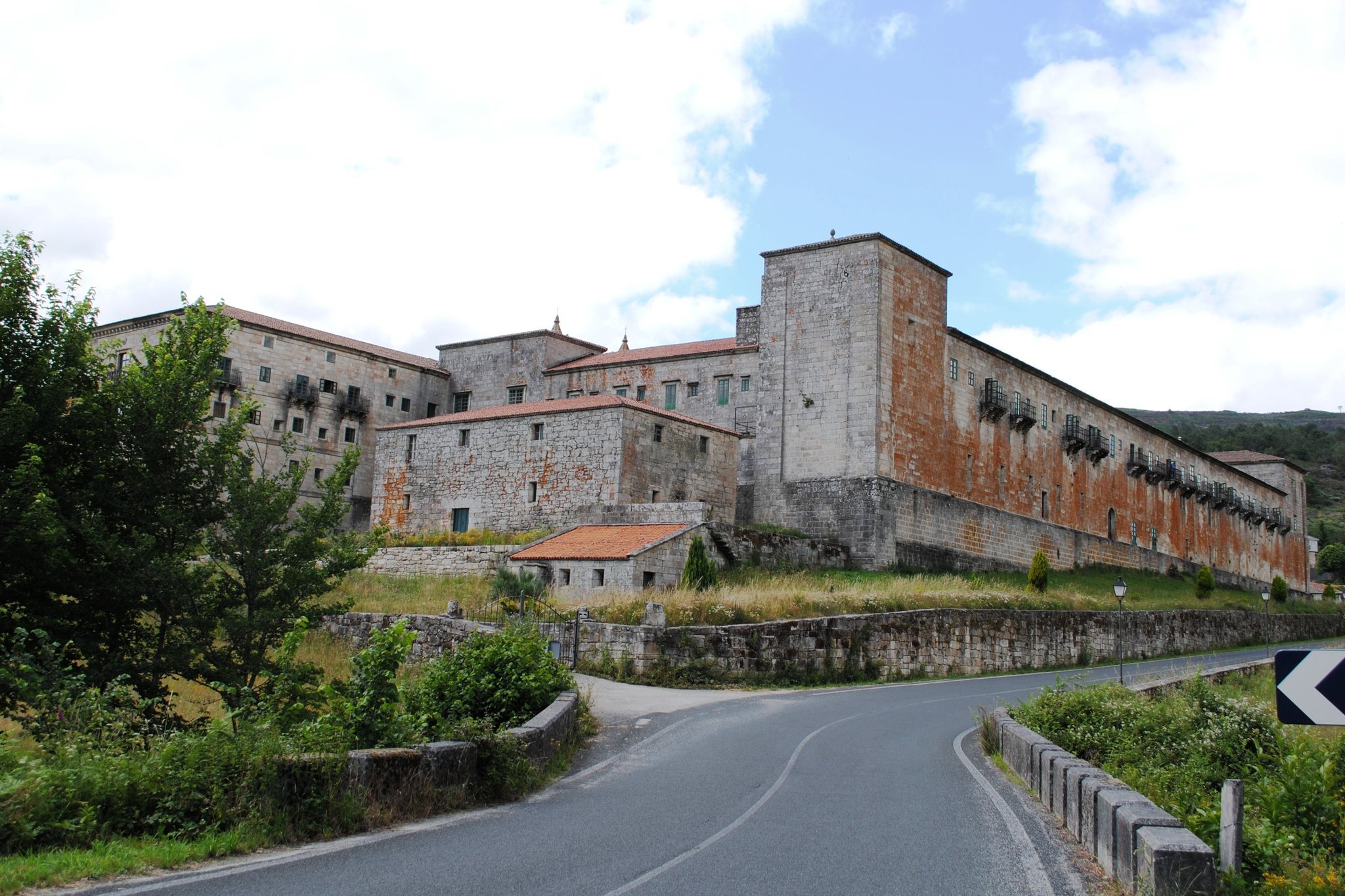
The monastery stands in Oseira, in the municipality of San Cristovo de Cea, within a high valley of the Sierra de Martiñá. Its extensive scale has led to the descriptions “the Escorial of the Cistercians” and “the Escorial of Galicia.” The complex brings together a major Cistercian church, three cloisters, chapter and service spaces, courtyards, and buildings that preserve successive Romanesque, Gothic, Renaissance, and Baroque phases.
Abbey church
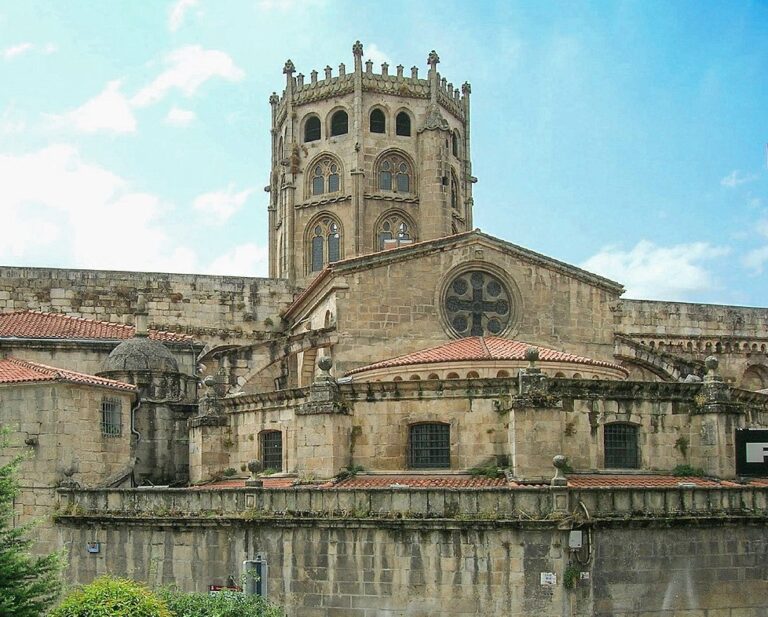
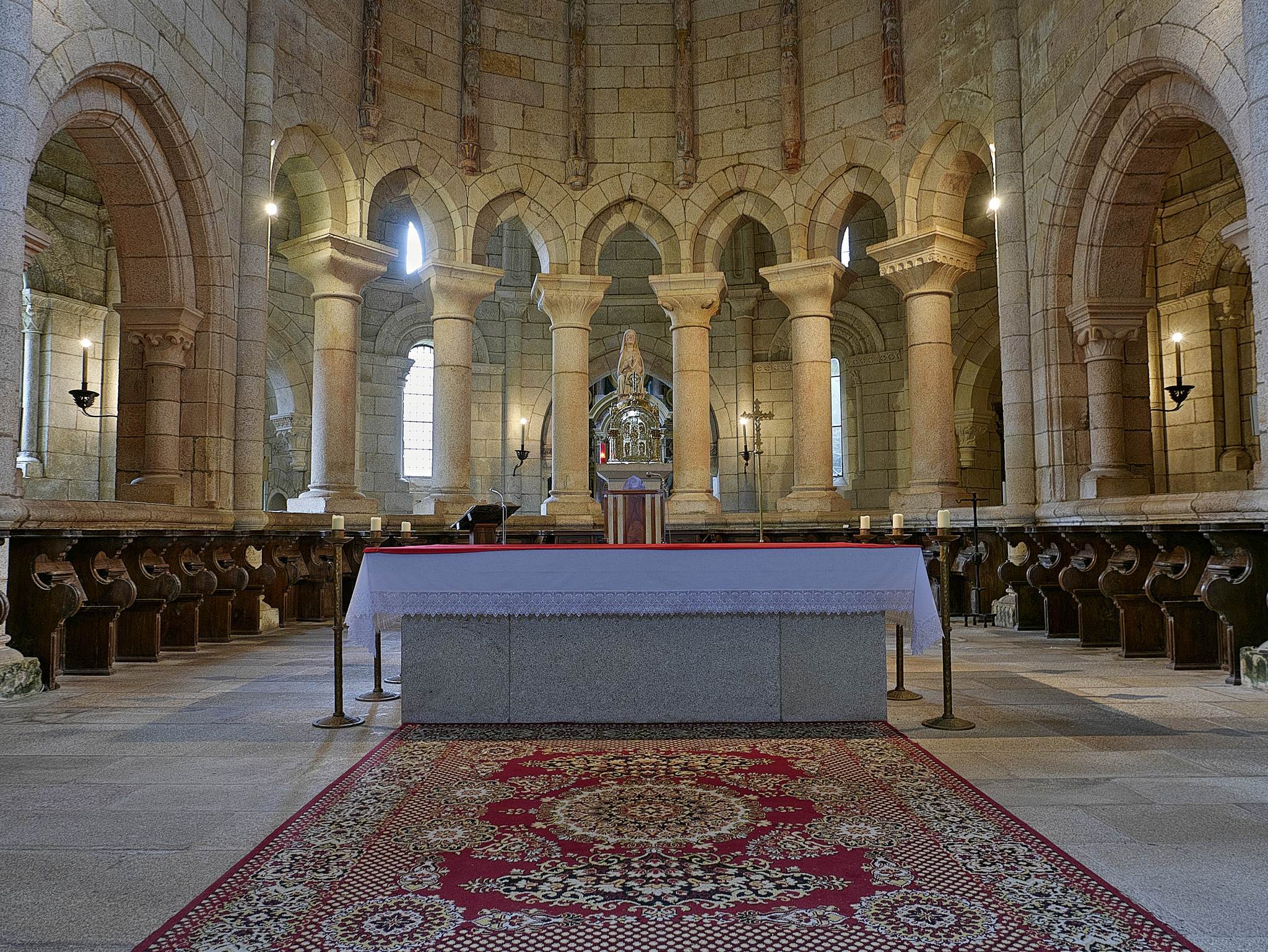
Construction of the abbey church began around 1200, and the building was consecrated in 1239. It combines pointed Romanesque and early Gothic features with the influence of pilgrimage churches. Its cruciform plan has seven bays, a projecting transept, and an ambulatory, a passage surrounding the choir. A pointed barrel vault covers the nave, with one window in each bay on both sides. The narrower aisles are lower than the nave, with pointed barrel vaults in the east and rib vaults in the west.
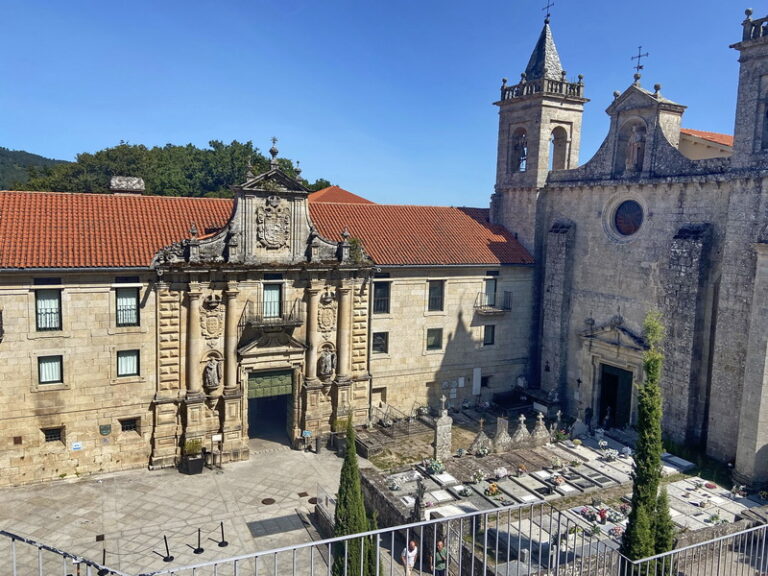
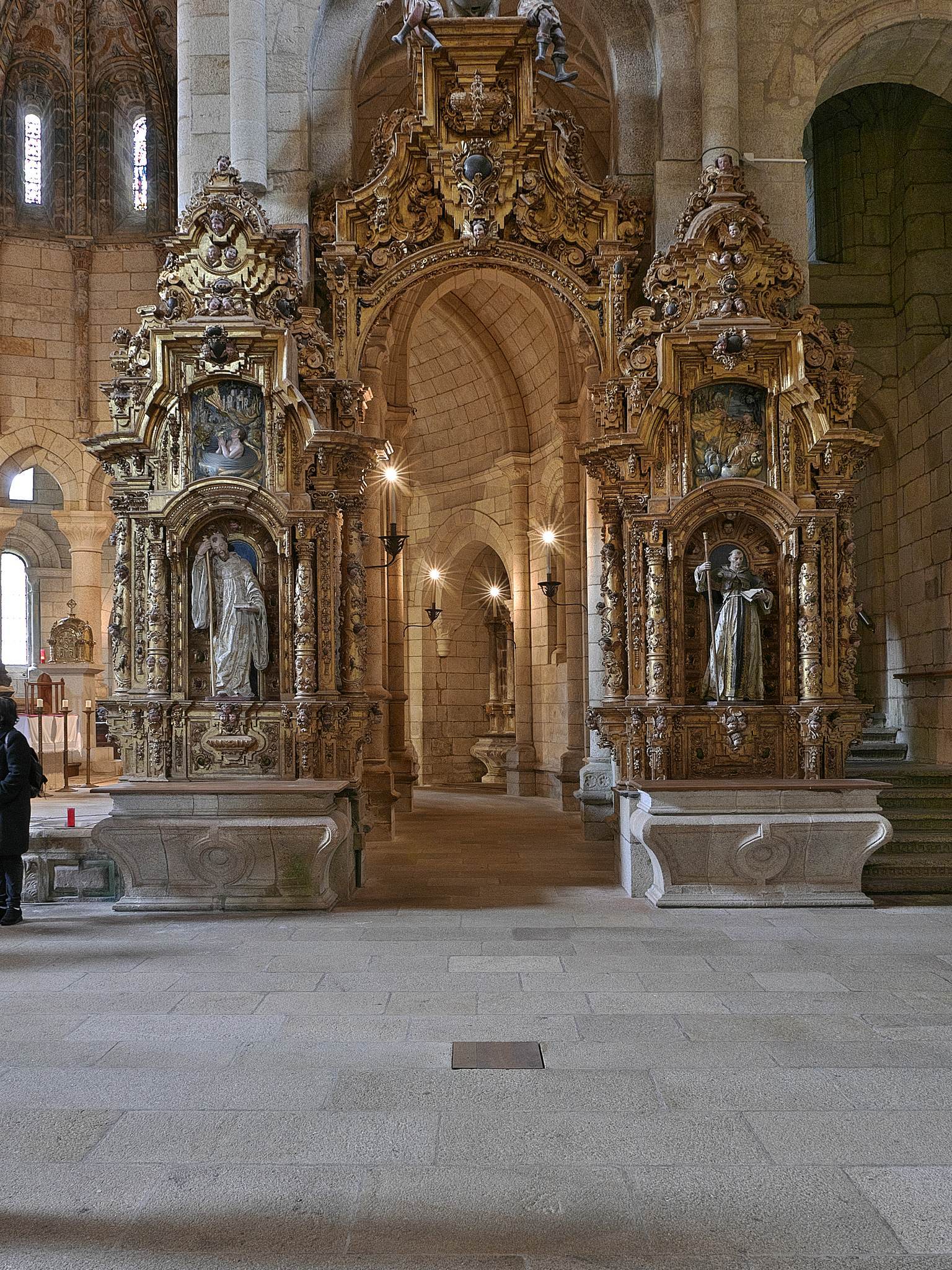
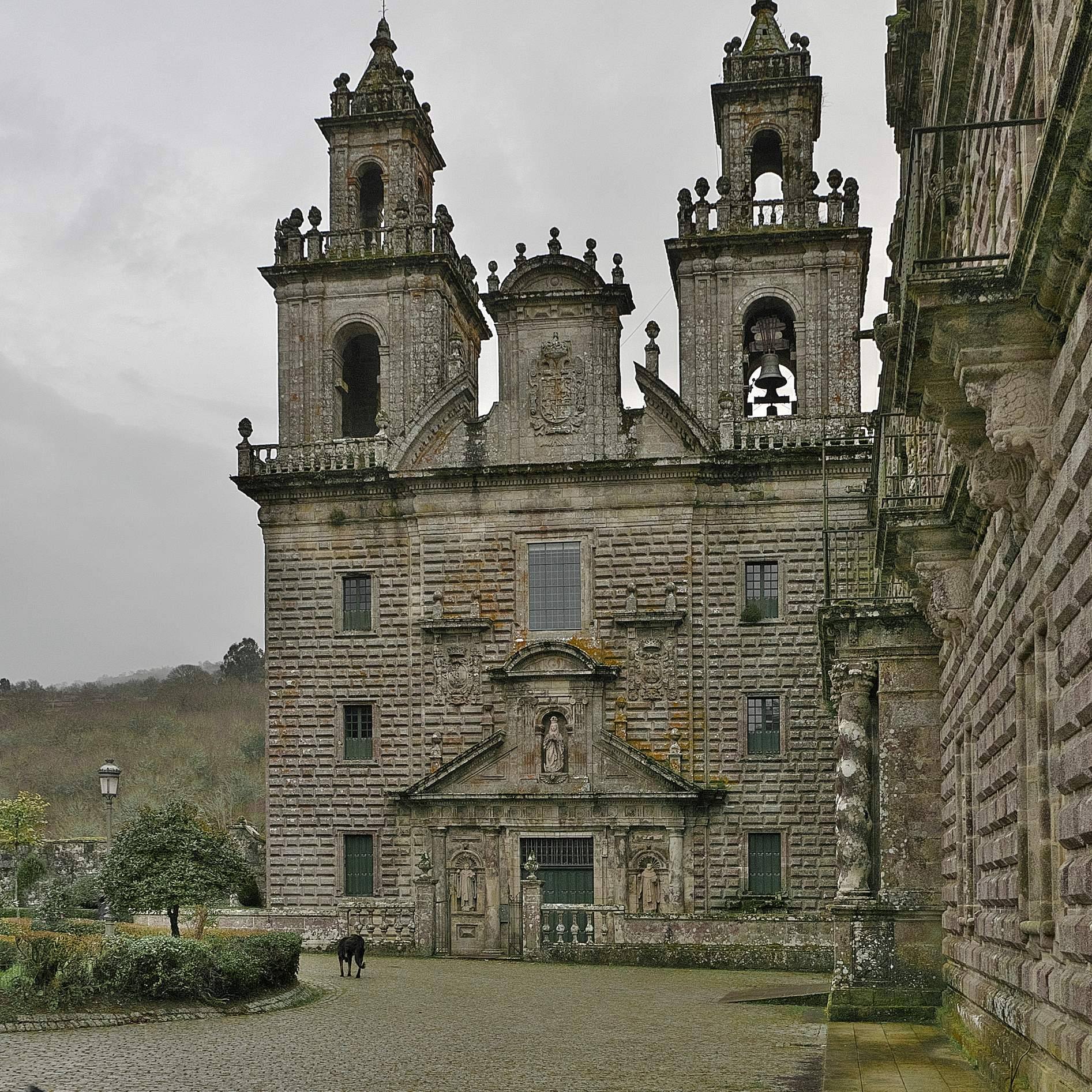
A late Gothic gallery occupies the west of the church. The north aisle facade contains a rose window, while the main facade faces west. After the fire of 1552, the facade, altars, and substantial parts of the monastery were remodelled in the Baroque style around 1700. The facade received twin towers, and the courtyards later known as the Courtyard of the Knights and Courtyard of the Medallions were also given Baroque treatment.
Chapter house and Renaissance spaces
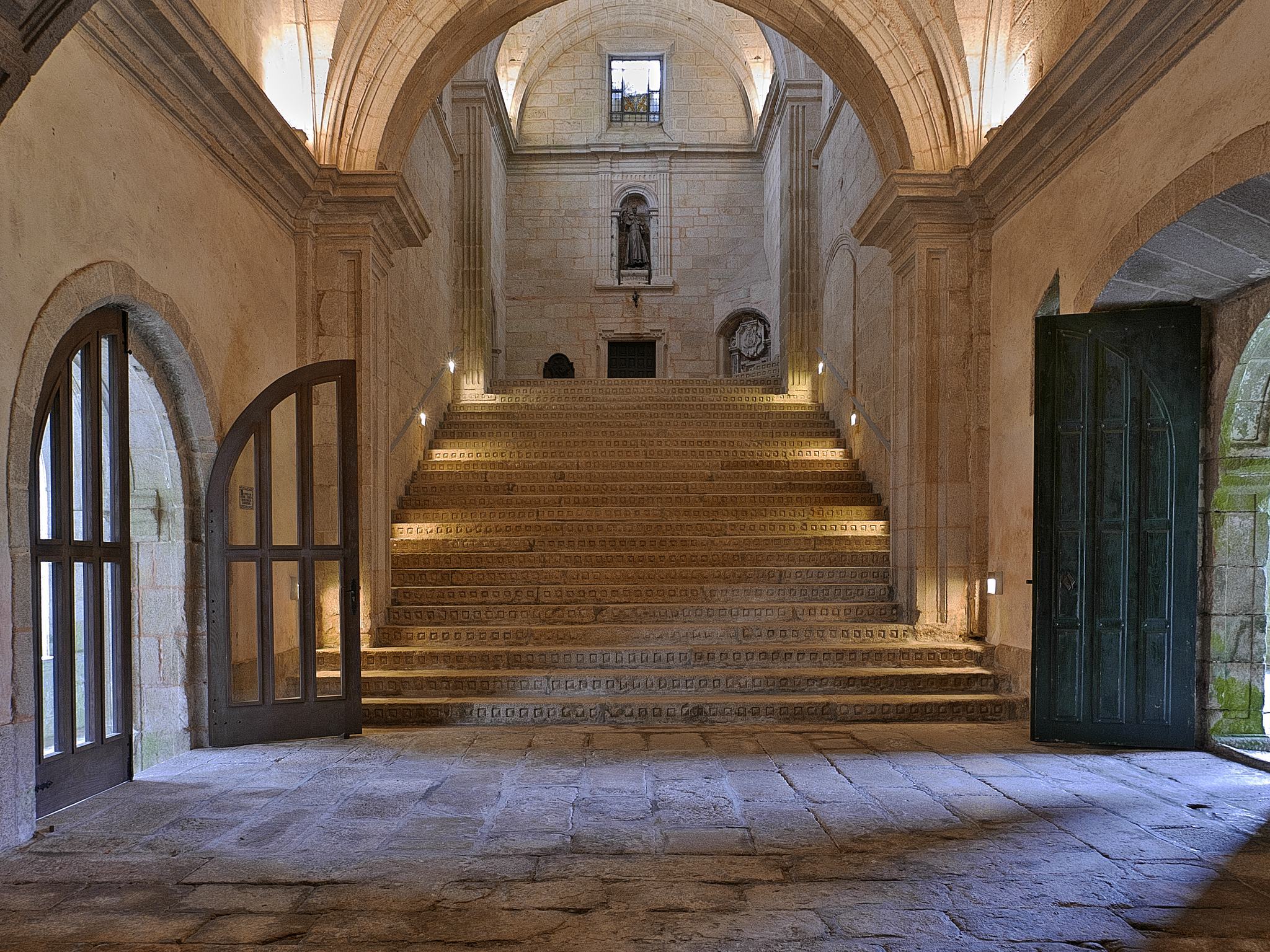
The chapter house, popularly called the Palm Tree Room, dates from around the turn of the sixteenth century. A chapter house is the room where a monastic community meets for governance and hears its rule. Here, the vault rests on four central columns with twisted shafts. Other Renaissance elements in the complex include the sacristy, kitchen, Bishop’s Staircase, and crenellated courtyard.
Cloisters and courtyards
Cloister of the Knights
The Cloister of the Knights lies behind the entrance vestibule of the main facade. Its former stables made it the point where visitors arriving on horseback entered the monastery, giving the cloister its name.
Regular or Processional Cloister
The Regular or Processional Cloister, also called the Cloister of the Medallions, served as the monastery’s principal route for processions. An earlier medieval cloister occupied the same area. During the eighteenth-century reconstruction, stone medallions depicting illustrious figures were reused from a sixteenth-century cloister.
The central fountain is a copy made by the sculptor Nicanor Carballo. The original fountain is now in the Plaza del Hierro in Ourense.
Cloister of the Pinnacles
The Cloister of the Pinnacles takes its name from the pinnacles that decorate the upper parts of its buttresses. It formerly contained another fountain, which is now in the Alameda of Ourense. A copy by Nicanor Carballo was installed in the cloister in 1991.
Lapidarium
Museum of Stone
The former monastic refectory houses the Lapidarium, or Museum of Stone. Its collection brings together stone objects and fragments recovered during restoration and archaeological excavations, including tomb slabs, capitals, columns, and decorative elements. These pieces preserve material from the monastery’s architectural history within the former dining space of the community.