Monastery of San Jerónimo de Buenavista: A Hieronymite Monastery in Seville


Site at a Glance
- Rating
- 4.4
- Popularity
- Low
- Country
- Spain
- Primary era
- Medieval
- External website
- Open
- Eras represented
- Medieval, Early Modern
- Civilizations
- Crown of Castile, Spanish
- Site type
- Religious
- Remains
- Monastery
On this page13 sections
History
The Monastery of San Jerónimo de Buenavista is a former Hieronymite monastery in Seville, Spain, built by the Order of Saint Jerome between 1414 and 1450 in the Flamboyant Gothic style. The Hieronymites were a Catholic order devoted to contemplative and scholarly religious life. The monastery was founded on 11 February 1414 by the jurist and friar Diego Martínez de Medina, with the support of Archbishop Alonso de Ejea and several Sevillian aristocrats.
Foundation and construction
Until 1426, Buenavista depended on the prior of the Hieronymite monastery of Guadalupe. The first friars lived in houses already standing on the property, adapting one of them as a chapel. Diego Martínez de Medina remained prior until his death in 1446, when his fellow founder Juan de Medina succeeded him. The monastery’s main construction campaign continued through 1450. A reform in the middle of the sixteenth century altered parts of the complex. Its architect is unidentified, although Juan de Herrera has been proposed, while the vaults appear to have been made by Diego de Riaño.
The community’s prosperity and large membership supported both religious and cultural activity. In 1491, the friars printed an antiphonary, a liturgical book containing chants used in Christian worship. From 1574, Philip II arranged for papal bulls, formal documents issued by the pope, to be printed at Buenavista rather than at El Escorial. This avoided transporting them to Seville before they were shipped to the Indies. The monastery installed a printing press, managed by the printers Alonso de la Barrera and Hernando Díaz.
Religious and civic connections
Buenavista held responsibilities beyond its own community. In 1505, Rodrigo Fernández de Santaella founded the College of Santa María de Jesús and appointed the monastery’s prior as its visitor, an ecclesiastical official who inspected and supervised a religious institution. In 1503, Catalina de Ribera entrusted the administration of the Hospital of the Five Wounds to the priors of Buenavista, the Carthusian monastery of Santa María de las Cuevas, and the Hieronymite monastery of San Isidoro del Campo. In 1522, Juana de Ayala, founder of the Convent of Santa María del Socorro, granted its patronage to the prior of Buenavista.
The monastery was also linked to the Spanish monarchy. Ferdinand the Catholic probably stayed there in 1508 and 1511 with his second wife, Germana de Foix, before entering Seville through the northern Macarena Gate. Charles I, also known as Emperor Charles V, stayed at Buenavista in 1526 before entering the city for his marriage to Isabel of Portugal. Philip II stayed there on 30 April 1570 before entering through the Goles Gate, and Philip IV stayed there on 29 February 1624. Philip V probably visited during his residence in Seville from 1729 to 1733.
Archbishop and scholar Diego de Deza was living at Buenavista when he died in 1523. From its foundation, the monastery also accumulated urban properties, especially in the northern parts of Seville within the city walls. In 1624, it contributed 45 houses to the royal treasury of Philip IV. A proposal by the Count-Duke of Olivares to create a novitiate college, an institution for forming novices preparing for religious life, was rejected because of its cost.
Artistic patronage and decline
Buenavista developed an important artistic network. Between 1522 and 1524, Pietro Torrigiano made a Penitent Saint Jerome for the monastery, followed around 1525 by a Virgin of Bethlehem. In the seventeenth century, the prior commissioned Francisco de Zurbarán to paint scenes from the life of Saint Jerome for the monastery of Guadalupe. From 1639, Zurbarán maintained a close relationship with Buenavista and lived in a house belonging to the order on Calle Rosario. Between 1656 and 1657, Juan de Valdés Leal painted works for the monastery sacristy, and between 1770 and 1780 Juan de Espinal produced 26 paintings on episodes from the life of Saint Jerome.
The institution declined during the seventeenth and eighteenth centuries. Its community numbered about 150 friars in 1669, around 40 in the middle of the eighteenth century, and only about 12 at the beginning of the nineteenth century. During the French invasion, the regular clergy was suppressed on 18 August 1808. The monastery and its contents were confiscated in February 1810, after which the complex was looted and devastated.
The Hieronymites received permission to return in 1823, but only a few friars came back, and the church could not be used. Many later obtained dispensations and departed. The remaining friars and recovered liturgical objects were transferred to the Convent of Santa Paula. The Spanish Hieronymite order was dissolved in 1835.
Later uses and protection
After the dissolution, the building served as a lazaretto, an institution for isolating people suspected of carrying contagious diseases, and later as a school. Enrique Hodson Cortés converted it into a glass factory in 1843. It was subsequently used for pig storage well into the twentieth century.
The former monastery was declared a Historical-Artistic Monument on 27 August 1964. Carmen Iglesias Zubiada bought it in 1966 and undertook reforms and restoration that converted it into a private residence. The Seville City Council acquired the complex in 1984, and in 2015 it became a neighborhood civic center.
Remains
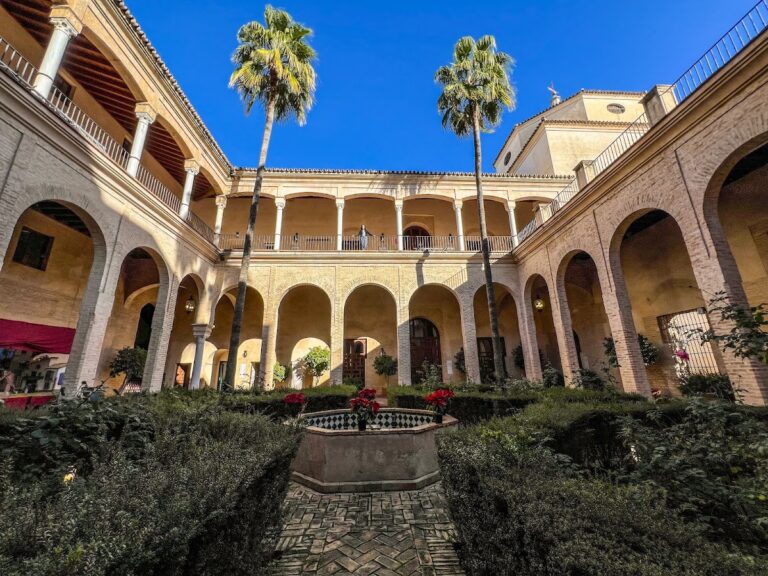
The surviving complex combines a Flamboyant Gothic monastery built between 1414 and 1450 with sixteenth-century alterations. Its earliest religious arrangement reused existing houses on the property, including one adapted as a chapel. Later construction created the monastery complex, while the sixteenth-century reform changed several of its parts and introduced elements associated with the building’s subsequent form.
Monastic fabric
Early buildings and chapel
The first installations consisted of houses already present on the site. The friars occupied these buildings while the monastery was being established, and one house was converted into a chapel. This early adaptation formed the initial religious setting before the larger Gothic construction campaign extended from 1414 to 1450.
Tower and bell chamber
The tower was remodeled during the sixteenth century. It was probably a Gothic tower originally, crowned by a bell gable, a wall-like upper structure with openings for bells. The existing bell chamber and its columns belong to the sixteenth-century remodeling.
Former artistic holdings
Torrigiano sculptures
The monastery’s former collection included Pietro Torrigiano’s polychrome terracotta Penitent Saint Jerome, made between 1522 and 1524, and his Virgin of Bethlehem, made around 1525. Both sculptures are now in the Seville Museum of Fine Arts. Their subjects reflect the monastery’s dedication to Saint Jerome, a Christian theologian and translator best known for producing the Latin Vulgate Bible.
Valdés Leal’s sacristy paintings
Juan de Valdés Leal’s sacristy cycle included The Baptism of Saint Jerome, The Temptations of Saint Jerome, The Flagellation of Saint Jerome, Saint Jerome Disputing with the Rabbis, Saint Jerome Disputing with the Pagan Doctors, and The Death of Saint Jerome. It also portrayed Saint Jerome, Saint Paula, Saint Eustaquia, and venerable members of the order, including Friar Pedro Fernández Pecha, Friar Pedro Yáñez de Figueroa, Friar Alonso Fernández, Friar Pedro de Cabañuelas, Friar Vasco of Portugal, Friar Alonso de Ocaña, Friar Juan de Ledesma, Friar Diego de Jerez, and Friar Hernando de Talavera. Saint Paula and Saint Eustaquia were Christian women associated with Saint Jerome’s ascetic and monastic circle.
These paintings are now dispersed among the Seville Museum of Fine Arts, the Prado Museum in Madrid, the Museum of Tessé in France, the Bowes Museum in the United Kingdom, the Cremer Collection in Dortmund, the Gallery of Old Masters in Dresden, and the Museum of Grenoble. The present locations of Saint Jerome Disputing with the Pagan Doctors and The Death of Saint Jerome are unknown.
Espinal’s Saint Jerome cycle
Between 1770 and 1780, Juan de Espinal made 26 paintings for the monastery. The cycle included The Birth of Saint Jerome, Saint Jerome Studying, Saint Jerome Saying Farewell to His Family, Saint Jerome Visiting the Catacombs, The Baptism of Saint Jerome, The Temptations of Saint Jerome, Saint Jerome Scourged by Angels, Saint Jerome Abandoned in the Desert, and The Ordination of Saint Jerome.
Other scenes showed Pope Damasus Consulting Saint Jerome about the Holy Scriptures, Saint Jerome Speaking to the Romans, Saint Jerome Speaking to Roman Women, Saint Jerome Presenting His Order’s Rule to Pope Damasus, The Bestowal of the Cardinal’s Hat on Saint Jerome, and Saint Jerome and Saint Paula Founding the Convents of Bethlehem. The cycle continued with Saint Jerome Disputing with the Rabbis, Saint Jerome Translating the Old Testament, Saint Jerome Praying before the Holy Places, Saint Jerome Embarking for Exile, and Saint Jerome Disputing with the Heretics.
The remaining subjects were Saint Jerome Attending Saint Paula’s Death, Saint Jerome Visiting Saint Augustine, Saint Jerome Visiting the Monks of the Thebaid, The Assault on the Monastery of the Monks of Bethlehem, Saint Jerome’s Last Communion, and The Death of Saint Jerome. Works from the cycle are held in churches and museums in Seville, Aracena, Huelva, and elsewhere in Spain, including the churches of Omnium Sanctorum, San Gil, San Roque, and the Castillo, as well as the museums of Huelva and Seville.
Nearby sites