Iglesia de Omnium Sanctorum: A Gothic-Mudéjar Parish Church in Seville
Site at a Glance
- Popularity
- High
- Country
- Spain
- Primary era
- Medieval
- Eras represented
- Medieval, Early Modern
- Civilizations
- Crown of Castile, Spanish
- Site type
- Religious
- Remains
- Church
On this page16 sections
History
Iglesia de Omnium Sanctorum is a Catholic parish church in Seville, Spain, founded in 1249 by Alonso Gómez Jequetiques de Cervantes and dedicated to All Saints. It belongs to the city’s Gothic-Mudéjar church group, built after Seville’s conquest in 1248. This architectural tradition combines Gothic forms brought by Castilian conquerors with building practices developed under Islamic rule in Iberia. The church is among Seville’s oldest and retains much of its medieval character.
Medieval foundations and rebuilding
An earthquake damaged the church in 1356. Renovations during the fourteenth and fifteenth centuries included a deep Gothic presbytery, the area around the main altar.
Nineteenth-century crosses and confraternities
The Hook Cross originally stood where Peris Mencheta, Guadiana, and Molino streets meet, at a place then called the Coal and Hook Weighing Place. Coal merchants used a hook on its pedestal to hang a steelyard, a hanging balance scale. They left alms from their sales to maintain the cross and support worship there. Removed in 1816, the cross was later set in a high shrine in the church wall.
The Cross of Linos Street came from a plague burial pit dating to 1649 and had its own brotherhood. After its removal in 1841, local residents asked for it to be put back; the church’s Sacramental Brotherhood supported its restoration in 1844. Residents argued that its two or four lanterns provided the street’s only lighting. In 1854, the cross was transferred to Omnium Sanctorum.
The Cross of Caravaca stood behind a grille in the middle of Calle Feria. A brotherhood devoted to the Holy Cross of Caravaca apparently erected it, and it was removed in 1839. Residents petitioned the city in 1840 to return it for worship at a street façade. The city asked the Omnium Sanctorum priest for the cross; he said it had gone to the priest of San Marcos, who denied receiving it. It was eventually found with San Marcos’s assistant priest, who had requested it for the cemetery of San Marcos’s Sacramental Brotherhood, at what is now Almirante Espinosa Street. He agreed to return it only in exchange for another cross. It may have been put back on a façade after its return, but by 1854 it had been transferred to Omnium Sanctorum.
Parish life and modern history
The church serves as the seat of the Sacramental Brotherhood of the Queen of All Saints, a Catholic lay confraternity associated with devotion to the Eucharist. Queen of All Saints is a title for the Virgin Mary. The church was declared a National Monument in 1931 and is also designated a Property of Cultural Interest in the monument category.
In 1936 the church was burned and looted, and its altarpiece disappeared. The building later underwent substantial restoration, including the renewal of its roofs in 1993.
Remains
The church’s surviving medieval fabric consists chiefly of its walls and main façade. Its layout includes a central nave, two side aisles, and a deep presbytery, while a square brick tower stands at the northwest end of the Gospel-side aisle.
Church architecture and bell tower
Main façade
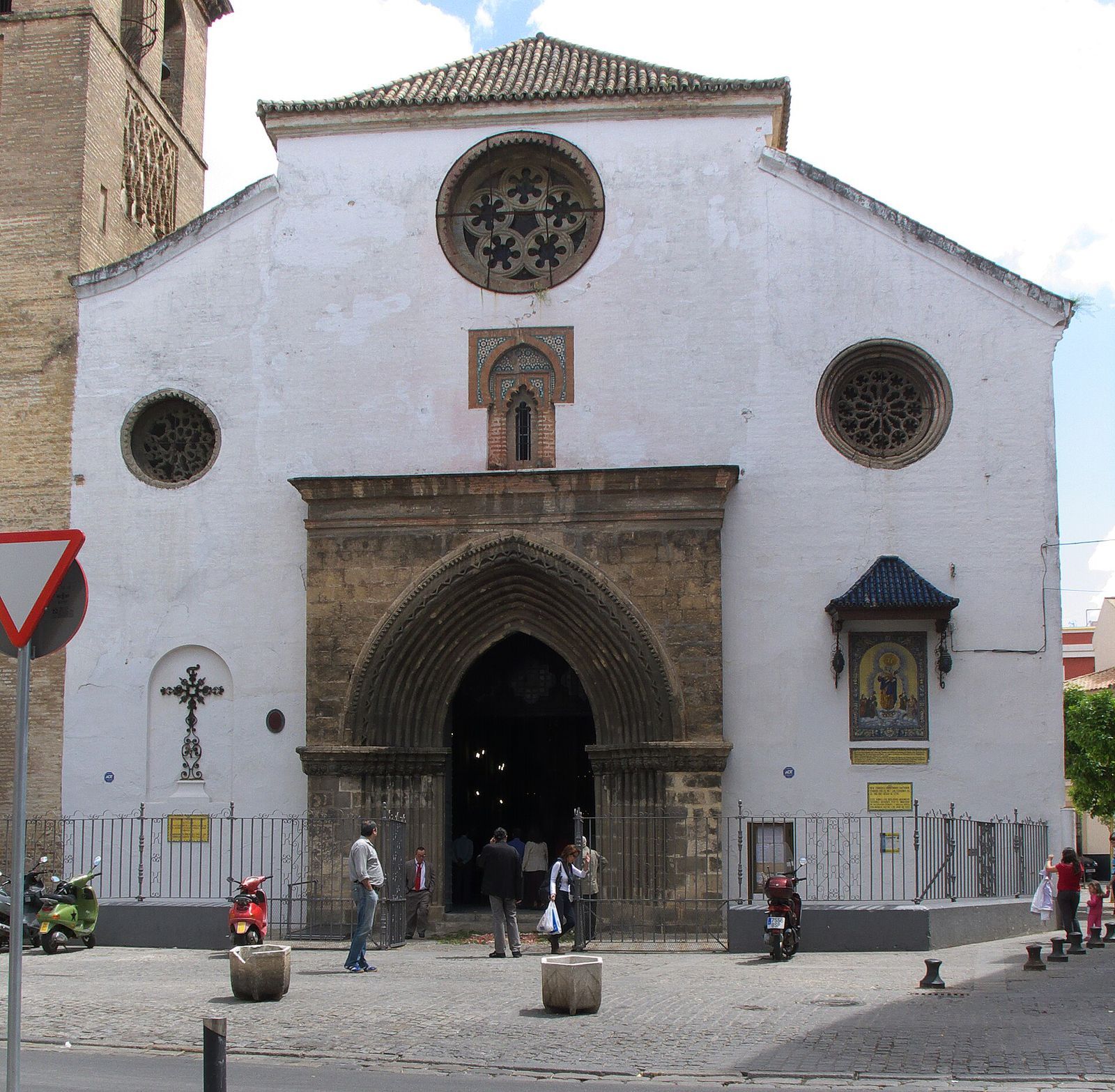
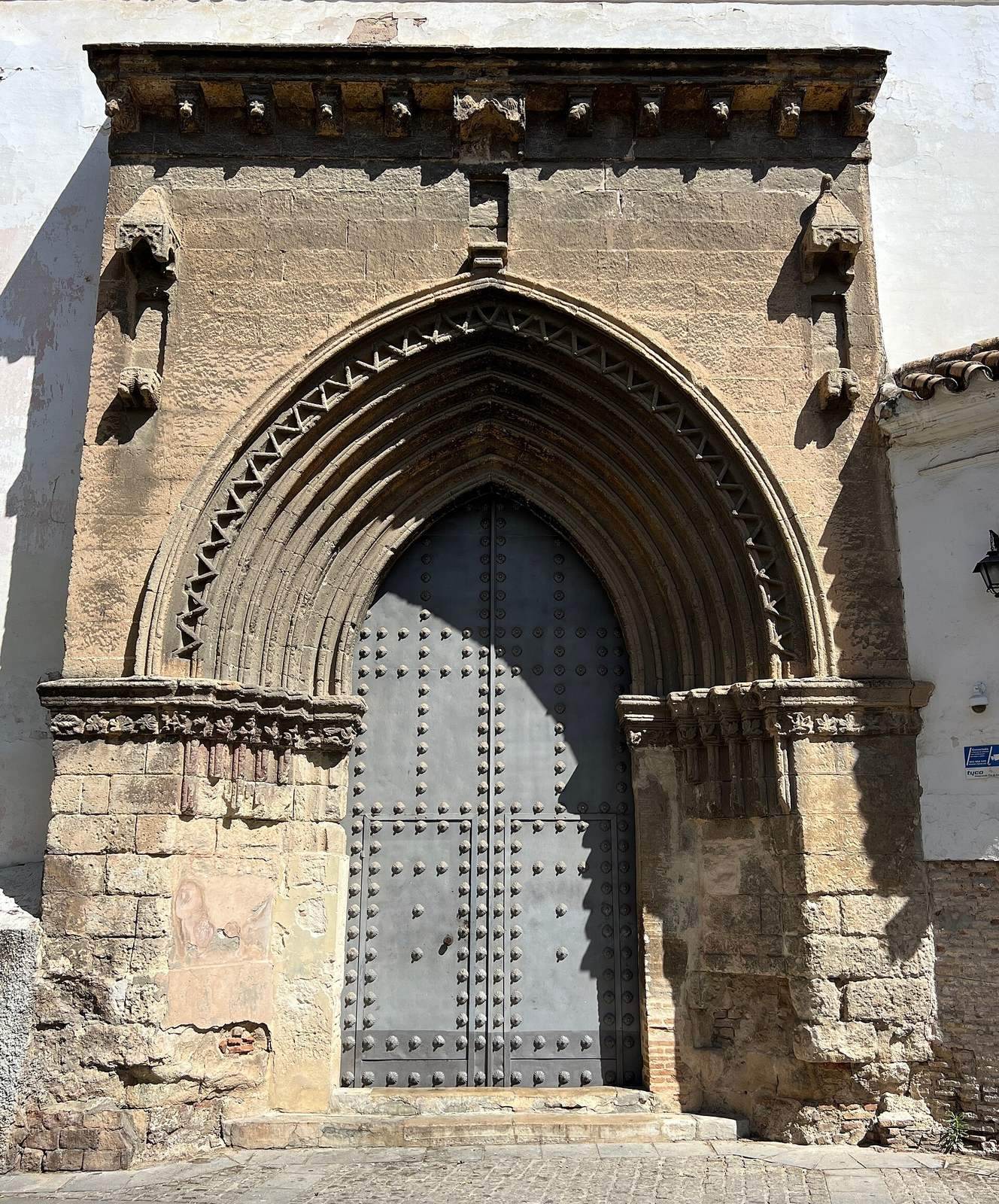
The main façade, at the end of the building, has a projecting stone portal framed by pointed arches and splayed archivolts, bands that follow an arch’s curve. Above the entrance is a small, richly ornamented Mudéjar window. A Gothic rose window lights the central nave, with two smaller rose windows serving the side aisles. Similar Gothic doorways open from both side aisles.
Presbytery
The Gothic presbytery comprises two rectangular bays and a pentagonal end bay. Outside, it forms a tall apse, or projecting church end, with buttresses at the corners and high Gothic windows between them. Pyramid-shaped battlement-like elements finish the upper edge.
Bell tower
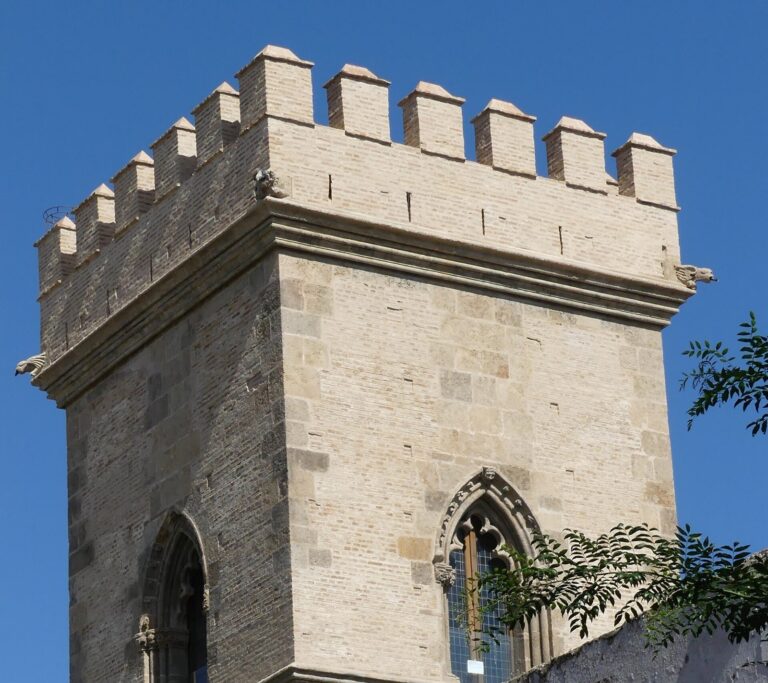
Built in the late fourteenth or early fifteenth century, the brick tower retains some of its original openings. Semicircular arches sit beneath multi-lobed arches framed by an alfiz, a rectangular border around an arch, and plant ornament. Interlaced decorative arches and sebka panels, networks of interlacing forms, also cover the tower; their patterns draw on the Giralda, Seville Cathedral’s bell tower, originally a minaret, or mosque tower, and an influential local model. Later alterations added a square upper stage with attached pilasters and openings on all four sides, topped by a tall polygonal spire. Eighteenth-century tiles also decorate the tower.
Chapel and interior works
Funerary chapel
The fifteenth-century funerary chapel of the knight Gonzalo Gómez de Cervantes has an octagonal vault supported by squinches, corner supports that help carry a vault. It was intended for Gonzalo, his wife Beatriz López de Bocanegra, and their descendants. They were the parents of Juan de Cervantes, who became a cardinal, a senior prelate in the Catholic Church. The Brotherhood of Carmen, devoted to Mary under the title Our Lady of Mount Carmel, now occupies the chapel. A separate tomb is associated with the House of Guzmán.
Sculpture, paintings, and altarpiece
The church’s associated works include a crucifix by Andrés de Ocampo dated 1592 and an image of Our Lady, Queen of All Saints, by Roque Balduque dated 1554. A separate image of Christ of the Good Death is attributed to Ocampo, and paintings by Juan de Espinal are also associated with the church. Its altarpiece, a decorated structure behind an altar, was made around 1630 by Diego López Bueno and includes paintings by Francisco Varela. It was restored and returned to the church in 1993.
Crosses
Hook Cross
The Hook Cross is set on the main façade beside the church entrance.
Cross of Linos Street
The Cross of Linos Street is inside the church, to the left of the main entrance screen.
Cross of Caravaca
The Cross of Caravaca is inside the church, to the right of the main entrance screen.