San Lucchese: Franciscan Church and Minor Basilica in Poggibonsi


Site at a Glance
- Rating
- 4.6
- Popularity
- Very Low
- Country
- Italy
- Primary era
- Medieval
- Eras represented
- Medieval, Early Modern, Modern
- Civilizations
- Grand Duchy of Tuscany, Republic of Florence
- Site type
- Religious
- Remains
- Monastery
On this page19 sections
History
San Lucchese is a Roman Catholic Franciscan church and convent in Poggibonsi, Italy, built and developed by the medieval Franciscan community from the thirteenth century in the Gothic religious tradition. It grew from Santa Maria in Camaldo, the parish church of the village of Camaldo, and became associated with Lucchese of Gaggiano, a figure traditionally regarded as the first Franciscan tertiary.
Origins at Camaldo
Local tradition says that Camaldo was founded by people from Fiesole who fled after the destruction of their city in 1010. This account belongs to local legend rather than established historical fact. Franciscan tradition places the convent’s beginnings in Saint Francis of Assisi’s visit to the Valdelsa in the early 1220s. According to that tradition, the commune of Poggibonizzo gave Francis Santa Maria de Vico Camalduli and two houses. There he is said to have met Lucchese of Gaggiano, later connected with the church’s dedication and with the early Franciscan third order, whose members were laypeople following Franciscan religious principles.
The presence of the Friars Minor, the religious order founded by Saint Francis and commonly known as the Franciscans, is securely documented by 8 August 1235. On that date, Martino, a friar from the convent, took part in the appointment of Poggibonizzo’s ambassador for a peace treaty with Florence and Orvieto. The friars initially seem to have restored the earlier Romanesque church. On 28 October 1236, Pope Gregory IX authorized the provost of Poggibonsi to allow construction of a new church. Bequests from local inhabitants financed the work, and donations increased after Lucchese’s death in 1251.
Thirteenth- and fourteenth-century development
Master Nicoletto completed an unspecified work in 1252, as stated by a marble inscription. Warfare and looting between Florentine and Sienese forces probably disrupted the building campaign, including during the conflicts of 1257 and 1270, when Poggibonizzo was destroyed. The works had advanced sufficiently by 1268 for Conradin of Swabia to visit them. A cemetery was already attached to the church, and an inscription commemorating Cambiuzzo Lotteringo remains built into the facade.
The transformation of the complex was substantially complete by 1300, when the high altar was built. The church probably reached its present dimensions during the second half of the fourteenth century. The friars held considerable prestige during that period and undertook numerous missions. Between 1333 and 1373, the commune issued grants for the friars, repairs to the church, the purchase of timber, and the completion of the Chapel of San Lucchese. In total, Poggibonsi passed 43 resolutions during the century concerning the convent’s worship and public life.
Observant period and modern history
In 1440, the convent passed to the Franciscan Observance, a reform movement that sought stricter adherence to practices associated with Saint Francis. San Lucchese hosted 25 assemblies of the Observant congregation between 1461 and 1580. The portal, the gable finial, and the loggia on the facade were constructed during this period, while later alterations were generally minor.
Napoleonic legislation suppressed the convent in 1810 and expelled the friars. San Lucchese became a curacy in 1814, meaning that it was served by a curate, and the convent buildings were sold to Francesco Frosini Martinucci in 1817. The Franciscans regained possession in 1925. Restoration and renovation followed in 1930–1932, after earlier damage had seriously affected the chapels by 1895.
Between 1903 and 1905, and again in 1910, the facade window and oculus were restored, while the Chapel of San Lucchese was repaired under the architect Giuseppe Castellucci. Further work addressed war damage in 1948, and the Siena monuments authorities directed another intervention in 1987. Additional campaigns dealt with deterioration, earth tremors, and the effects of shelling in 1943, particularly on the facade and roof, with the aim of recovering the building’s earlier appearance.
In July 1938, Pope Pius XI raised the church to the rank of minor basilica, a papal honor granted to certain churches and distinct from the major basilicas of Rome. San Lucchese remains affiliated with the Order of Friars Minor and retains its Catholic identity.
Remains
San Lucchese is regarded as an important Gothic religious building in the Valdelsa. It follows the simple mendicant tradition associated with Franciscan churches, with a broad nave and restrained architectural treatment. A simple portico precedes the church, while a cloister stands to its right. The surviving complex combines medieval fabric, later additions, frescoes, sculpture, painted furnishings, and elements restored after damage.
Church fabric
Facade and portico
The church has a gabled facade preceded by a simple portico. A high oculus illuminates the upper part of the front. The portal, the finial at the top of the gable, and the facade loggia belong to the later medieval development of the complex. The blocked doorway on the northern side incorporates the marble inscription naming Master Nicoletto and giving the date 1252 for his completion of an unspecified work. Another inscribed stone in the facade commemorates Cambiuzzo Lotteringo. The present bell tower is modern.
Nave and apsidal chapels
Inside, a single broad nave is lit by Gothic windows and covered by exposed timber roof trusses. It ends in three apsidal chapels with ribbed cross-vaults, vaults whose structural ribs define and support the intersecting curved surfaces. The apsidal chapels were built around the middle of the fourteenth century. The square-ended central apse has a large two-light window, or bifora, in its rear wall. Several steps lead up to the raised presbytery. The interior was restored after the Second World War and presents a Gothic-Franciscan appearance.
Cloister and communal rooms
Cloister
The cloister to the right of the church has lunettes containing frescoes by Ferruccio Nicodemo. Painted in 1622, they depict scenes from the life of Saint Francis and add a later Franciscan cycle to the medieval structure.
Refectory
The refectory contains two frescoed scenes of the Multiplication of the Loaves and Fishes by Gerino da Pistoia, dated 1513. Their location reflects the religious decoration of a room used by the convent community.
Interior artworks and furnishings
Frescoes in the church
On the upper right wall is a triptych-shaped fresco of the Madonna and Child with saints. Its gable contains God the Father and the Annunciation. The work is probably attributed to the Sienese painter Paolo di Giovanni Fei. Beneath it is the Martyrdom of Saint Andrew by Bartolo di Fredi. Another fresco by Bartolo di Fredi, Saint Nicholas of Bari, is on the left side of the nave.
Chapel of San Lucchese
The Chapel of San Lucchese in the left transept contains the Stories of Saint Stephen, a fresco cycle executed by Cennino Cennini in 1388. The chapel was repaired during the early twentieth-century restoration campaign.
Della Robbia altarpiece
Near the entrance stands a Della Robbia altarpiece by Giovanni della Robbia, showing the Madonna and Child with saints. It is dated 1517.
Sacristy cabinet
The sacristy contains a pierced-work painted cabinet by Memmo di Filippuccio. Its decoration includes 17 figures of apostles and saints.
Works formerly associated with San Lucchese
Taddeo Gaddi’s 1355 Madonna Enthroned with Child, Angels, and Female Saints, formerly kept at San Lucchese, is now in the Uffizi. A reproduction was donated to the basilica in 2024 and placed in the right transept. The Coronation of the Virgin, a polyptych by the Master of San Lucchese, was destroyed during wartime events in 1944.
Presbytery organ
The presbytery contains a Mascioni pipe organ, opus 823, made in 1962. It has electric action, 19 stops, two manuals, and a pedalboard, and stands on the floor beneath the apse window.
Earlier remains
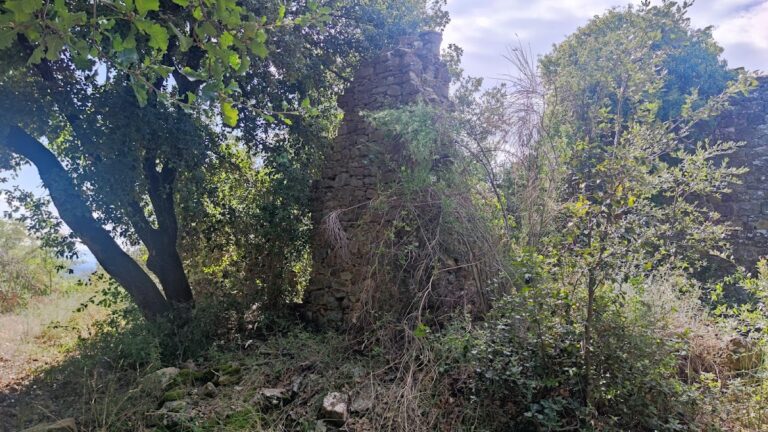
Restoration work revealed remains of the original church of Santa Maria in Camaldo along the western side of the present building. These surviving traces preserve the physical connection between the Franciscan complex and the earlier parish church of Camaldo from which San Lucchese developed.
Nearby sites