Monastery of Panagia Molyvdoskepastos: A Byzantine and Greek Orthodox Monastery in Greece


Site at a Glance
- Rating
- 4.9
- Popularity
- Medium
- Country
- Greece
- Primary era
- Medieval
- External website
- Open
- Eras represented
- Medieval, Early Modern
- Civilizations
- Byzantine, Ottoman
- Site type
- Religious
- Remains
- Monastery
On this page8 sections
History
The Monastery of Panagia Molyvdoskepastos is an all-male Greek Orthodox monastery in Greece, near the settlement of Molyvdoskepastos. Dedicated to the Dormition of the Theotokos, the Christian belief in the Virgin Mary’s falling asleep and departure from earthly life, it is a Patriarchal and Stauropegic monastery, meaning that it stands under the direct authority of a patriarch, while also belonging to the Metropolis of Dryinoupolis, Pogoniani, and Konitsa. Tradition attributes its foundation to the seventh-century Byzantine emperor Constantine IV Pogonatus, reportedly after his return from an expedition to Sicily in 671–672. A foundation inscription attributed to the founder dates the original catholicon, the principal church of an Eastern Orthodox monastery, to 670.
Early foundation and ecclesiastical role
The earliest surviving remains in the area date no earlier than the eleventh century, while the present catholicon belongs to the thirteenth or fourteenth century. The monastery stood near Depalitsa, also known as Dipalitsa, the Byzantine-period name of present-day Molyvdoskepastos. From the twelfth through the seventeenth century, it served as the seat of the Archbishopric of Pogoniani, giving it an important administrative and religious role in the region.
At the end of the thirteenth or the beginning of the fourteenth century, the monastery was renovated by Andronikos Komnenos Palaiologos, a megas doux, a high Byzantine official traditionally associated with command of the imperial fleet. He was the grandson of Michael II Komnenos Doukas, the ruler of Epirus. During this period, the catholicon was enlarged and two chapels were added, reflecting the monastery’s developing liturgical needs.
Learning, property, and regional connections
A further renovation took place in 1521, or around 1521–1522, through the efforts of inhabitants of the surrounding villages of old Pogoniani. This period brought the monastery its greatest prosperity. It held extensive property and dependent estates known as metochia, including holdings as far away as the Danubian Principalities and Romania. It also maintained a school, a workshop for copying manuscripts, and a large library.
During Ottoman rule, the monastery functioned as a spiritual, cultural, and economic center for the surrounding region. From the fourteenth century, its school taught monks and laypeople to transcribe manuscripts, and many scholars and writers of the period received their education there. A large commercial center called Pazari operated immediately northwest of the monastery and contributed to its finances.
Routes through the area connected the monastery with wider regional networks. In the Roman and Byzantine periods, a branch of the Via Egnatia passed nearby, linking northern Epirus with Konitsa and the rest of Greece through the Mertziani Bridge. These routes were closed in 1944 after the establishment of the communist regime in Albania, altering the monastery’s historic connections across the border region.
Destruction and revival
The monastery remained without monks from 1913 until 1988. During those decades, parts of its property were encroached upon, while sacred objects and relics were stolen. In 1943, bombing by the occupying Nazi forces caused near-total destruction. The monastic cells and archive burned completely, and the catholicon was looted.
A new brotherhood re-established the monastic community in 1988, with the encouragement and spiritual guidance of Saint Paisios the Athonite, a twentieth-century Greek Orthodox monk and spiritual guide, and with the blessing of Metropolitan Sebastianos. The monastery celebrates its feast on 15 August. A vigil begins during the night of 14 August and continues until dawn.
A local tradition connects the monastery with the demarcation of the Greek-Albanian border. According to the story, officials initially assigned it to Albania, but the horses carrying them became wild and threw them to the ground. The decision was then changed, and the monastery remained in Greek territory, approximately 400 metres from the border. The monastery is also associated with the Monastery of Saint Christopher and the Monastery of Saints Constantine and Helena.
Remains
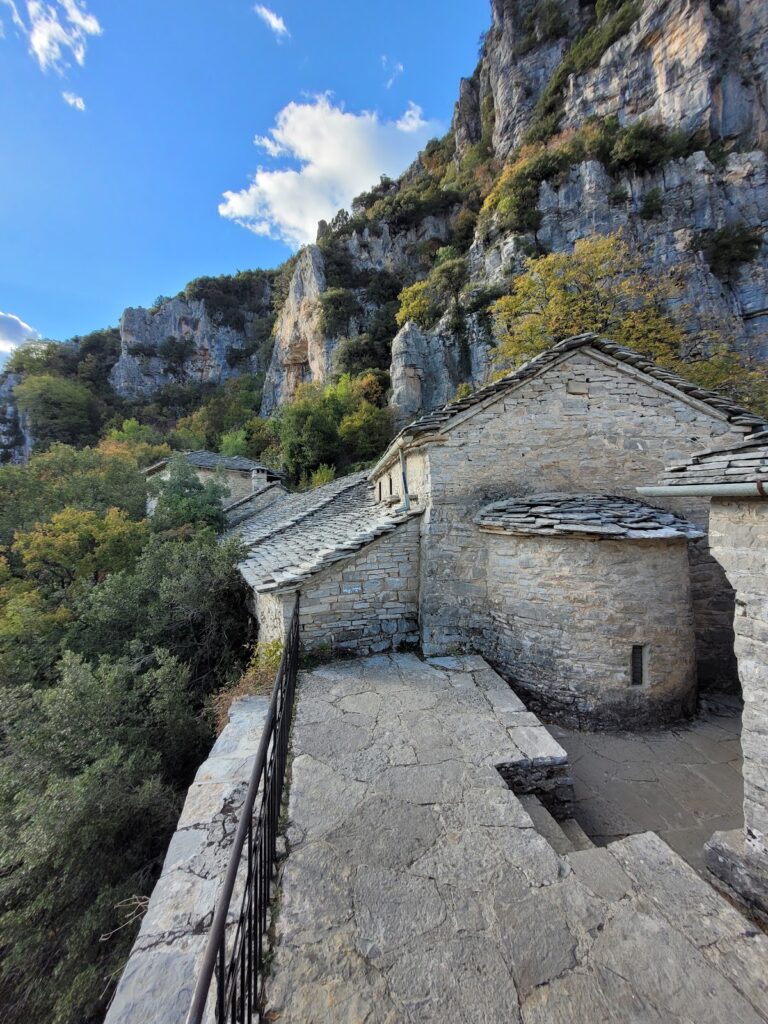
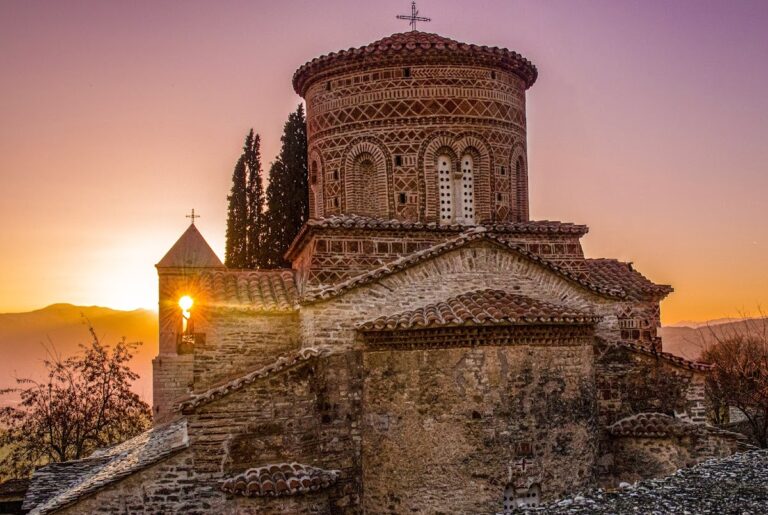
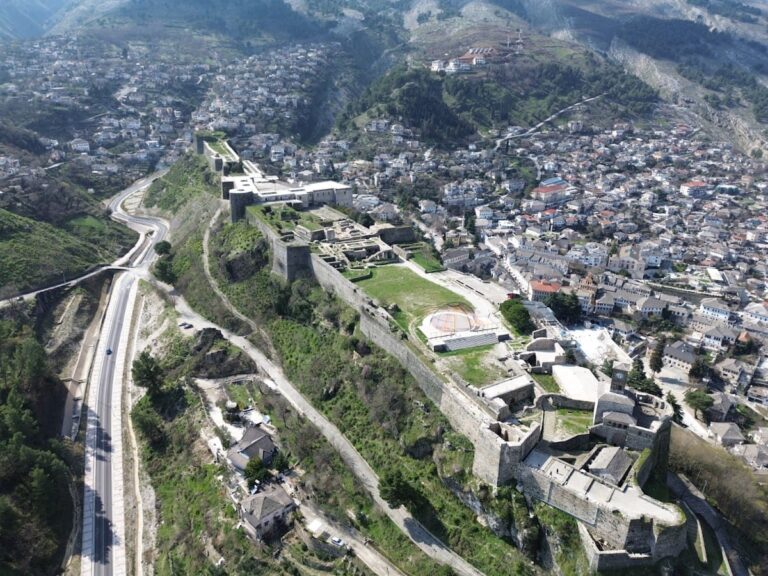
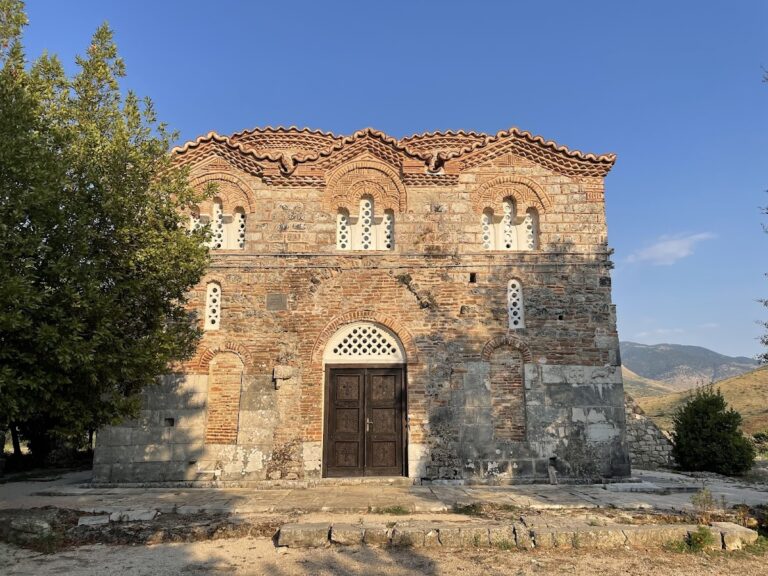
The monastery stands near the confluence of the Aoos and Sarantaporos rivers, at the foot of Mount Meropi-Nemertsika and about 400 metres from the Greek-Albanian border. It lies approximately 20 kilometres from Konitsa and 55 kilometres from Ioannina. The complex includes the Byzantine-style catholicon, two bell towers, and a garden. Its name, Molyvdoskepastos, meaning “lead-covered,” refers to the former lead-sheet roof of the catholicon, which was later replaced with stone slabs.
The catholicon and its architectural phases
The catholicon has an unusual composition formed through successive changes as the monastery’s liturgical and practical needs expanded. In its first phase, during the eleventh and twelfth centuries, an earlier church was rebuilt as a small cross-shaped, three-ended church with a dome. At the end of the thirteenth or the beginning of the fourteenth century, a central section covered by intersecting vaults was added. The chapel of the old Timios Prodromos, or Saint John the Baptist, was built to the south, while the chapel of Saint Paraskevi was added to the north.
During the renovation around 1521, the catholicon received a large three-part narthex, or entrance vestibule, known as the Lite. The dome is exceptionally high and has been described as the highest in Greece in proportion to its architectural type. Damage in 1537, possibly caused by an earthquake, led to additional work in the main church, including enlarged arches and further supporting piers. The church was then painted anew by Eustathios Iakovou, a protonotarios, or ecclesiastical administrative official, from Arta.
Frescoes and interior features
The surviving frescoes appear in places in three superimposed layers, one Byzantine and two post-Byzantine. The earliest paintings date from the beginning of the fourteenth century and show two artistic styles executed with comparable techniques, probably by two painters from the same workshop. A later cycle was painted in 1521–1522, covering parts of the earlier Byzantine work. Its anonymous painter signed the cycle with the words, “God knows whose all this labour was.” Both layers remain visible, especially in the lower portions of the western wing of the cross-vaulted section and in other parts of the church.
The 1537 painting campaign by Eustathios Iakovou is also associated with his signed work in the historic chapel of the Monastery of Mavriotissa at Kastoria. The western narthex contains frescoes depicting Constantine Pogonatus and Andronikos Palaiologos. Inside the church, the iconostasis, the screen separating the sanctuary from the main worship space, is made of old marble.
The icon and monastic grounds
The monastery houses the miracle-working icon of Panagia Molyvdoskepastos. Its date of creation is unknown. After it was stolen and left exposed outdoors, rotten sections were removed and damaged areas were retouched. The icon has reportedly been stolen several times and subsequently returned. Together with the catholicon, bell towers, garden, and associated chapels, it forms the surviving physical core of the monastery complex.
Nearby sites