Monastero di S. Nicola di Casole: A Byzantine Greek-Rite Monastery near Otranto


Site at a Glance
- Rating
- 3.9
- Popularity
- Very Low
- Country
- Italy
- Primary era
- Medieval
- Eras represented
- Medieval
- Civilizations
- Norman
- Site type
- Religious
- Remains
- Monastery
On this page9 sections
History
Monastero di S. Nicola di Casole was a Basilian monastery near Otranto, Italy, founded in 1098-1099 in the Romanesque period and dedicated to Saint Nicholas of Bari. Its Byzantine Greek rite followed the Eastern Christian liturgy and ecclesiastical customs, which remained widespread in Salento until the fifteenth century. The monastery became an important historical, artistic, and cultural center of medieval southern Italy.
Early occupation and foundation
Archaeological research indicates that the site was occupied as early as the eighth or ninth century. The foundation of the monastery belongs to 1098-1099, when Joseph served as its first abbot. This date is preserved in monastic rules compiled in 1160. A separate tradition attributes the foundation to Bohemund I of Antioch in 1098, claiming that the Norman prince entrusted the monastery to Basilian monks led by Joseph, but documentary evidence does not support that account.
Bohemund I was a Norman prince and a leading figure in the First Crusade. A different Bohemund, Bohemund of Taranto, transferred the Casale Casole to the monastery in a donation dated 1104-1111. The grant exempted the estate and the monastery’s other possessions from all taxes, establishing an important material basis for the community.
Royal and papal protection
The monastery subsequently received support from the Norman rulers of southern Italy. Empress Constance confirmed earlier donations in general terms, while a liturgical memorial at San Nicola names Bohemund, his wife Constance, their son Bohemund II, Roger II, his first wife Elvira, and their sons Roger and William I. Roger II became the first king of Sicily, and William I later succeeded him.
Frederick II, the Hohenstaufen emperor and king of Sicily, confirmed his mother’s privilege and released the monastery from several charges, including those associated with purchasing and selling provisions for the monastic community. In 1305, Charles II of Anjou, the Angevin king of Naples and Sicily, confirmed documents presented to him by Bohemund, Constance, and Frederick II.
The papacy also recognized and supported San Nicola. An unknown pope granted the monastery exemption from ordinary ecclesiastical jurisdiction. It appears in additions to the Liber censuum, a medieval papal register of church revenues, dues, and related rights, and paid eighteen years of arrears in 1233. Documents issued by Honorius III in 1218 and Innocent IV in 1254 were also preserved by the monastery.
Reorganization and dependent establishments
In 1266, after the death of King Manfred, Cardinal-Bishop Radulf of Albano reorganized ecclesiastical affairs in the Kingdom of Sicily. He reconsecrated the monastery church, transferred Basilius, the community’s hegumen or monastic head, to San Vito del Pizzo, and appointed Jacobus as abbot of San Nicola. Jacobus held the office from 1266 to 1275.
San Nicola controlled a network of dependent establishments, known as metochia. These religious houses or estates attached to a larger monastery were located at Vaste, Policastro, Trulazzo, Melendugno, Alessano, Castro, and Minervino. A privilege issued by Honorius III also lists a monastery at Monopoli among San Nicola’s possessions.
A center of Greek learning
Between the eleventh and twelfth centuries, San Nicola developed into a major cultural center. Its scriptorium, a specialized place for copying manuscripts, produced Greek and Latin books, while its library preserved a substantial collection. The monastery provided accommodation for visiting students and maintained a school of painting and manuscript illumination, the decoration of handwritten books with images, ornamental designs, and colored initials.
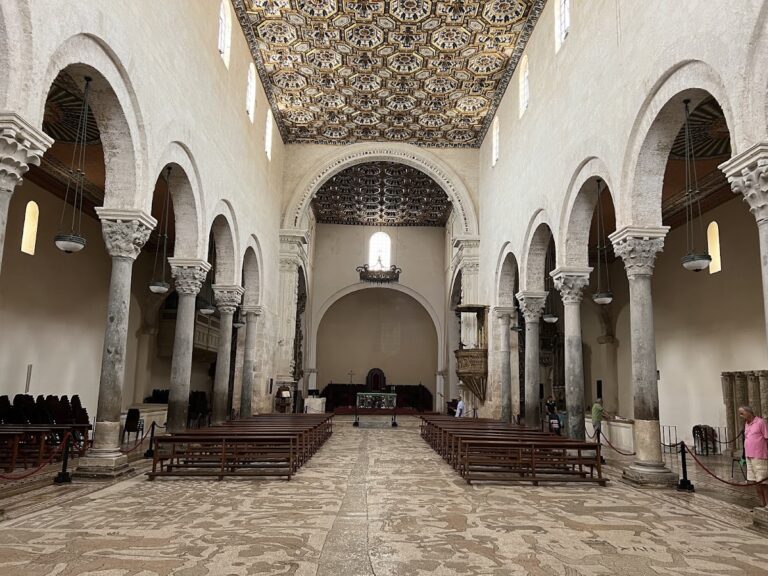
At the beginning of the thirteenth century, Abbot Nektarios, also known as Nicola of Otranto, led a circle of Greek-language poets at the monastery. The group included Georgios of Gallipoli and Johannes of Otranto, also called Johannes Grassus. The relationship between San Nicola and Pantaleone, the Greek mosaicist associated with the floor mosaic of Otranto Cathedral, remains uncertain. Pantaleone’s supposed origin at the monastery is unproven, although it is considered possible that texts from the library influenced the mosaic’s iconographic and symbolic program.
Ottoman occupation and later decline
During the Ottoman capture of Otranto in 1480, troops commanded by Ahmet Pasha occupied the monastery and used it as a strategically placed observation outpost. The later fate of the complex is uncertain. One tradition describes it as destroyed in 1480, while another holds that the occupation led to abandonment and gradual decline. The library was rapidly dispersed.
Some manuscripts were removed and saved during the occupation by Sergio Stiso, a Salentine Greek humanist, and Cardinal Giovanni Bessarion, a Byzantine-born churchman and humanist who collected Greek manuscripts in Italy. After the monastery’s destruction or decline, its properties continued to be assigned as ecclesiastical commendams, institutions or benefices entrusted to holders who administered their revenues without necessarily residing there.
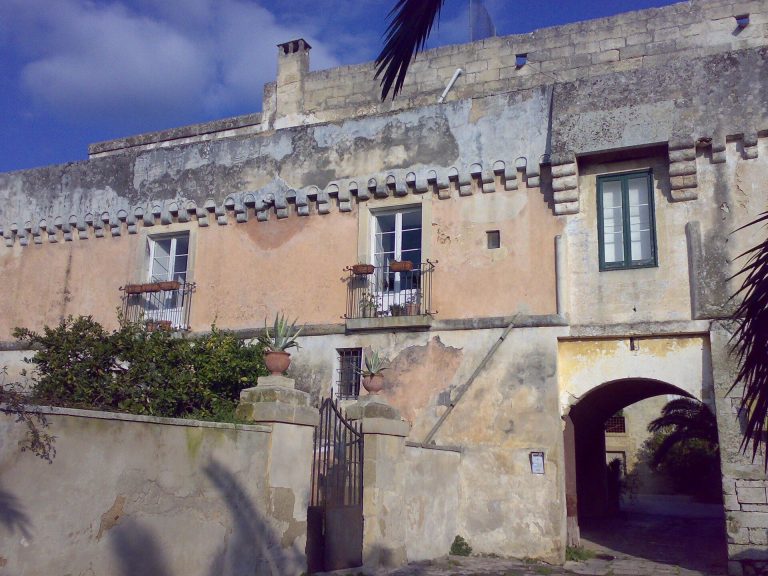
Small Latin-rite communities continued to use the monastery until the seventeenth century. The complex later became part of a masseria, a rural agricultural estate or fortified farm complex characteristic of southern Italy, and retained that agricultural use until the twentieth century. It was finally abandoned, leaving ruins within a privately owned estate near Otranto.
Remains
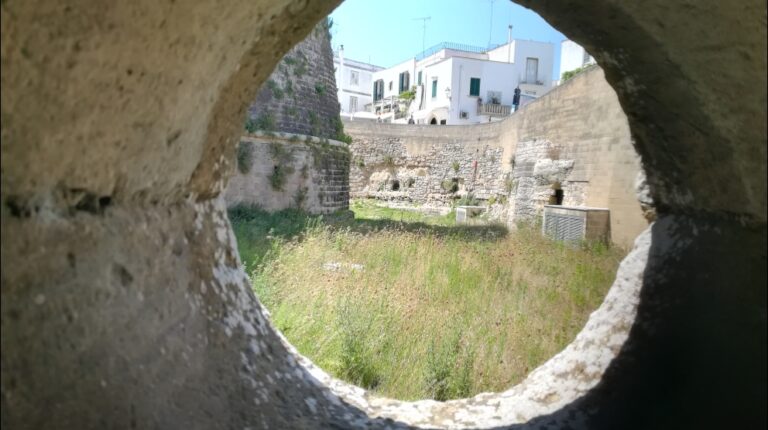
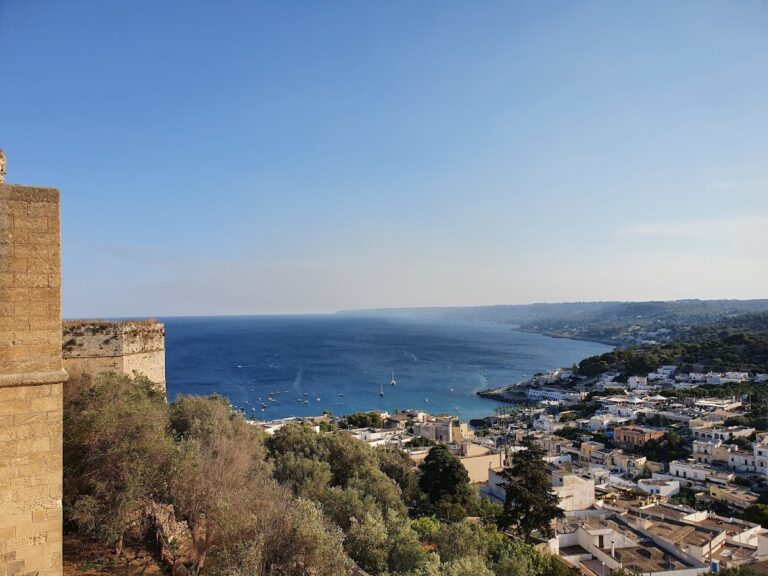
The remains stand in the Palascìa area, about 3 kilometres south of Otranto along the coastal road toward Santa Cesarea Terme. They occupy part of a masseria, reflecting the site’s later agricultural use. Only sparse ruins survive, but the rectangular plan of the abbey church remains legible. Parts of the perimeter walls and a nearly intact semicircular apse preserve the outline of the principal ecclesiastical building.
Church and monastic buildings
The complex is classified as Romanesque, while finely carved ribs survive at the junctions between some walls and show Gothic architectural characteristics. Around the church stood subsidiary buildings used by the monks, including chapels, small rooms, and simple huts. The name Casole is associated with the Salentine dialect word for these huts. Facilities for visiting students formed part of the wider educational complex, alongside the spaces connected with manuscript production and painting.
Fresco and surviving manuscripts
A small surviving section of fresco depicts a bearded figure lifting its hands toward heaven in prayer. The monastery’s intellectual and religious life is also preserved through manuscripts that once belonged to Casole. The Typikon Casulano, a monastic rulebook setting out liturgical observances, discipline, meals, fasts, and daily organization, survives in the National Library of Turin. Other manuscripts and parchment fragments originating from Casole have been identified in Rome, Venice, and Bari.