Misliya Cave: A Prehistoric Rock Shelter in Israel

Site at a Glance
- Popularity
- High
- Country
- Israel
- Primary era
- Stone Age
- Eras represented
- Stone Age
- Civilizations
- Unclassified
- Site type
- Domestic
- Remains
- House
On this page16 sections
History
The Paleolithic occupations
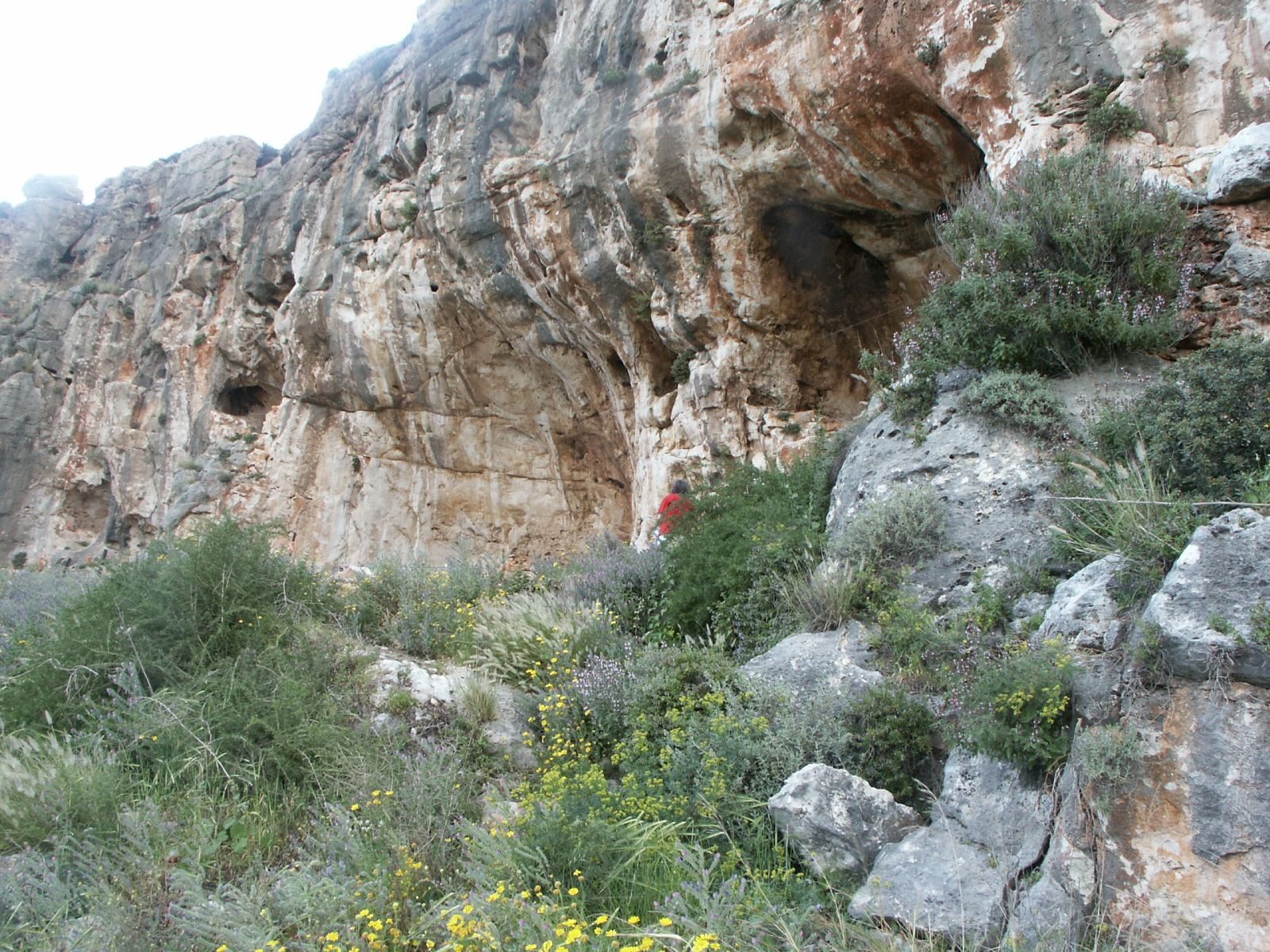
Misliya Cave is a prehistoric rock shelter on the western slope of Mount Carmel in Israel, with principal occupation layers dating to about 300,000–150,000 years ago. These layers span the transition between the Lower and Middle Paleolithic, subdivisions of the prehistoric Stone Age. On the lower terrace, the Acheulo-Yabrudian, a named stone-tool industry, dates to about 300,000–250,000 years ago. The upper terrace’s Mousterian industry dates to about 250,000–150,000 years ago.
The two assemblages have been compared with layers E and D at Tabun Cave, dated to about 400,000–260,000 and 260,000–190,000 years ago, respectively. At Misliya, differences in tool shapes and stone-working methods have led researchers to interpret the Acheulo-Yabrudian and Mousterian occupations as technologically unconnected.
Cave changes and the surrounding landscape
The cave roof collapsed in several episodes, after which people used parts of the shelter again. The western area above the lower terrace probably collapsed and became exposed first; the latest major collapse preceded most use of the upper terrace. A collapse around 160,000 years ago buried and helped preserve the fossil known as Misliya-1.
During the occupations, the Carmel and coastal plain included both Mediterranean woodland and open ground. People could use the wooded mountain plateau as well as the coastal plain. With sea level near today’s level or tens of metres lower, the plain between the cliff and sea ranged from about 1.5 kilometres wide to several kilometres farther west. Rodent remains, many likely deposited in owl pellets, include voles, forest dormice, jirds and mice. They also include the mole vole Ellobius lutescens, which disappeared from the region around the middle of the Middle Paleolithic and now lives in cooler, higher parts of western Asia.
Mousterian lifeways
Mousterian occupants hunted ungulates and gathered wild plants and ostrich eggs. Their prey included Persian fallow deer, gazelles, aurochs, wild goats, wild boar, red deer and roe deer. Bone-part patterns and butchery marks suggest that gazelles were carried to the cave whole and processed there. Larger fallow deer were first butchered near the kill site, with portable, meat- and fat-rich portions brought back. Cut marks on meat-rich bones indicate early access to carcasses, probably through hunting rather than scavenging. The predominance of prime-age adult fallow deer has been interpreted as evidence of systematic hunting.
Researchers have linked these hunting practices, skilled stone-tool production, regular fire use and apparently extended stays to behavior resembling that of later hunter-gatherers. Mousterian occupants also brought 11 Mediterranean marine shells to the cave, including Glycymeris nummaria and Cerastoderma glaucum. Their purpose is uncertain; they have been proposed as possible evidence of symbolic activity rather than subsistence. Misliya is among the earliest known sites with marine-shell finds.
Discovery and the Misliya-1 fossil
Fritz Brotzen discovered the cave in 1925, and he and Elise Jenny Baumgartel published its scientific description in 1927. The site was also known as Brotzen Cave. Later surveys involved Abraham Ronen, Yaakov Olami, Mina Weinstein-Evron and Daniel Kaufman. A pilot excavation took place in late 2000 and early 2001, followed by systematic excavations from 2001 to 2010 led by Mina Weinstein-Evron and Israel Hershkovitz, with teams from the Universities of Haifa and Tel Aviv working through the University of Haifa’s Zinman Institute of Archaeology.
Misliya-1, an upper jaw recovered from the upper terrace in 2002, is among the earliest known remains of Homo sapiens outside Africa. A 2018 assessment placed its age at about 177,000–194,000 years ago; a later reassessment estimated about 152,000 years, with uncertainty of roughly 24,000 years and potentially wider effective margins given the dates of the surrounding layers. Its age has been interpreted as pushing back the proposed timing of human dispersal from Africa into Eurasia.
Remains
Rock shelter and terraces
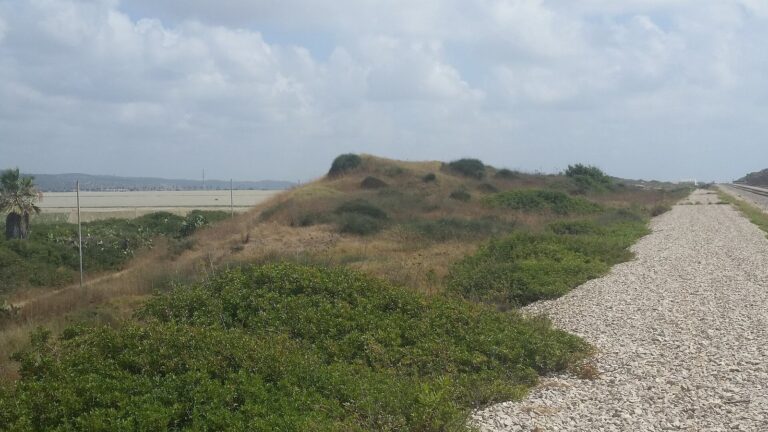
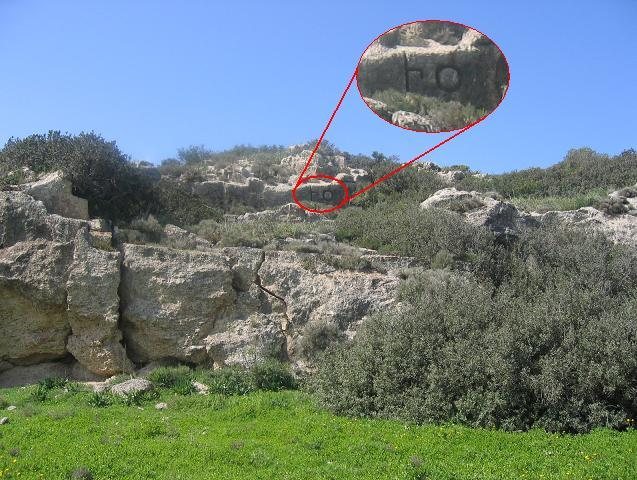
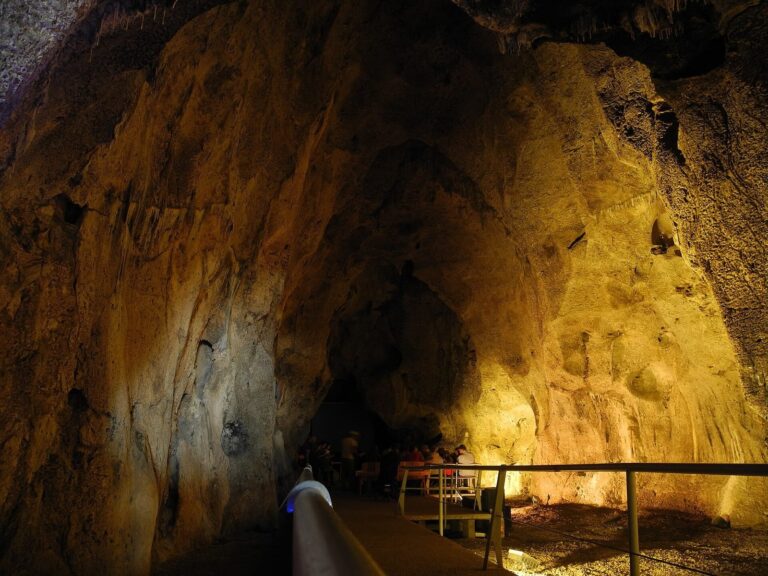
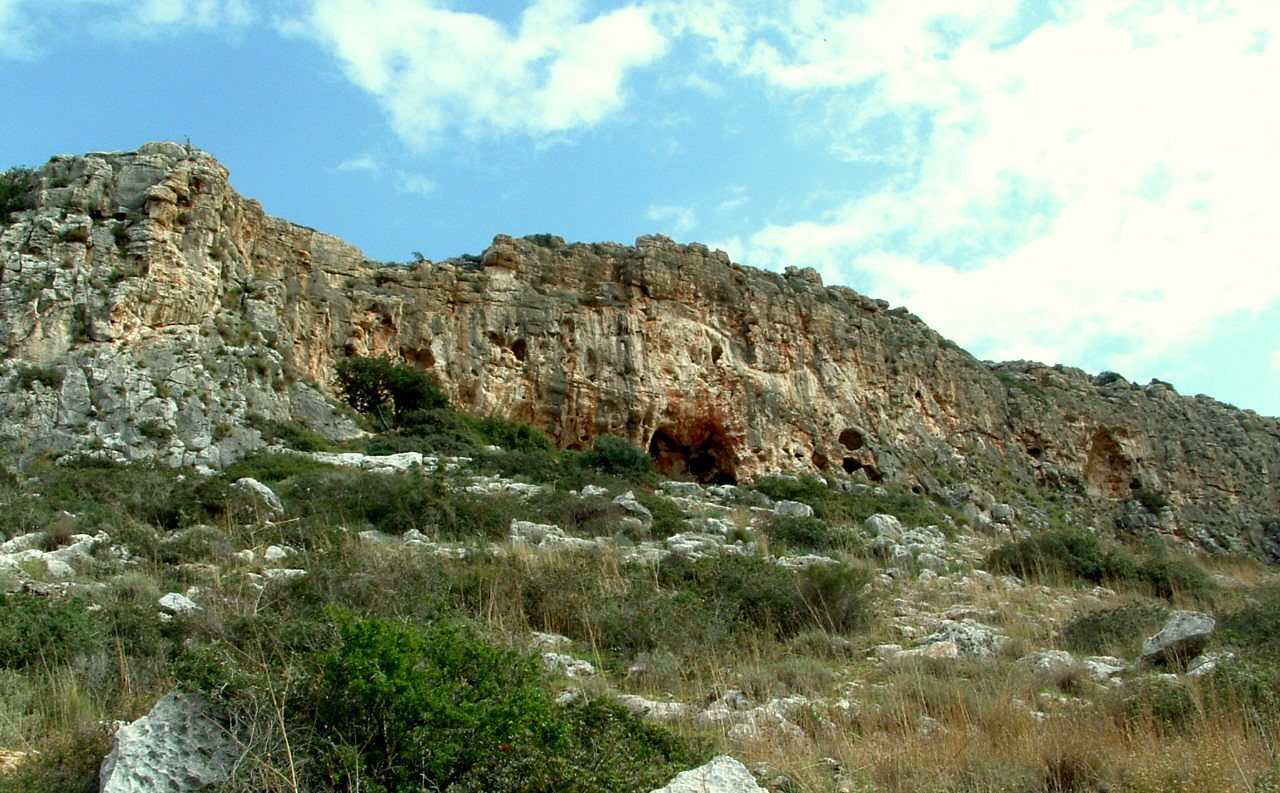
The site extends about 80 metres along a west- to southwest-facing limestone cliff, where the slope of Mount Carmel meets the rock face. It lies about 90–95 metres above sea level, at a cliff roughly 17–20 metres high. The shelter formed from a larger cave and now consists of three shallow niches with natural terraces in front. The lower terrace lies farthest west, the upper farthest east beside the cliff, with a middle terrace between them. Only the eastern half of the upper terrace remains roofed. A 2–4-metre layer of breccia, rock made of cemented fragments, covers the terraces. A central area of softer sediment on the upper terrace was excavated across about 20 square metres to a depth of roughly 2 metres; test sections also cut through breccia elsewhere.
Stone tools
Lower terrace assemblage
The lower terrace’s hard breccia contains several thousand flint artefacts of the Acheulo-Yabrudian industry, especially broad, slanted scrapers and handaxes. Many of the tools shaped on both sides are relatively small, less symmetrical and more pointed than handaxes of the earlier Acheulean tradition, known especially for this tool form. Most of the flint came from Nahal Galim, 2–3 kilometres away, although some was brought from sources tens of kilometres distant.
Upper terrace assemblage
A large rockfall lies beneath the upper terrace’s thick Mousterian deposits, while the underlying material contains Acheulo-Yabrudian artefacts. The Mousterian layers have yielded about 50,000 flint pieces, including varied points and blades with reworked edges. Elongated forms are common, among them Abu Zif points, a type of stone point. Both the Levallois method, which uses prepared cores to produce flakes of planned shapes, and blade-making methods, which produce elongated flakes, are represented; blade production predominates. Most flint came from nearby Carmel sources such as Nahal Galim, Mount Oren and Nahal Me’arot, about 2–8 kilometres away. Wear patterns on elongated Abu Zif points indicate use on plant materials and other substances.
Hearths and food remains
Hearths
Several hearths occur in the upper terrace’s Mousterian layers. Their ash and other burned material show against the lighter cave sediment. The best-preserved hearth measures about 1 metre across and 20 centimetres thick, and appears to have been used repeatedly in the same place. Flint artefacts and burned animal bones lie in and around the ash. Microscopic study of the sediment identified burned plant material used as fuel.
Animal remains
Thousands of fossilized animal bones have been recovered from the cave, forming, with the stone tools and hearth deposits, the main material evidence for occupation and food processing. Some bones bear cut marks. Activity around a hearth has been reconstructed as beginning with animal processing some distance away, possibly near a cave wall, followed by the transfer of selected parts to the fire. Flint knives could remove meat from limb bones, while stone hammerstones were used to break bones for marrow; food remains accumulated around the hearth.
Misliya-1
Jaw and identification
Misliya-1 is the left half of an adult upper jaw. It retains part of the palate, eight teeth extending from a wisdom tooth to a canine, and the root of an incisor. Three-dimensional measurements of the teeth were compared with modern humans and other ancient human fossils. The tooth structure differs from that of Neanderthals, a separate extinct human group, and other ancient human specimens. The combination of incisor and canine features was identified as characteristic of anatomically modern humans, meaning people with the anatomical features of humans today.
Dating evidence
Different dating methods have produced different estimates. Uranium-thorium dating, which measures radioactive decay in uranium-bearing material, placed mineral crust attached to the jaw at 185,000 ± 8,000 years. Thermoluminescence, which estimates when a mineral was last heated, dated nine nearby burned flints to 179,000 ± 48,000 years. Combined uranium-thorium and electron-spin-resonance dating, which estimates accumulated radiation in a sample, placed tooth dentin at 174,000 ± 20,000 years. Uranium-thorium dating of dentin alone produced a much younger result of 70,200 ± 1,600 years, attributed to changes in the tooth after fossilization.