Mirahori Mosque: An Early Ottoman Mosque in Korçë, Albania

Site at a Glance
- Rating
- 4.8
- Popularity
- Very Low
- Country
- Albania
- Primary era
- Medieval
- External website
- Open
- Eras represented
- Medieval, Modern
- Civilizations
- Ottoman
- Site type
- Religious
- Remains
- Mosque
On this page12 sections
History
Mirahori Mosque is an Ottoman mosque in Korçë, Albania, built in the mid-1490s under Sultan Bayezid II. Founded by Iljaz bej Mirahori, it is one of Albania’s oldest Islamic buildings and the country’s oldest surviving single-dome mosque. The building helped turn a small settlement into a Muslim town and became the centre of a wider charitable foundation.
Iljaz bej Mirahori and the foundation
Iljaz bej Mirahori was born in Korçë and served as a Janissary, a soldier in the Ottoman standing infantry, during the Ottoman siege and conquest of Constantinople in 1453. He later became Mir-i Ahur, an Ottoman court official responsible for the imperial stables, and married a daughter of Sultan Mehmed II, the ruler who conquered Constantinople. He is associated with rebuilding or refounding Korçë after its destruction by the Turks in 1440.
Mirahori established the mosque under Sultan Bayezid II, whose reign lasted from 1481 to 1512. His purpose was to transform Korçë into a Muslim town. Under Ottoman law, a settlement needed both a Friday mosque and a marketplace for its residents to be registered as townspeople rather than peasants.
The mosque was supported by a vakıf, a charitable religious endowment whose revenues maintained public and religious institutions. The foundation included an imaret, or soup kitchen, a bakery, storage rooms, a han for lodging and commerce, a hamam or public bath, and a mekteb, an elementary religious school. Its income came from villages in the Görice region and Përmet, as well as from a bathhouse and shops in Istanbul and a bathhouse and mill in Janina. The endowment is regarded as one of the earliest of its kind in the Albanian lands.
Tradition, repairs, and changing use
A tradition recorded by the writer Sami Frashëri holds that the mosque was built over the foundations of an earlier monastery dedicated to Saint Paraskevi. This remains a foundation tradition rather than a securely established archaeological fact.
The mosque received repeated repairs over the centuries. During Albania’s communist period, the Institute of Cultural Monuments restored it in 1977–1978, and the building was then used as a museum. Religious use resumed in 1991. The minaret was destroyed by the 1961 earthquake and rebuilt after 2006, with the reconstruction completed in 2008. A major restoration followed in 2013, financed by the Turkish government and carried out through the Turkish Cooperation and Coordination Agency.
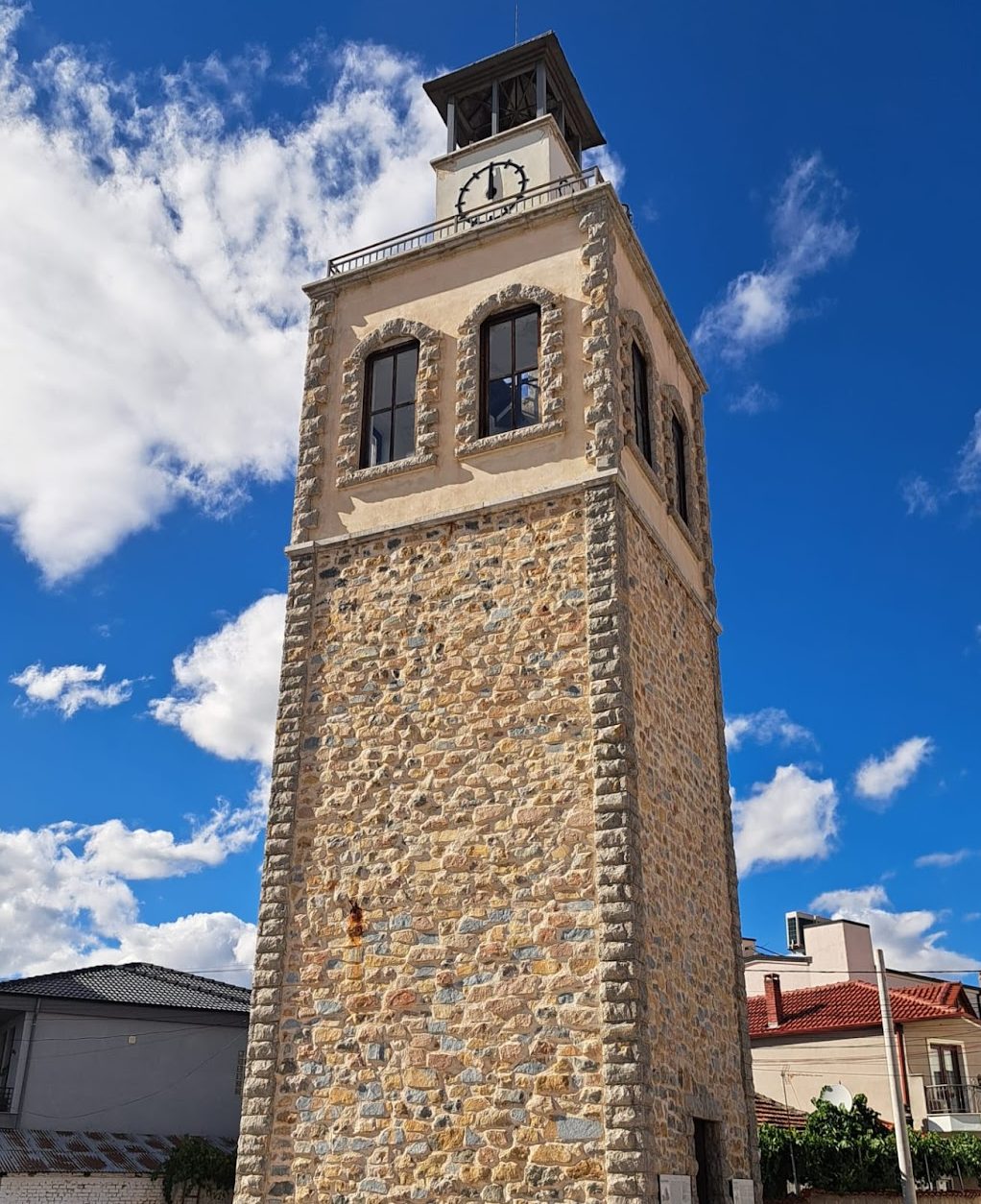
Mirahori Mosque was placed on Albania’s cultural-monument list in 1948, and its protected status was confirmed in 1971 as an architectural monument under reference KO104. The old Ottoman clock tower of Korçë, destroyed in the 1960 earthquake, was later reconstructed on the mosque’s grounds. The mosque is now active again as a place of worship.
Remains
The mosque stands west of Korçë’s city centre and south of the Old Bazaar. Its courtyard, measuring approximately 30 by 55 metres, contains the mosque and the founder’s tomb building. The main structure combines a square prayer hall, a domed roof, an entrance porch, and a minaret. White limestone blocks form the walls in horizontal courses separated by red brick, producing finely crafted cloisonné masonry, in which masonry units are framed by brick bands.
Prayer hall and entrance porch
Prayer hall
The prayer hall is square, with exterior walls measuring about 11.75 by 11.75 metres and an interior prayer space measuring 9.48 metres square. A single, almost hemispherical dome covers the room. It is clad in copper and rises above a drum on an octagonal base. The present interior orientation was installed in the nineteenth century.
Entrance porch
A portico projects from the front of the prayer hall. Three pointed arches rest on massive piers, and three small domes cover the porch. The portico is now glazed, with a wooden door set in its centre. An inscription above the entrance identifies the mosque as built in 1494–1495. The surviving text dates from 1872–1873 because the earlier inscription was not preserved. It consists of five lines of Ottoman verse carved on a large stone slab and contains several errors.
Minaret and courtyard buildings
Minaret
The original minaret rose from the northwestern corner of the prayer hall and reached approximately 32 metres in height. The 1961 earthquake destroyed that tower. The reconstructed minaret, rebuilt after 2006 and completed in 2008, now forms part of the mosque complex.
Founder’s tomb building
Iljaz bej Mirahori’s tomb building stands beside the mosque within the courtyard. Its present form is probably largely the result of a nineteenth-century reconstruction, linking the founder’s memorial directly with the mosque he endowed.
Clock tower
The mosque grounds also contain the later reconstruction of Korçë’s old Ottoman clock tower. The original tower was destroyed in the 1960 earthquake, and the rebuilt structure forms part of the wider historic setting of the complex.
Dome windows
During the 2013 restoration, the round windows in the dome were closed with white grilles. This intervention forms part of the building’s present appearance alongside its copper-covered dome, glazed porch, and reconstructed minaret.