Monastery of Saint Naum: A Medieval Orthodox Monastery in North Macedonia


Site at a Glance
- Rating
- 4.8
- Popularity
- High
- Country
- North Macedonia
- Primary era
- Medieval
- Eras represented
- Medieval, Early Modern, Modern
- Civilizations
- Byzantine, First Bulgarian Empire, Ottoman
- Site type
- Religious
- Remains
- Monastery
On this page14 sections
History
The Monastery of Saint Naum is an Orthodox monastery in North Macedonia, about 30 kilometres south of Ohrid, founded by Saint Naum of Ohrid in the late ninth or early tenth century. Construction was completed around 900–905 within the Christian and literary sphere of the First Bulgarian Empire, with support from the Bulgarian rulers Boris I and Simeon I. The complex became one of the historical centers of the Ohrid Archbishopric and remains a pilgrimage destination associated with the saint.
Foundation and the life of Saint Naum
Saint Naum was a disciple of the ninth-century missionaries and translators Cyril and Methodius, who helped develop and spread Slavonic liturgical writing. He also worked alongside Saint Clement of Ohrid, continuing their Christian and literary mission in the Balkans. After ending his teaching activities, Naum withdrew to the monastery around 900 or 905. He died on 23 December 910 and was buried in the monastery church.
The church was originally dedicated to the Archangels Michael and Gabriel. After Naum’s burial, both the church and the institution became known by his name, and the site developed into a major pilgrimage center. His relics were believed to heal illnesses, including mental illness. Traditional names for the monastery, Saint Sium and Saint Zauma, were popularly connected with the healing of the mind.
The Ohrid Archbishopric and later ecclesiastical history
After the decline of the First Bulgarian Empire, the monastery was placed under the Ohrid Archbishopric in 1018. The archbishopric was a major Orthodox institution centered on Ohrid. When it was subordinated to the Ecumenical Patriarchate of Constantinople and the Diocese of Prespa in 1767, Greek bishops and the Greek language became prominent in ecclesiastical administration and liturgy. In 1873, administration passed to the Greek ecclesiastical community of Ohrid. The monastery is now administered by the Debar–Kicevo Metropolitanate of the Macedonian Orthodox Church–Ohrid Archbishopric.
Tradition attributes a renovation of the monastery to John Vladimir, an early medieval ruler of Duklja who is venerated as an Orthodox saint. According to the tradition, he undertook the work in thanksgiving for victory over his enemies. His association with the site was later expressed through a chapel dedicated to him and an icon placed in the church iconostasis, the screen separating the sanctuary from the main body of an Orthodox church.
Rebuilding, fires, and nineteenth-century change
During the second half of the seventeenth century, the abbot Gabriel established a hospital. The monastery was repeatedly rebuilt, with a major reconstruction taking place in the early eighteenth century. A fire in 1711 preceded the installation of a new iconostasis, and the monastery buildings were substantially reconstructed during the same period. In 1806, the church was repainted at the expense and under the supervision of Abbot Stefan of Plovdiv, with assistance from Hadji Jacob and the trustee Ivan Gavrilov. Tarpo, son of Konstantin the painter from Korça, completed the work on 6 September 1806.
The mid-nineteenth century brought conflict over ecclesiastical language and authority between Bulgarian and Greek communities. During this period, the Greek abbot Dionysius burned the monastery’s Slavonic books. A fire damaged the monastery in 1845, while another in 1870 destroyed the entire complex except the church. The present monastery buildings were erected afterward. By that time, monks no longer lived there permanently.
Landholding, pilgrimage, and political change
During the Bulgarian National Revival, a fair was held at the monastery on Saint Naum’s feast day. The institution also possessed extensive endowments and agricultural resources. By the mid-nineteenth century, its income included revenue from the villages of Ljubaništa, Pojan, and Stenje, and its holdings included about 8,000 sheep. The monastery continued to draw devotees seeking healing, including Muslims from the surrounding region. Pilgrims formerly spent the night beside Saint Naum’s tomb while praying for recovery. Its principal feast is Saint Naum’s day on 20 June; other major observances include 23 December, 27 July for the Seven Saints, and the feast of the Archangels.
Serbian forces took control of the monastery area in November 1912 after the Battle of Bitola. Following the diplomatic settlement of 1913, Serbian border authorities withdrew to Saint Naum. In 1916, the Austro-Hungarian command announced the completion of its occupation of Serbia by taking the monastery. Amid a disputed border settlement, the monastery was transferred during 1923–25 by Ahmet Zogu to King Alexander I Karađorđević and Queen Maria of Romania. In 1925, negotiations between the Kingdom of Serbs, Croats and Slovenes and Albania definitively assigned it to the former in exchange for the southern village of Peshkëpi.
After the Serbian takeover, a royal residence was built near the monastery. Alexander and Maria visited the monastery and its holy-water spring during the 1925 settlement period, and Alexander returned in May 1926. The former Tower of Saint Vladimir was demolished in 1929. On Alexander’s initiative, a replacement tower and the Chapel of Saint Vladimir were built, and both were consecrated on 4 June 1929. The architect was Momir Korunović, and Stepan Kolesnikov painted the icons.
In 1920, the monastery housed Serbian monks, two Russian monks, 37 novices, and 75 servants. Its estate covered about 2,000 hectares, mainly arable land, and was cultivated by peasants working on a share basis and by monastery servants. Livestock was said to include 1,400 sheep, 150 pigs, 120 cattle, 75 packhorses, six buffaloes, and 15 donkeys. The monastery controlled approximately two kilometres of Lake Ohrid shoreline, where fish were caught with nets about 500 metres long and eight metres high. Serbian monks also brought 2,000 Hungarian plum seedlings to the estate. Prota Stevan Đorđević was the monastery’s superior in 1931 and remained so in 1938.
A traditional story tells of a bear that replaced an ox killed while a peasant was ploughing near the monastery. In the legend, Saint Naum prayed for the peasant, after which the bear returned and pulled the plough with the remaining ox. A large painting above the entrance commemorated the episode, and a taxidermied bear was kept at the monastery until the beginning of the twentieth century.
The monastery and the Ohrid region, including Lake Ohrid and its surrounding area, form part of the UNESCO-recognized natural and cultural heritage of the Ohrid region.
Remains
Setting and church
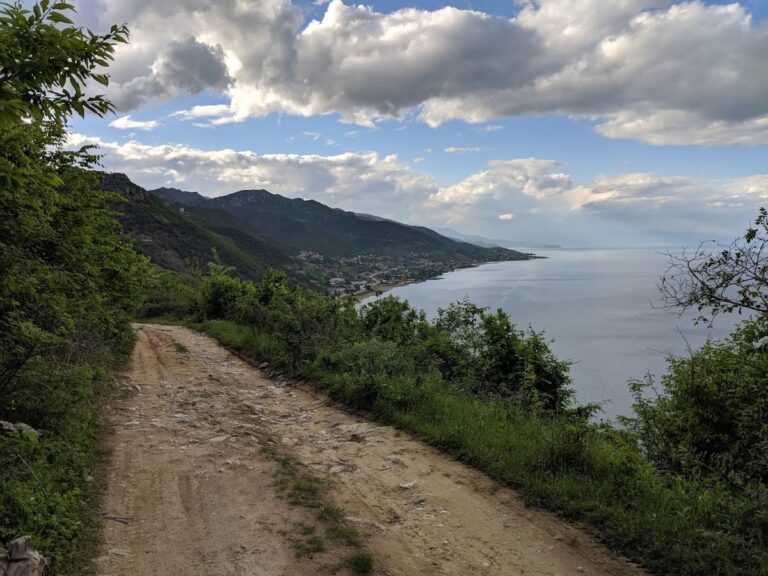
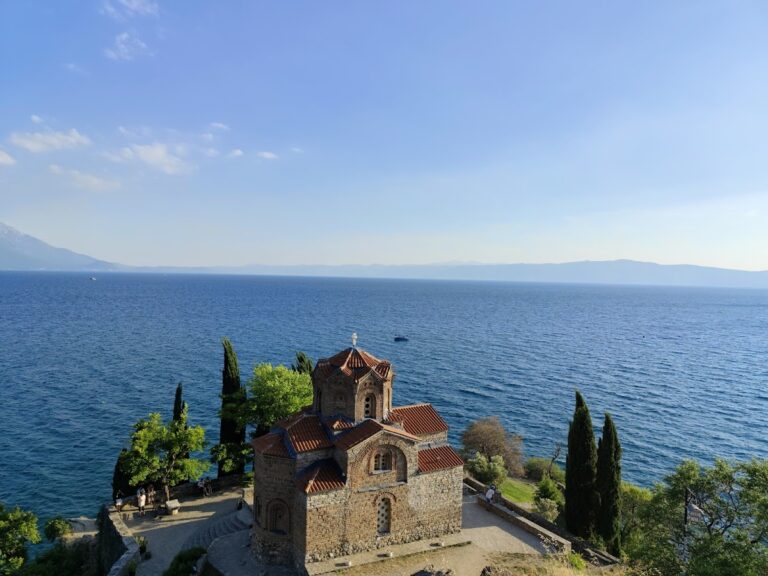
The monastery stands on a small hill at the southeastern end of Lake Ohrid, about 695 metres above sea level. The northern side of the hill falls steeply toward the lake. A plain around the site is enclosed by the lake, Mount Galičica to the east, and a hill to the southwest. The monastery lies about two kilometres west of Ljubaništa, a few hundred metres from the North Macedonia–Albania border, and approximately six kilometres from Pogradec.
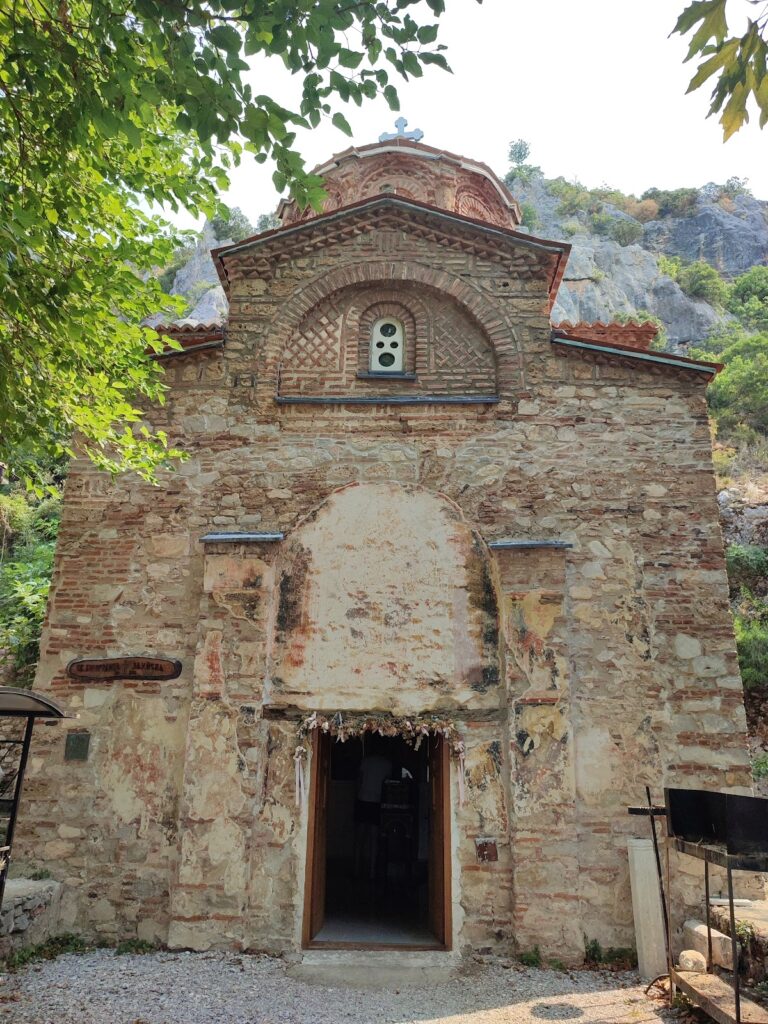
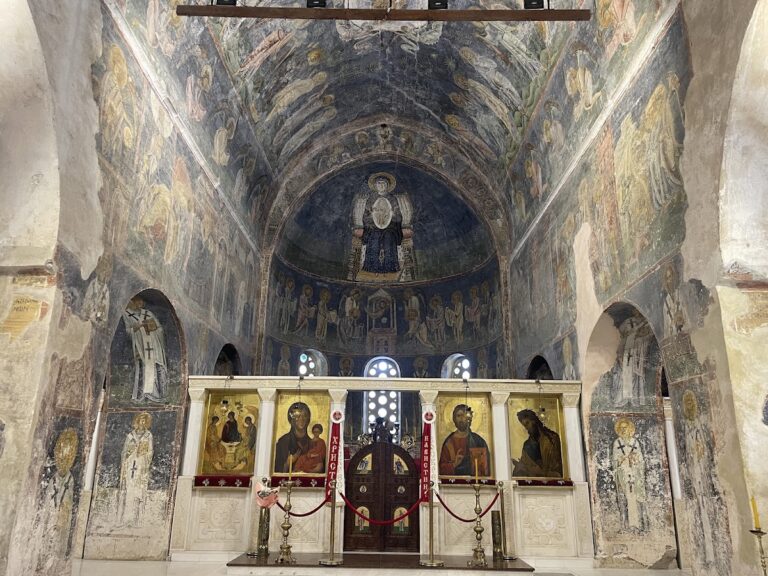
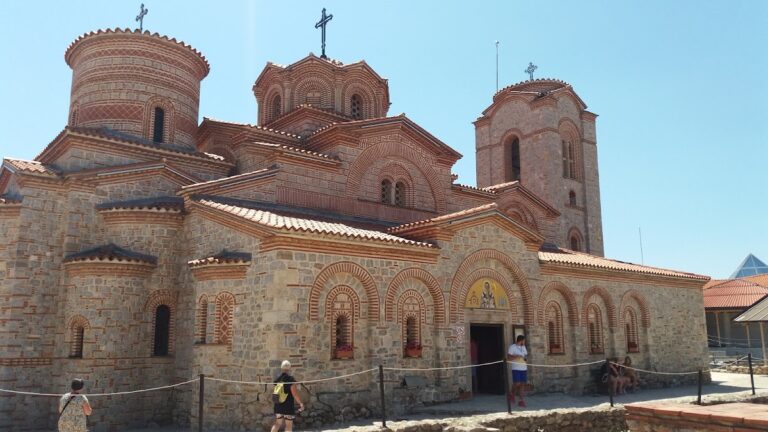
The church is a three-aisled, cross-shaped building organized around a central dome, following a typically Byzantine design. Its construction took place in several stages between the ninth and fourteenth centuries. Two entrance halls, or narthexes, resemble those of the Church of the Holy Mother of God Perivlepta in Ohrid. Inside, frescoes depict episodes from the life of Saint Naum and scenes associated with other Slavic apostles. The surviving frescoes and icons carry Greek inscriptions.
Frescoes and iconostasis
The early-eighteenth-century iconostasis was painted by the hieromonk Konstantin, a monk ordained as a priest, between 1711 and 1716. Its principal icons include Saint Vladimir and Saint Marina, paired with Saints Clement and Naum. A miniature Dormition of Saint Naum appears between them, while the position of Saint Vladimir’s icon expresses his traditional role as patron of the monastery.
The 1806 fresco program includes a figure identified as Michael, Archon of Bulgaria. An archon was a high-ranking title whose meaning varied according to historical context; here the figure represents the Bulgarian ruler Boris I as ktitor, or founder, patron, or principal donor. An inscription above the church entrance names Abbot Stefan of Plovdiv, Metropolitan Kalinik of Prespa, Hadji Jacob, trustee Ivan Gavrilov, and the painter Tarpo in connection with the repainting.
Saint Naum’s tomb
Saint Naum’s tomb occupies a small separate chamber on the right side of the church, where his remains lie in a marble sarcophagus. The chamber was also used for overnight devotional stays. A popular tradition holds that a person who places their head against the tomb can hear the saint’s heartbeat, reinforcing the chamber’s association with healing pilgrimage.
Monastery buildings and associated chapels
The complex included buildings capable of lodging up to 100 travellers. Covered terraces were added in 1811, and the present monastery buildings were erected after the fire of 1870. Their form therefore belongs largely to the rebuilding that followed the destruction of the earlier complex, while the church preserves a longer sequence of medieval and early-modern construction.
Tower and Chapel of Saint Vladimir
The former Tower of Saint Vladimir was demolished in 1929. Its replacement contains the Chapel of Saint Vladimir on the ground floor, decorated with oil-painted frescoes. A new church dedicated to Saint John Vladimir was also built near the monastery after 1912. The replacement tower and chapel were consecrated on 4 June 1929.
Hermitage of Saint Naum
The monastery’s associated Hermitage of Saint Naum was built in 1361 by Caesar Gregory, the brother of Vuk Branković. A hermitage is a small religious retreat associated with a hermit. After the First World War, the retreat was occupied by the hermit monk Simeon Milosavljević, known as the “Yellow Devil.”
Seal and bell
A wooden circular monastery seal dated 1774 depicts Saint Naum with a long beard. Its Greek inscription translates as “Seal of the sacred monastery of our holy God-bearing father Naum the Wonderworker, 1774.” A bell was donated to the monastery church in 1940 by Roma from Resen.
Karst springs and Lake Ohrid
At the foot of the monastery hill, powerful karst springs form a basin. Karst springs emerge where water moves through soluble rock, typically limestone. The spring water is described as deriving approximately half from Mount Galičica and Mali i Thatë and half from Lake Prespa, whose underground outflow contributes to the springs. The spring area includes a pond and wetland covering about 30 hectares.
Approximately 15 underwater springs and 30 above-ground springs feed the pond. They are commonly identified with the source of the Black Drin, the river that flows from Lake Ohrid toward the north at Struga. An outlet about 30 metres long carries water from the spring pond into Lake Ohrid.
Nearby sites