Mičevac: A Medieval Fortress in Bosnia and Herzegovina
Site at a Glance
- Popularity
- Very Low
- Country
- Bosnia and Herzegovina
- Primary era
- Medieval
- Eras represented
- Medieval
- Civilizations
- Kingdom of Bosnia
- Site type
- Military
- Remains
- Castle
On this page7 sections
History
Mičevac is a medieval fortress in Bosnia and Herzegovina, on the right bank of the Trebišnjica River about 2–3 km upstream from Trebinje. Its construction date is unknown. Under the Kosača family, it served as a strategic military post controlling a major road and customs activity.
Origins and Kosača rule
A local legend credits the fortress’s foundation to Mičeta, an otherwise unidentified voivode, a South Slavic title often used for a military leader or high-ranking noble. Nearby prehistoric hillforts indicate settlement in the surrounding area from the Eneolithic, the transition between the Neolithic and Bronze Age, but do not establish when Mičevac was built.
Mičevac belonged to the district of Trebinje, in an area known as Pobrđe. It first belonged to the Pavlović family and later to the Kosača family, powerful Bosnian noble houses. When the regional ruler Stjepan Vukčić Kosača gained control of Trebinje in 1438, Mičevac is thought to have passed under his authority. The fortress was also called “Herceg’s town,” referring to herceg, a title meaning duke.
Charters associated with Stjepan describe Mičevac as a castle in 1444, a fortress in 1448, and a town in 1454. Under Kosača rule, it had a military-strategic role, controlled a major road, and housed customs officials. Dubrovnik, an Adriatic maritime city-state and trading power, protested against the Kosača customs officials without success.
From 1451 to 1454, Dubrovnik fought Stjepan Vukčić Kosača. During the conflict, Dubrovnik told its ally King Tomaš of Bosnia that it would buy or capture Mičevac, Vrm, and four other towns held by Stjepan.
Settlement and Ottoman conquest
A developed settlement called Podmičevac lay below the fortress at Varošište. A Kosača customs post there is recorded from 1436. Podmičevac had a local town official: Radoslav Dup held that role in 1456, while Radosav Dup is identified as Mičevac’s commander. A Kosača customs official is also recorded at the fortress by 1456, and Podmičevac is mentioned in 1460.
The Ottomans captured Mičevac in 1466, the year Trebinje also came under Ottoman rule. The town subsequently lost importance and does not appear in later historical records. In March 2003, Bosnia and Herzegovina designated the medieval town of Mičevac a national monument.
Remains
Fortified enclosure
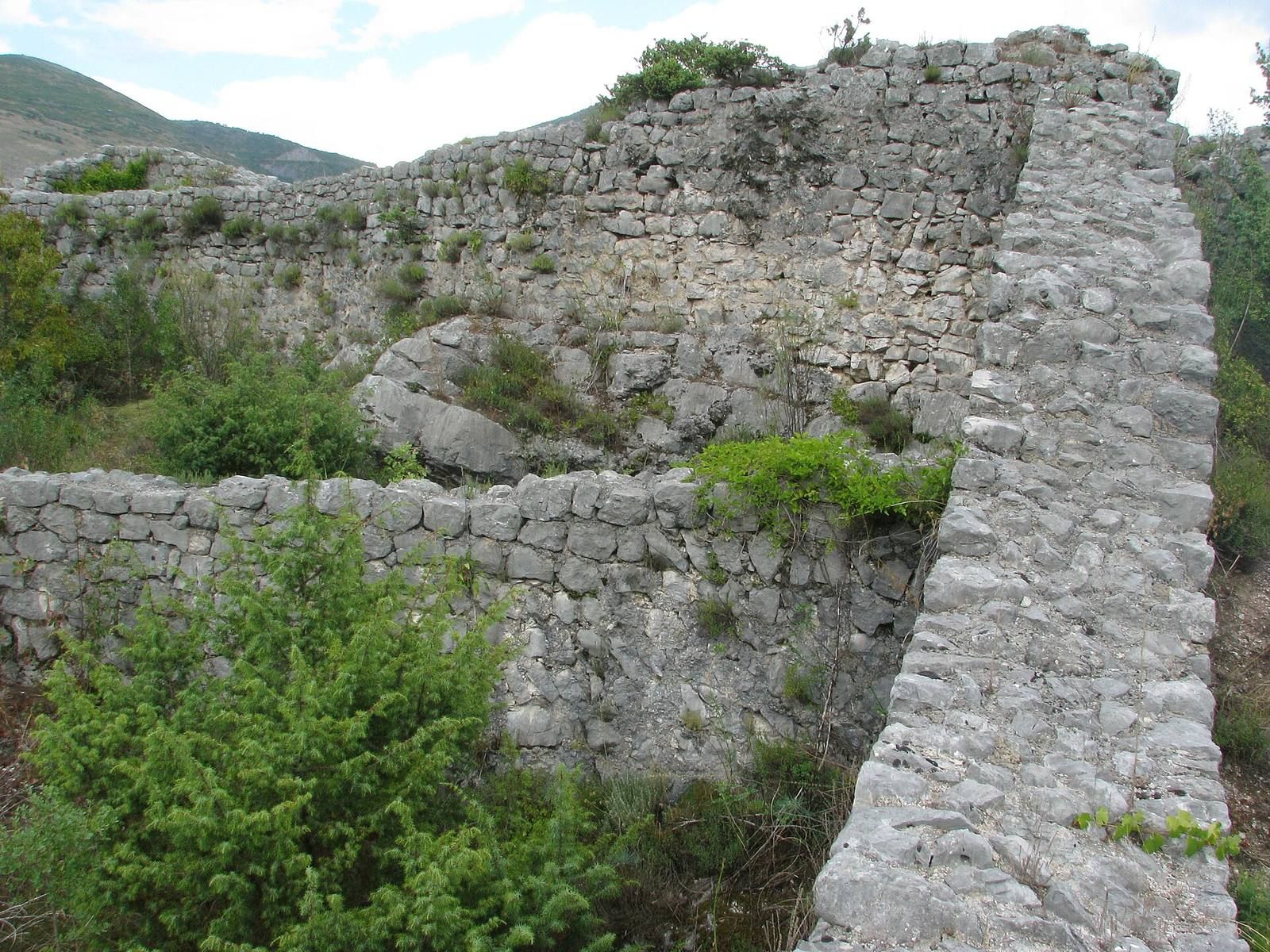
The fortress stands on a low hill below 325 m in elevation. Its fortified enclosure covers about 1,300 m² and has a rounded, irregular rectangular outline. It extends 58 m from east to west, with a width of 23 m at the middle, 16 m at the eastern end, and about 10 m at the western end. Five principal towers are described as facing the Trebišnjica; a detailed description identifies four massive towers that continue directly from the ramparts. Connecting walls reach 2 m thick in places. A small enclosed area against the southern wall protected the main entrance. The road from Trebinje toward Nikšić passes north and east of the fortress, where access is easier than from the south, where rocks descend steeply toward the river.
Interior palace
A building identified as a palace stood against the eastern half of the enclosure’s interior. It measured 14 by 7.2 m, and its walls were 0.95 m thick. A semicircular enclosed space occupied its southwest corner. Its purpose is unknown, though it may have served as the base for an oven. A building in a similar position at Blagaj on the Buna is also identified as a town palace.
Finds
Material associated with Mičevac includes Slavic pottery, iron objects, Dubrovnik coins, and majolica and glass from Italy and Germany. Majolica is tin-glazed earthenware.