Duži Monastery: A Serbian Orthodox Monastic Center in Bosnia and Herzegovina
Site at a Glance
- Rating
- 5
- Popularity
- Very Low
- Country
- Bosnia and Herzegovina
- Primary era
- Early Modern
- Eras represented
- Early Modern, Modern
- Civilizations
- Ottoman
- Site type
- Religious
- Remains
- Monastery
On this page9 sections
History
Duži Monastery is a Serbian Orthodox monastery in Bosnia and Herzegovina, first recorded in 1694 during the late seventeenth century after the destruction of Tvrdoš Monastery in the Morean War. It became a refuge for the Tvrdoš monks and an important ecclesiastical center in Herzegovina, later serving as the seat of the Serbian Orthodox bishopric before the see moved to Mostar.
From Tvrdoš refuge to episcopal seat
A small Church of Saint Panteleimon already stood at Duži when Tvrdoš was destroyed. The Morean War, a conflict between the Ottoman Empire and the Republic of Venice, forced the Tvrdoš brotherhood to seek refuge at the site. The monks later returned from Savina Monastery, while Duži took responsibility for Tvrdoš properties, including land and vineyards. The monastery had traditionally functioned as a metoch, a dependent estate administered by a larger monastery.
In 1694, the see of the Serbian Orthodox Eparchy of Hum was transferred from Tvrdoš to Duži. The eparchy was the territorial diocese responsible for Orthodox communities in the region. The see remained at Duži until transfers to Mostar between 1751 and 1760 and again in 1777. Bishop Aksentije Palikuća, a hieromonk, or ordained Orthodox monk, transferred it to Mostar during the first move, while his successor, Bishop Stefan, returned it to Duži. After the abolition of the Peć Patriarchate in 1766, the Serbian Orthodox ecclesiastical institution that had organized the church in the region, Duži came under Constantinople’s jurisdiction before the see was moved again to Mostar in 1777.
Patronage and nineteenth-century conflict
The monastery received substantial support from the Trieste merchant Jovan Kurtović through his brother Simeon, a hieromonk at Duži. Kurtović financed two buildings, a vineyard, and a mill on the Trebišnjica near Bioča. In 1777, he also donated two Venetian candlesticks that remain in the monastery church. The monastery’s traditional dedication was associated with the Dormition of the Mother of God, which commemorates Mary’s death and bodily assumption. The church was renewed in 1695 in honor of the Intercession of the Mother of God, a feast commemorating her protection, and since 1992 the Intercession has been the monastery’s patronal feast.
Duži was repeatedly looted and damaged during the nineteenth century because its monks supported Serbian uprisings against Ottoman rule. In 1857, Luka Vukalović and his insurgents used the monastery as a base and defeated the forces of Hadži-beg Resulbegović in a battle beside it. Ottoman attacks brought looting or damage in 1858, 1861, and 1877. In January 1863, Ottoman forces burned and abandoned the monastery. Serbian pandurs then guarded it, while the superior fled to Zadar and the priest Vasilije Ignjatović temporarily settled there after the Ottoman withdrawal.
During the Herzegovina Uprising of 1875 to 1877, the insurgent leader Mićo Ljubibratić also maintained his headquarters at Duži. After the Congress of Berlin in 1878, Bosnia and Herzegovina came under Austro-Hungarian occupation. A major fire severely damaged the monastery in 1886, after which it was restored. The Austro-Hungarian government contributed 200,000 florins to the renovation, and a Serbian-language bronze plaque thanking Emperor Franz Joseph was placed in the renewed church.
Clergy, war, and twentieth-century changes
In 1861, Nikifor Dučić served as the monastery’s chief cleric and deputy and held the Gold Cross of Merit. Archimandrite Gerasim Jovanović, an archimandrite being a senior monastic rank, served as superior for more than forty years. He supported Serbian schools despite persecution by the Austro-Hungarian authorities and died in February 1926.
After the First World War, Russian monks who had fled Russia following the October Revolution lived at Duži. Three were killed in 1941 by Yugoslav Partisans. The monastery was abandoned after the Second World War and fell into disrepair. From 1954 to 1958, part of the Yugoslav People’s Army used the complex to house soldiers.
Women’s monastery and recent restoration
Duži became a women’s monastery in 1959, and its nuns gradually restored the deteriorated complex. Teodora Delić served as abbess from 1959 until 2015. During the 1992 to 1995 war, the front line ran near Duži and Croatian forces shelled the monastery from the direction of Dubrovnik, but the monastery suffered no major damage. Restoration began in 1998, with Milan Pešut of Ljubinje as ktitor, the principal patron responsible for rebuilding or supporting an Orthodox monastery, and Gavrilo Marković of Belgrade as the fresco painter.
Remains
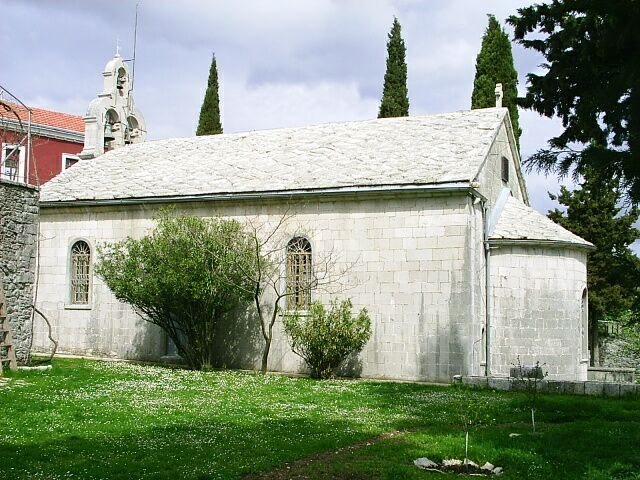
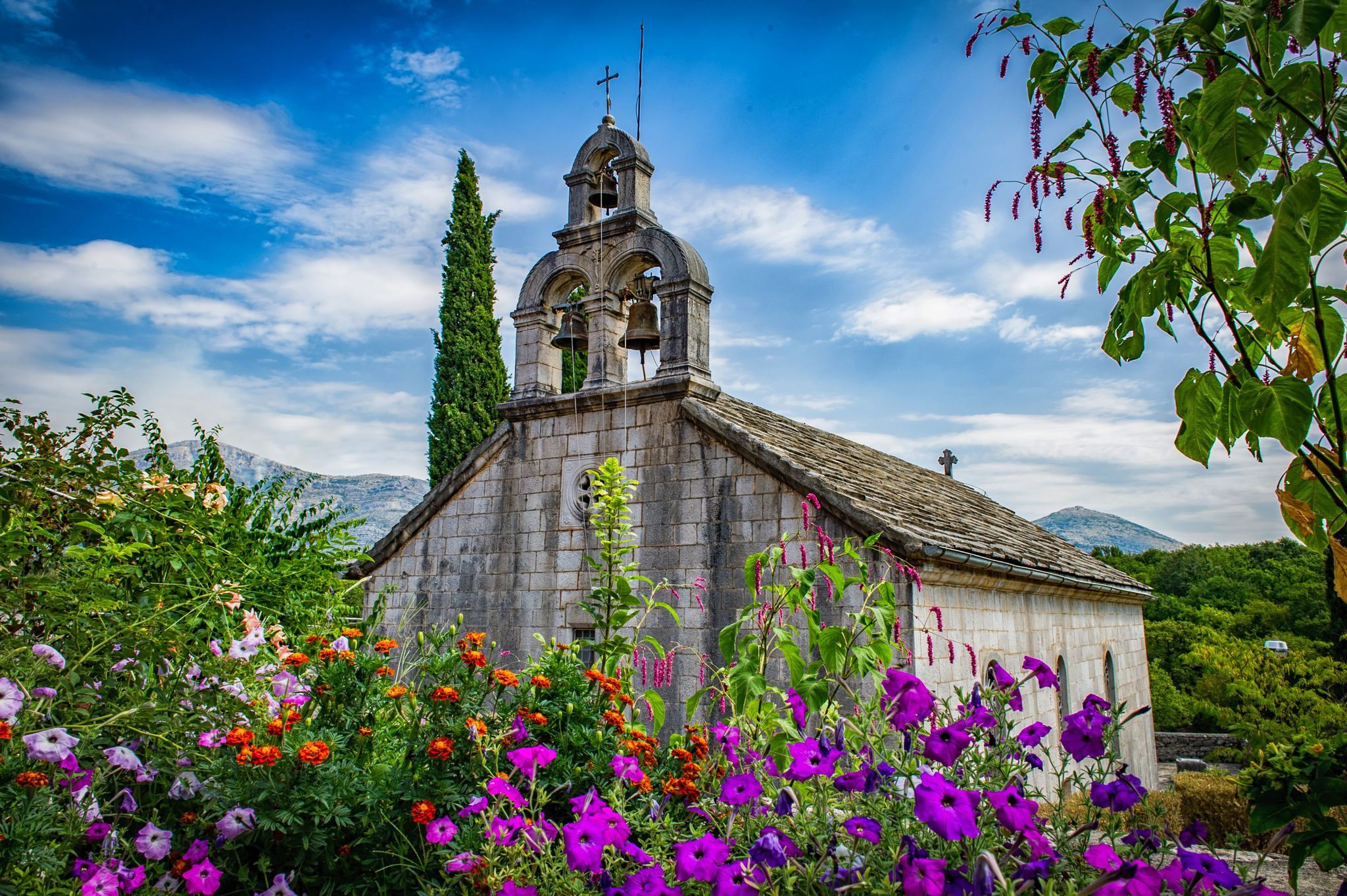
The monastery stands in Popovo Polje near the Trebišnjica River, close to Trebinje in southern Republika Srpska. The surviving complex includes a single-nave church with a semicircular apse, a bell tower, ecclesiastical furnishings and manuscripts, and an estate connected with vineyards, a mill, and agricultural production.
Church and bell tower
The monastery church is a single-nave building ending in a semicircular apse. Its bell tower received its first bell on 1 January 1861, during the tenure of Evstadije Dučić. The bell weighs approximately 5.5 hundredweight and was brought from Dubrovnik in one day over difficult mountain routes by Dubrovnik porters under the supervision of the Russian consul Petković and the merchant Božo Bošković. Tatiana Vasilchikova, a Russian countess from Saint Petersburg, donated it. Russian monks painted the church walls with frescoes in a Russian style in 1935. The building also contains the bronze commemorative plaque installed after the 1886 restoration and the two Venetian candlesticks donated by Jovan Kurtović in 1777.
Manuscripts, icons, and church objects
Duži preserves handwritten ecclesiastical books dating from the seventeenth to the nineteenth centuries, brought by Russian monks from Kyiv and Moscow. The collection includes two manuscript Gospels, a memorial book, and a five-loaf offering vessel. Bishop Nektarije donated a menaion, a book of services for the months of the ecclesiastical year, together with icons of the Ascension and Doubting Thomas. The monastery also holds an icon of the Mother of God attributed to an unknown Cretan painter of the sixteenth century and a particle of the True Cross.
Monastic estate and agricultural production
The estate associated with Jovan Kurtović’s patronage included two buildings, a vineyard, and a mill on the Trebišnjica near Bioča. The sisterhood continues an agricultural economy based on beekeeping and the production of honey, wine, rakia, and dairy products. Before the Second World War, the estate also had a farm for peacocks and canaries. Count Sava Vladislavljević was among the monastery’s benefactors.